Saint
Joachim of Alexandria
Patriarch of Alexandria
Greek Patriarch of Alexandria from 1486 to 1567.
- Feast
- September 17old style September 30
- Reposed
- 156716th century
- Place
- Egypt
- Order
- Hierarchs
Life
Saint Joachim I, also called Joachim the Athenian or Pani, was Greek Patriarch of Alexandria in the second half of the fifteenth century and the first half of the sixteenth, between 1486 (or 1487) and 1565 or 1567, with an interruption. The Church of Alexandria glorified him as a holy hierarch, and in 2003 the Holy Synod of the Russian Church entered his name in its diptychs. He is commemorated on 17 September.
His life
He was a native of Athens and left Greece with his parents after the Turkish invasion. He spent twelve years on Sinai, and in 1480 came to Palestine, where he grew close to the future Patriarch of Jerusalem, Germanus. Visiting Egypt often, he won fame and authority, and in 1487, at the age of thirty-eight, he was elected to the patriarchal throne of Alexandria. The sources stress the strictness of his asceticism and that his piety was recognized even by those of other faiths. The dates of his birth (around 1448-1449), the beginning of his rule (1486 or 1487) and its end (1565 or 1567) are not certain.
When Egypt was conquered by the Turkish sultan Selim I (1512-1520), Joachim asked for a guarantee securing the privileges of the patriarchate. He kept in touch with the court of the Russian tsars, from which he received money to support the patriarchal throne. On the initiative of the council of Constantinople of 1544, he established the rule that all later archbishops of Sinai should be appointed by the Patriarch of Jerusalem. In his long patriarchate he witnessed great political changes in the Near East: in 1516-1517 the Turks conquered Syria and Egypt, which remained for centuries in the Ottoman Empire.
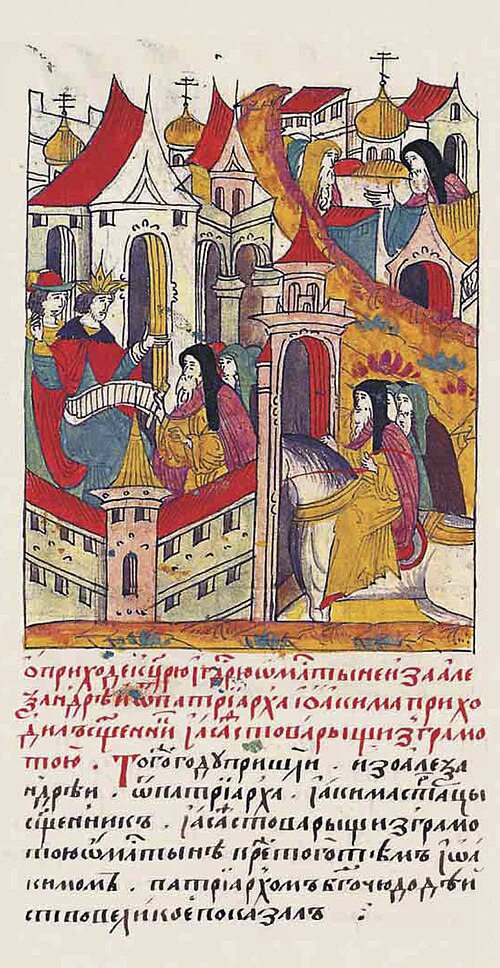
In 1556 he sent a letter to Tsar Ivan IV, asking the Orthodox monarch for material help for Saint Catherine's Monastery on Sinai, which had suffered from the Turks. In 1558 the tsar sent to Egypt an embassy led by Archdeacon Gennady, who, however, died in Constantinople before arriving. From then the embassy was led by a Smolensk merchant, Vasily Poznyakov. His delegation visited Alexandria, Cairo and Sinai, brought the patriarch a fur coat and an icon sent by the tsar, and left an interesting account of its two and a half years of travel. The Russian monk Arseny (Sukhanov), visiting Egypt in 1651, reported that 600 Orthodox Arabs and Greeks lived permanently in Cairo, and with visitors about a thousand.
The miracle of the mountain
A tradition tells of great miracles worked through his prayer. When plague raged in Egypt, an enemy of the Christians, a doctor by profession, spread among the Turks the rumour that the Christians were to blame for the misfortune, bewitching the water. The slander reached the sultan of Egypt, who demanded that Patriarch Joachim be brought to him for explanations. The sultan first held a long conversation with him about faith, but, seeing that the saint defended the Christian faith with deep conviction and clear proofs and refuted Islam, ordered him, to prove the words of the Gospel, to move a mountain near Cairo. The patriarch did not waver in faith: he asked for several days for prayer, and with the faithful appeased the Lord by fasting, vigil and prayers, asking Him not to put them to shame. At the appointed time, before a great crowd, the patriarch said to the mountain, in the name of Christ, to move from its place to another: the mountain shook at its foundations and left its place. Stopped by the same name of Christ, it received in Turkish the name "dur-dag" ("stand, mountain"). The Coptic tradition attributes the moving of the mountain, possibly identified with Mokattam, to Simon the Tanner.
Not knowing how to shake the Orthodox, the ill-wishers prepared a deadly poison and persuaded the sultan to order the patriarch to drink it, again referring to the words of Christ. The sultan ordered the poison to be given to the patriarch. Full of faith in the power of the Cross of Christ, the patriarch blessed the cup with the sign of the cross, drank, and remained unharmed. Then, rinsing the cup with water, he asked that the water be drunk by the doctor who had prepared the drink. It could not be refused, since the sultan himself demanded it. The doctor drank the water and died. When Saint Nephon, Patriarch of Constantinople, learned of these events, he sent to Alexandria Bishop Acacius of Randinia and the venerable Theophilus to learn the details, and they confirmed the miracle. Joachim died in 1567, the sources say, at the age of 119.
Commemorated the same day September 17
 Lambert of MaastrichtSaint · Bishop of MaastrichtSep 17
 Sophia of RomeMartyrSep 17
 AgathocliaMartyr · Patron of MequinenzaSep 17
 Columba of CórdobaVenerable Martyr · Nun of CórdobaSep 17
 Dionisie ErhanSaint · Bishop in BessarabiaSep 17
- Daniel of YelisavetgradSaint · ElderSep 17
- 100 Egyptian MartyrsHoly MartyrsSep 17
- Alexander of AxylouVenerable · Venerable of Axylou, an AlamanSep 17
- Alexandra KhvorostyannikovaVenerable MartyrSep 17
- AnastasiusSaint · the WonderworkerSep 17
- AsclepiodoteMartyrSep 17
- Broccan CloenVenerableSep 17