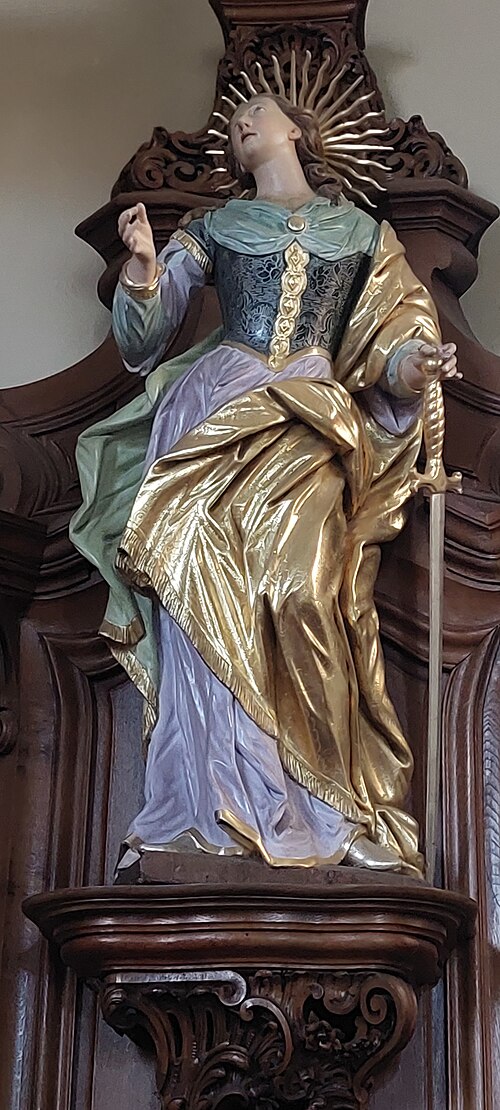
Martyr
Sophia of Rome
Martyr of Rome, venerated as the mother of Sts. Faith, Hope and Love.
- Feast
- September 17old style September 30
- Reposed
- 1372nd century
- Place
- Rome
- Order
- Martyrs
Life
The Holy Martyr Sophia of Rome is a martyr of the early Church, venerated by many Churches. The tradition of the saints' lives links her with Sophia of Milan, the mother of the holy Pistis, Elpis and Agape (Faith, Hope and Love), whose veneration is attested from the sixth century. Her feast is on 30 September (in the West, on 15 May).
The tradition of Sophia and her daughters
The best-attested narrative, usually dated between the seventh and eighth centuries but set in the reign of the pagan emperor Hadrian (117-138), shows Sophia as a pious widow in Rome who raised her three daughters, Faith, Hope and Love, in the Christian faith. Summoned before Hadrian for their beliefs, the girls were interrogated and tortured. Faith, twelve, was whipped, burned and then beheaded; Hope, ten, and Love, nine, were thrown into a furnace and then beheaded. Their mother was forced to watch their torments and death, but encouraged them to remain faithful to Christ. Sophia herself was neither tortured nor killed: she took the bodies of her daughters, buried them and stayed praying at the tomb until, after three days, from grief she wished to die. She was buried in the same grave with her daughters, on the Aurelian Way. According to another version she too was put to death after her daughters and buried on the Appian Way. The story often uses their Latin names: Sapientia, Fides, Spes, Caritas. There are several tombs attributed to Sophia and her three daughters. It is debated whether the story rests on a real fact or is a legend born of the Christian thought that faith, hope and love are the fruit of wisdom (in Greek, sophia). Scholars see the features of motherhood in the narrative rather as conventions of the Byzantine hagiographic genre than as historical details. There is also an old tendency to confuse Saint Sophia with Hagia Sophia, the Holy Wisdom of God.
Relics and veneration in the West
Another tradition, the German, regards Sophia as a Roman virgin who suffered under Diocletian (around 304), buried first in the cemetery of Gordian and Epimachus; Pope Sergius II is said to have moved her remains to the church of San Martino ai Monti, where an inscription mentions a virgin martyr named Sophia. Fragments of relics, received by Bishop Remigius of Strasbourg from Pope Hadrian I, were brought from Rome, in 778, to the monastery he founded on the island of Eschau, in Alsace, and placed in the church dedicated to Saint Trophimus; from there her veneration spread in Germany. From 1143 Sophia is mentioned with her daughters; the relics stayed there until the French Revolution, when they were lost. In 1938 Bishop Charles Ruch brought two new particles from Rome. Her feast of 15 May numbers her among the Ice Saints, whose days are tied to the last frosts in Central Europe; in Germany she is called kalte Sophie (cold Sophia), and in Slovenia wet Sophia. She is painted on a column in the nave of Saint Stephen's cathedral in Vienna, from the fifteenth century.
Commemorated the same day September 17
 Lambert of MaastrichtSaint · Bishop of MaastrichtSep 17
 Joachim of AlexandriaSaint · Patriarch of AlexandriaSep 17
 AgathocliaMartyr · Patron of MequinenzaSep 17
 Columba of CórdobaVenerable Martyr · Nun of CórdobaSep 17
 Dionisie ErhanSaint · Bishop in BessarabiaSep 17
- Daniel of YelisavetgradSaint · ElderSep 17
- 100 Egyptian MartyrsHoly MartyrsSep 17
- Alexander of AxylouVenerable · Venerable of Axylou, an AlamanSep 17
- Alexandra KhvorostyannikovaVenerable MartyrSep 17
- AnastasiusSaint · the WonderworkerSep 17
- AsclepiodoteMartyrSep 17
- Broccan CloenVenerableSep 17