Venerable Martyr
Dionysius
A monk who died a martyr for his faith in Christ, commemorated in the calendar of the Orthodox Church.
- Feast
- January 23old style February 5
- Reposed
- 160817th century
- Order
- Martyrs
Life
Holy Venerable Martyr Dionysius was a monk of the Epiphany Monastery in Kostroma, killed on 30 December 1608, in the Time of Troubles, by the Polish-Lithuanian interventionists and their accomplices, together with other brethren: the hieromonks Triphilius, Macarius and Savvatius, the hierodeacon Athenogenes, the monks Varlaam, Job, Herodion, Simeon, Cyril, Maxim, Joasaph and Gury. They are commemorated on 5 February, in the Synaxis of the Saints of Kostroma.
Kostroma has been since the seventeenth century one of the symbols of the overcoming of the Time of Troubles. A glorious page of Kostroma's history was the labour of the inhabitants of the Epiphany men's monastery, who fell at the hands of the interventionists on 30 December 1608. The Epiphany Monastery, founded in the 1420s by Venerable Nikita of Kostroma, a disciple and kinsman of Venerable Sergius of Radonezh, in a suburb of the city, was at the beginning of the seventeenth century well ordered. In the autumn of 1608 the armies of the supporters of False Dmitry II, called by the people the thief of Tushino, won battles against the government forces. Like the inhabitants of other cities, the people of Kostroma resolved to swear loyalty to the thief, hoping thus to escape plunder and death. For this an embassy of Kostroma set out for Tushino, led by the archimandrite of the Ipatiev Monastery, Theodosius, and the abbot of the Epiphany Monastery, Arsenius. But soon the plunder and violence of the interventionists led to the rising of the people: at the end of 1608 Galich, Vologda, Totma and Nizhny Novgorod rose to fight the invaders. The new authority in Kostroma was also overthrown; the traitor voivode, Prince Gorbaty-Mosalsky, was seized and executed by the people of Kostroma.
The fall of the monastery
To put down the uprising the Tushino men sent punitive detachments, under Colonel Lisovsky and the captains Stravinsky and Lanckoronski, with two thousand Cossacks and 608 mercenaries. The land militia, poorly organised, could not stand. On 28 December (old style) 1608 the interventionists took Kostroma, but met the resistance of the inhabitants of the Epiphany monastery. On 30 December the monastery was taken by force and plundered, and its defenders died as martyrs. The church historian of Kostroma I. V. Bazhenov wrote that the monks of the monastery, loyal to Tsar Shuisky, shut themselves in it and resolved to lose many treasures and even their lives rather than renounce their duty and oath; martyrs of faithfulness, they all perished at the hands of the robbers after the monastery was taken by force. After the killing of the monks, the evildoers plundered the icons, vessels, vestments and books and destroyed the charters.
The commemoration
In the synodikon of the monastery, preserved to this day, from the end of the sixteenth and beginning of the seventeenth century, there is an entry commemorating those killed: the brethren, servants and attendants of the monastery, killed by the traitors to the tsar and by the Lithuanians, in the year 7117: the hieromonks Triphilius, Athenogenes, Varlaam, Dionysius, Job, Herodion, Simeon, Cyril, Maxim, Joasaph, Macarius, Savvatius, Gury, the servants Peter, Athanasius, Epiphanius, and others. Then the synodikon lists thirty-four peasants of the monastery, from eight villages. The brethren of the Exaltation of the Cross Monastery in the Kostroma Kremlin also died: Archimandrite Gennady, the hieromonk Anthony and nine monks. The triumph of the interventionists was short. In February 1609 a new uprising seized Kostroma; many traitor nobles who had supported the Tushino men were drowned in the Volga, and those left in the city took refuge in the Ipatiev Monastery, but were soon defeated by the voivode David Zherebtsov. The memory of those killed at the capture of the Epiphany monastery was observed every year there. The refectory rule, from the first half of the seventeenth century, provided: on 30 December a panikhida is to be sung and the Liturgy served by the whole community for the slain brethren, for the servants, for the women servants and for the Christians of the monastery, killed in 7117 by the traitors and the Lithuanians. The commemoration continued after the monastery was turned, in the nineteenth century, into a convent, named Epiphany-Anastasia, until its forcible closing in the twentieth century. The revival of the monastery, begun in 1990, also brought the renewal of the old customs. On 5 March 2004 Patriarch Alexy II approved the list of the Synaxis of the Saints of Kostroma, in which are also the names of the defenders of the monastery fallen in the time of troubles. Since then they are honoured as locally venerated saints of the land of Kostroma.
Commemorated the same day January 23
 Paulinus of NolaSaint · Bishop of NolaJan 23
 EmerentianaMartyrJan 23
 Clement of AncyraHieromartyr · Bishop of AncyraJan 23
 Abraham of GalichVenerable · Abbot and founder at ChukhlomaJan 23
 Agathangelus of RomeMartyr · Deacon of RomeJan 23
 Messalina of FolignoMartyr · Virgin of FolignoJan 23
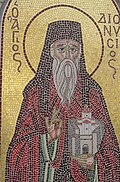 Dionysius of Mount OlympusVenerable · Monk on Mount OlympusJan 23
 Gennady of KostromaVenerable · Founder of Gennady MonasteryJan 23
 Barlaam of ChikoyVenerable · Abbot of Chikoy MonasteryJan 23
 Alexander of VochskVenerable · HegumenJan 23
 Catherine CherkasovaVenerable Martyr · NoviceJan 23
- Amasius of TeanoSaint · Bishop of TeanoJan 23