Saint
Dionysius of Ephesus
A saint of Ephesus, commemorated in the calendar of the Orthodox Church.
- Feast
- August 4old style August 17
- Era
- 3rd century
Life
Saint Dionysius of Ephesus was among the Seven Youths of Ephesus: Maximilian, Iamblichus, Martinian, John, Dionysius, Exacustodianus, also called Constantine, and Antoninus. They lived in the third century. They are commemorated on 17 August and on 4 November, and a second time on 22 October.
Saint Maximilian was the son of the governor of Ephesus, and the other six youths the sons of other prominent citizens. They were friends from childhood and all were in military service. When Emperor Decius (249-251) arrived at Ephesus, he ordered all citizens to appear to offer sacrifice to the pagan gods; the disobedient awaited torments and death. By the denunciation of those seeking the emperor's favour, the seven youths were also called to judgment. Before the emperor they confessed their faith in Christ. Their military insignia, their belts, were at once taken from them. But Decius let them go free, hoping that they would change their decision while he was on campaign. The youths left the city and hid in a cave on Mount Ochlon, where they prayed, preparing for martyrdom. The youngest, Iamblichus, dressed in beggar's rags, went into the city to buy bread. Once, in the city, he heard that the emperor had returned and that they were being sought for judgment. Maximilian encouraged them to leave the cave and appear of their own will. Learning where they were hiding, the emperor ordered the entrance of the cave walled up with stones, so that they might die there of hunger and thirst. Two officials who were present at the walling up of the entrance were secret Christians. Wishing to preserve the memory of the saints, they put among the stones a sealed casket, with two tin tablets, on which were written the names of the seven youths and the circumstances of their suffering and death.
The wondrous sleep
But the Lord brought upon the youths a wondrous sleep, which lasted almost two centuries. By then the persecutions of Christians had ceased, although in the time of the holy and right-believing Emperor Theodosius the Younger (408-450) heretics appeared who denied the resurrection of the dead at the second coming of the Lord Jesus Christ. Then the Lord revealed the mystery of the resurrection of the dead and of the life to come through His seven youths. The owner of the land on which Mount Ochlon stood began a stone building, and the workers opened the entrance of the cave. The Lord raised the youths, and they woke as from an ordinary sleep, not knowing that almost two hundred years had passed. Their bodies and clothes were whole. Preparing to receive torments, the youths asked Iamblichus to buy bread again from the city, to gain strength. Approaching the city, the young man was amazed to see the Holy Cross on the gate. Hearing the Name of Jesus Christ spoken freely, he began to doubt whether he had come to his own city. Paying for the bread, he gave the merchant a coin with the image of Emperor Decius and was detained as one who had hidden a treasure of old coins. They took him to the governor, with whom the bishop of Ephesus then was. Listening to the young man's puzzled answers, the bishop understood that God was revealing through him a mystery and went with the people to the cave. At the entrance, the bishop took from the pile of stones the sealed casket and opened it. He read on the tin tablets the names of the seven youths and the circumstances of the walling up of the cave by order of Emperor Decius. Entering the cave and seeing the youths alive, all rejoiced and understood that the Lord, by waking them from the long sleep, was revealing to the Church the mystery of the resurrection of the dead. Soon the emperor himself came to Ephesus and spoke with the youths in the cave. Then, before all, the holy youths bowed their heads to the ground and fell asleep again, this time until the general resurrection. The emperor wished to place each in a costly shrine, but the youths appeared to him in a dream and told him to leave their bodies in the cave, on the ground. In the twelfth century the Russian abbot Daniel, a pilgrim, saw in the cave the relics of these seven youths.
The second commemoration of the seven youths is on 22 October. According to a tradition that entered the Russian Prologues, on this day the youths fell asleep the second time; according to a note in the Greek Menaion of 1870, they fell asleep first on 4 August and woke on 22 October. The holy youths are also mentioned in the service of the beginning of the church year, on 1 September.
Commemorated the same day August 4
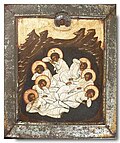 Seven Youths of EphesusHoly Martyrs · The Seven SleepersAug 4
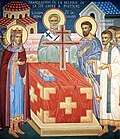 Euphronius of ToursSaint · Bishop of ToursAug 4
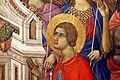 Crescentius of RomeMartyr · Child martyr of RomeAug 4
- Eudocia the MartyrMartyrAug 4
- Agabius of VeronaSaint · Bishop of VeronaAug 4
- Antoninus of EphesusSaintAug 4
- Bartholomew of NicomediaMartyrAug 4
- BroghanSaintAug 4
- BuanVenerableAug 4
- Constantine of EphesusSaint · ExakoustodianAug 4
- CrescentioMartyrAug 4
- DariaSaintAug 4