Venerable
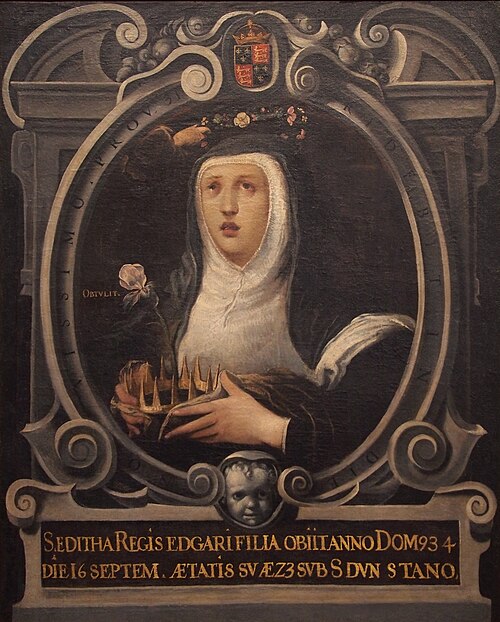
Edith of Wilton
Nun of Wilton Abbey
Daughter of King Edgar of England, a nun at Wilton in the tenth century, venerated as a saint.
- Feast
- September 16old style September 29
- Reposed
- 98410th century
- Place
- Wilton
- Order
- Venerables
Life
Saint Edith of Wilton was the daughter of King Edgar of England and Saint Wulfthryth, a nun in the community of Wilton Abbey in the tenth century. She fell asleep on 16 September 984, at the age of twenty-three. The Church remembers her on 16 September.
She was born around 961 at Kemsing in Kent. Her mother Wulfthryth, of noble birth, had been educated at Wilton and became its abbess. Her parents may have been married, and Edgar may have abducted Wulfthryth from the abbey, but when Edith was an infant Wulfthryth returned with her to Wilton and the marriage was dissolved. Edith and her mother stayed there all their lives. Her half-brothers, Edward the Martyr and Æthelred II, both became king after their father.
According to Goscelin's account, at two Edith was dedicated to the religious life at Wilton in a ceremony attended by her father and royal officials. Her father brought her the finest clothes and jewellery, her mother set religious objects before her, and she chose those of her mother. Edgar secured the best education for her, with two foreign chaplains, Radbod of Reims and Benno of Trier. It is not certain whether Edith became a nun or remained a lay member of the community. Goscelin, who completed her Life around 1080, says she always dressed richly, since this befitted her royal rank and kept the royal patronage of the community. The Life was written from the testimony of the nuns of Wilton and dedicated to Archbishop Lanfranc. At fifteen her father offered her the position of abbess of three convents, but she declined. In 978, after the murder of her half-brother Edward the Martyr, she may have been offered the throne of England, which she also refused.
In 984 she built a chapel at Wilton dedicated to Saint Denis, consecrated by Archbishop Dunstan of Canterbury, who is said to have foretold her imminent death and that the thumb of her right hand would remain uncorrupted. She fell asleep three weeks later and was buried in the chapel she built. At her translation on 3 November 987, presided over by Dunstan, her thumb had not decayed. Few miracles are told of her, many of them about the protection of her relics and the property of the Wilton community, and her cult did not spread widely until thirteen years after her death. The support for her elevation to sainthood by church and lay authorities was probably linked to their wish to connect themselves with the descendants of King Edgar.
Commemorated the same day September 16
 Cornelius of RomeHieromartyr · Bishop of RomeSep 16
 Ludmila of BohemiaMartyr · Duchess of BohemiaSep 16
 MeletinaMartyr · of MarcianopolisSep 16
 Ninian of WhithornSaint · Apostle to the Southern PictsSep 16
 Kuksha of OdessaVenerable · Priest and monk of OdessaSep 16
- Dorotheus the EgyptianVenerable · Hermit in EgyptSep 16
- AbundantiusMartyrSep 16
- Abundius and AbundantiusHoly MartyrsSep 16
- AnfadanSaintSep 16
- BasilSaint · Bishop of GortynaSep 16
- CaemhanSaintSep 16
- Cassian of GlyphiaVenerableSep 16