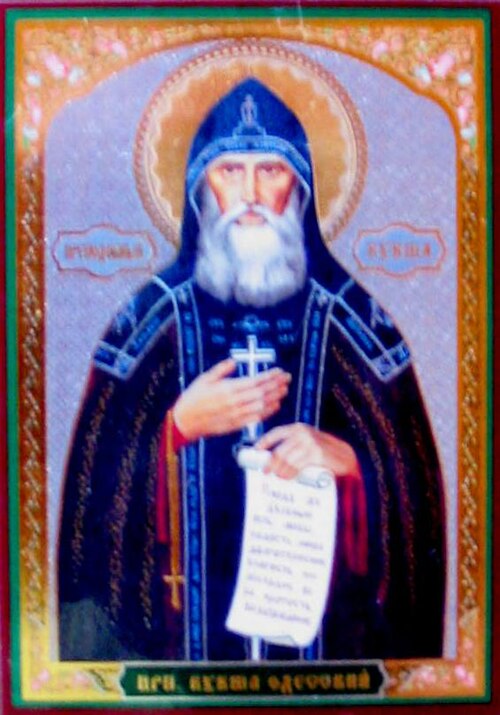
Venerable
Kuksha of Odessa
Priest and monk of Odessa
Priest and monk, born Kuzma Velichko in 1875 in the Kherson region, who died in 1964 at Odessa.
- Feast
- September 16old style September 29
- Reposed
- 196420th century
- Place
- Odesa
- Order
- Venerables
Life
Venerable Kuksha of Odessa, born Kuzma (Kosma) Velichko, was a priest, monk and schema-monk from Ukraine who lived from 1875 to 1964. He passed through Mount Athos, the Kyiv Caves Lavra, the Soviet camps and exile, and ended his days at Odessa. The Orthodox Church honours him as a saint of our own times, commemorated on 11 December (24 December on the new calendar) and on 16 September, the day his relics were found.
Childhood and pilgrimages
He was born on 12 January 1875 (old style) in the village of Arbuzynka in the Kherson Governorate, to Kirill and Kharitina Velichko, descendants of Ukrainian Cossacks. His mother had dreamed in her youth of becoming a nun and hoped that one of her children would take the monastic path. He had two brothers, Theodore and John, and a sister, Maria.
While still young he went on foot to monasteries: the Kyiv Caves Lavra, the Lavra of the Holy Trinity and Saint Sergius, Valaam and Solovki. In 1895 he made a pilgrimage to Jerusalem and stayed there six months, venerating all the holy places of Palestine. On the way back he stopped at Mount Athos and told the archimandrite of the monastery of Saint Panteleimon that he wished to join the community. The archimandrite told him to return in a year and gave him a small icon of Saint Panteleimon, which Kuzma kept all his life.
Mount Athos
In 1896, with his parents' blessing, he reached Athos and became a novice at the monastery of Saint Panteleimon, where he was put in charge of baking the prosphora. In 1897 he went to Jerusalem again, with his mother. Back on Athos, he served for eleven years as guestmaster in the house for pilgrims.
He was tonsured a rasophore with the name Constantine, and in 1904 received monastic tonsure with the name Xenophont. In 1912–1913, when the Imiaslavie controversy disturbed Athos, the Greek authorities demanded that many foreign monks leave, among them Xenophont, who had taken no part in it.
The Caves Lavra
In 1913 he entered the Kyiv Caves Lavra. The next year, after the outbreak of the First World War, he worked with other monks for ten months on the Kyiv–Lviv hospital train, and then returned to the monastery. He longed for the Great Schema, but his age, forty, was an obstacle.
In 1931, at the age of fifty-six, he fell gravely ill and was thought to be dying. Believed to be on his deathbed, he was tonsured into the Great Schema on 8 April 1931 and was given the name Kuksha, after a saint whose relics lie in the nearby caves. He recovered. He was ordained hierodeacon on 3 April 1934 and hieromonk on 3 May of the same year. He was known for his humility and temperance.
Persecution
After the Lavra was closed by the Soviet authorities, he served at the church in Voskresenskaya Slobodka. In 1938 he was accused of being a "cult servant" and sentenced to five years in a camp at Vilva, in the Molotov region of the Urals. At sixty-three he and other priests and monks worked fourteen hours a day in the cold on poor food. Metropolitan Anthony of Kyiv sent them pieces of the consecrated Eucharist and loaves of bread, so that hundreds of condemned priests and monks could receive communion.
After his release, in the spring of 1943, he was sentenced to three years of exile at Kungur, without permission to serve. He is said to have lived in the bell tower of the only open church in the town. The bishop of Solikamsk blessed him, and he often conducted services in the village.
Last years
In 1947 he returned to the Kyiv Caves Lavra. Four years later the authorities moved him to the Pochayiv Lavra, where for three years he served matins in the cave churches. In April 1957, in Holy Week, he was transferred to the monastery of Saint John the Theologian at Khreshchatyk in Bukovina. When that monastery was closed three years later, the monks were sent to Pochayiv, and he was moved on 19 July 1960 to the Dormition Monastery in Odessa, where he spent the last four years of his life.
So many of the faithful came to him that the authorities tried to isolate him from people. He fell asleep in the Lord on 24 December 1964 and was buried in the monastery cemetery. He was the sponsor at the monastic tonsure of the future Metropolitan Volodymyr (Sabodan) of Kyiv.
Veneration
Veneration of him began right after his death. His relics were found on 29 September 1994, and the Synod of the Ukrainian Orthodox Church canonized him as a locally venerated saint, in 1994 or 1995 according to the sources. On 3 February 2016 the Council of Bishops of the Russian Orthodox Church numbered him among the saints venerated by the whole Church. The shrine with his holy relics stands at the Dormition Monastery in Odessa.
Commemorated the same day September 16
 Cornelius of RomeHieromartyr · Bishop of RomeSep 16
 Ludmila of BohemiaMartyr · Duchess of BohemiaSep 16
 MeletinaMartyr · of MarcianopolisSep 16
 Ninian of WhithornSaint · Apostle to the Southern PictsSep 16
 Edith of WiltonVenerable · Nun of Wilton AbbeySep 16
- Dorotheus the EgyptianVenerable · Hermit in EgyptSep 16
- AbundantiusMartyrSep 16
- Abundius and AbundantiusHoly MartyrsSep 16
- AnfadanSaintSep 16
- BasilSaint · Bishop of GortynaSep 16
- CaemhanSaintSep 16
- Cassian of GlyphiaVenerableSep 16