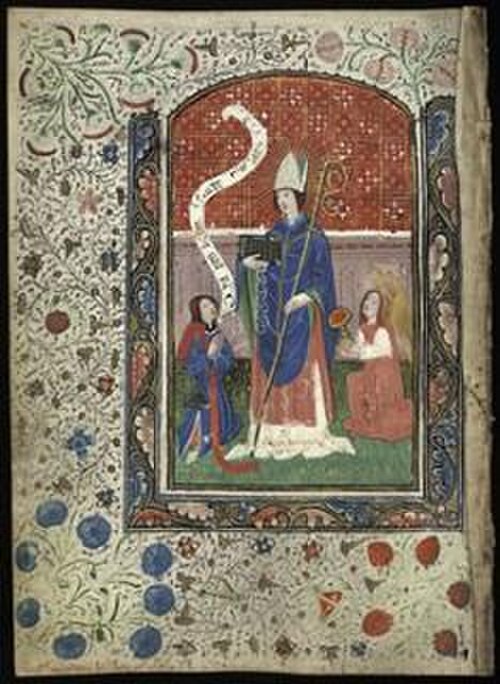
Saint
Ninian of Whithorn
Apostle to the Southern Picts
Missionary among the Picts of southern Scotland, called their apostle and honored by many dedications.
- Feast
- September 16old style September 29
- Reposed
- 4325th century
- Place
- Wigtownshire
- Order
- Hierarchs
Life
Saint Ninian, called the Apostle to the Southern Picts, was a Christian missionary in what is now Scotland. He is first mentioned in the eighth century, and tradition links him to Whithorn in Galloway and to the church called Candida Casa, the White House. He is commemorated on 16 September. In northern England and Scotland many churches were dedicated to him; in some parts of Scotland he is called Ringan, and in northern England Trynnian.
What is known and what is told
There is no unchallenged historical proof about his life, and nothing is known of his teaching. The earliest mention is a short passage in the Ecclesiastical History of the English People by the monk Bede, from 731, which says that Bishop Ninian brought the southern Picts to the faith. An eighth-century poem, The Miracles of Bishop Ninian, tells some miracles attributed to him. A Life of him was written around 1160 by Ailred of Rievaulx. The southern Picts were those south of the mountains called the Mounth, which cross Scotland north of the Firths of Clyde and Forth. By the seventh century they were Christian, and Northumbria placed a bishop at Abercorn, an effort abandoned after the defeat at Dun Nechtain in 685. Christianity was present in Galloway from the fifth century. In 731 Northumbria placed a bishop at Whithorn, and Bede's account served to strengthen the legitimacy of the new bishopric. The English name hwit ærn is the translation of the Latin candida casa and survives in the modern name Whithorn.
According to tradition, Ninian was a Briton who studied at Rome, was consecrated bishop, founded a see at the Candida Casa at Whithorn, which he dedicated to Saint Martin of Tours, brought the southern Picts to Christianity, and was buried at Whithorn. Variants of the story say that he actually knew Saint Martin, that his father was a Christian king, and that he was laid in a stone sarcophagus near the altar of his church. Other variants say that he left for Ireland and died there in 432. The date of his birth is reckoned from the mention of Saint Martin, who died in 397; according to the Russian tradition, Ninian came to Whithorn in 397, built a stone church and preached first among the Britons, then among the southern Picts. It is believed that on his missionary journeys he reached as far as the Shetland Islands and Ireland.
His identity
Ninian's historical identity is uncertain. Scholars have suggested that the name might be a form of the name of Saint Finnian of Movilla, or even an error of medieval copyists; according to another hypothesis, he is to be identified with several saints of Ireland. Tradition, however, places him as the first Christian missionary in Scotland, before Patrick and Columba, who come after him. He is still honoured in many places in Scotland and northern England.
Commemorated the same day September 16
 Cornelius of RomeHieromartyr · Bishop of RomeSep 16
 Ludmila of BohemiaMartyr · Duchess of BohemiaSep 16
 MeletinaMartyr · of MarcianopolisSep 16
 Edith of WiltonVenerable · Nun of Wilton AbbeySep 16
 Kuksha of OdessaVenerable · Priest and monk of OdessaSep 16
- Dorotheus the EgyptianVenerable · Hermit in EgyptSep 16
- AbundantiusMartyrSep 16
- Abundius and AbundantiusHoly MartyrsSep 16
- AnfadanSaintSep 16
- BasilSaint · Bishop of GortynaSep 16
- CaemhanSaintSep 16
- Cassian of GlyphiaVenerableSep 16