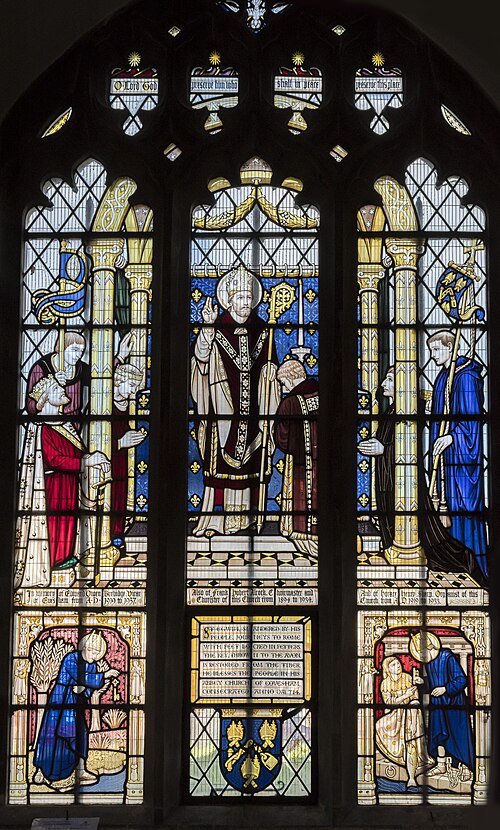
Saint
Egwin of Evesham
Bishop of Worcester
Benedictine monk and third bishop of Worcester in England, who died in 717.
- Feast
- December 30old style January 12
- Reposed
- 7178th century
- Place
- Evesham Abbey
- Order
- Hierarchs
Life
Saint Egwin was a Benedictine monk and the third bishop of Worcester in England, founder of Evesham Abbey. He fell asleep on 30 December 717. He is venerated in the Roman Catholic and the Orthodox Church, where he is counted in the Synaxis of the Saints of Britain and Ireland.
He was born at Worcester into a noble family, a descendant of the kings of Mercia, perhaps a nephew of King Æthelred. When he became a monk, the king, clergy and people together demanded he be bishop, and he was consecrated after 693. As bishop he was a protector of orphans and widows and a fair judge. He struggled with the local people over acceptance of Christian morality, above all Christian marriage and clerical celibacy, and his stern discipline roused resentment that reached his ecclesiastical superiors. He then set out on pilgrimage to Rome to seek vindication from the pope. According to a legend he locked shackles on his feet and threw the key into the River Avon. It is also told that in crossing the Alps his companions grew thirsty. Those who did not believe in his holiness asked him mockingly to pray for water, as Moses did in the desert, and those who believed asked him in faith. Egwin prayed prostrate, and a clear stream gushed from the rock. As he prayed at the tomb of the apostles in Rome, a servant brought him the very key, found in the mouth of a fish caught in the Tiber. He freed himself from the shackles and obtained from the pope release from the slander of his enemies.
On his return he founded Evesham Abbey, dedicated to the Mother of God, which became one of the great Benedictine houses of medieval England, on the place where, according to tradition, the Virgin showed a swineherd named Eof that a church should be built. He took part in the council of Clovesho, though more recent historians doubt that such a council took place. He died at the abbey he had founded and was buried there, on 30 December 717, or 720 according to Mabillon. His Life was written around 1016 by Byrhtferth of Ramsey and around 1130 by Dominic of Evesham. His tomb was destroyed in 1540, with the abbey church, at the dissolution of the abbey.
Commemorated the same day December 30
 Felix I of RomeSaint · Bishop of RomeDec 30
 TimonApostle · One of the Seven DeaconsDec 30
 Macarius of MoscowSaint · Metropolitan of MoscowDec 30
 Anysia of ThessalonicaMartyr · Virgin of ThessalonicaDec 30
 Zoticus the Orphan-FeederMartyr · Feeder of orphans in ConstantinopleDec 30
- Anysius of ThessalonikiSaint · Bishop of ThessalonicaDec 30
- Theodora of CaesareiaVenerableDec 30
- Theodora of ConstantinopleVenerableDec 30
- Connla of RusgachSaintDec 30
- Daniel the WonderworkerSaintDec 30
- Elias of ConquesSaintDec 30
- Eugene of MilanSaint · Bishop of MilanDec 30