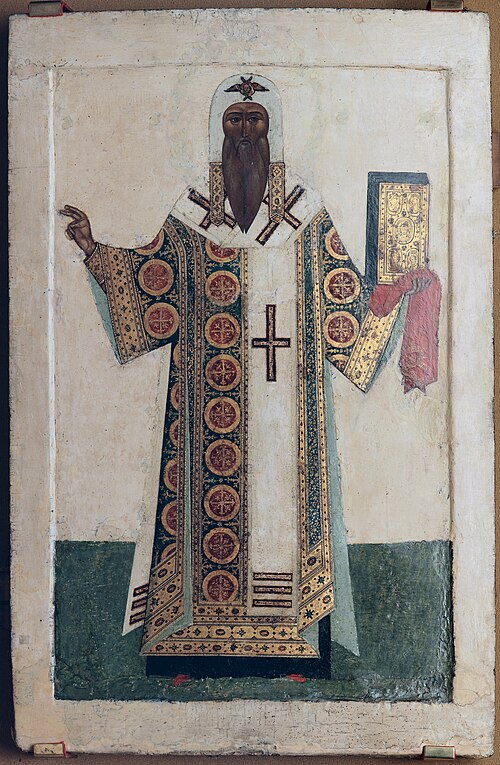
Saint
Macarius of Moscow
Metropolitan of Moscow
Metropolitan of Moscow and all Rus from 1542 to 1563, earlier archbishop of Novgorod.
- Feast
- December 30old style January 12
- Reposed
- 156316th century
- Place
- Moscow
- Order
- Hierarchs
Life
Saint Macarius was metropolitan of Moscow and all Rus from 1542 to 1563, earlier archbishop of Novgorod. A writer, icon painter and organiser of church life, he was a close adviser of Tsar Ivan the Terrible and remained in history for the great collections of lives of the saints. He fell asleep at the end of December 1563 and was canonised by the Russian Church in 1988.
He was born around 1482 at Moscow, of devout parents, with the name Mikhail; his father, Leontius, died soon after his birth, and his mother later received the monastic habit with the name Euphrosyne. He entered as a novice the Nativity of the Mother of God Pafnutiev-Borovsk monastery and at tonsure received the name of the great hermit Macarius of Egypt. He was a good icon painter and a firm supporter of Joseph of Volokolamsk and his disciples. In 1523 he became abbot of the Luzhetsky monastery at Mozhaisk, where he came to know Grand Prince Vasily III; he was one of the few clerics who supported the prince's divorce from Solomonia Saburova and blessed his second marriage to Elena Glinskaya. In 1526 he was consecrated archbishop of Novgorod and Pskov, a see that had been vacant seventeen years. There he put into effect the decisions of the councils of 1503-1504, led the monasteries toward common life (of twenty-four, only four were cenobitic in 1528, and at the end of his ministry there were eighteen), supported the compilation of a new chronicle, renewed icons and churches (the frescoes of Saint Sophia), and sent in 1533 and 1535 missionaries among the Finno-Ugric peoples on the Neva, lakes Ladoga and Onega and up to the Kola Peninsula. Also at Novgorod he attempted to gather all the books read in the Russian land, the beginning of the great Menaion of Macarius (the Great Menaion Reader); in 1541 the twelve volumes reached the library of Saint Sophia. He is also credited with beginning the Book of Degrees of the Royal Genealogy.
On 16 or 19 March 1542, supported by the boyar group of the Shuisky princes, he was elected metropolitan of Moscow, in place of Joasaph. Soon he began to oppose the Shuiskys and helped remove them in 1543. He had great influence on Ivan's policy, as a member of the so-called Chosen Council. He crowned him tsar on 16 January 1547 and blessed his marriage to Anastasia Zakharyina-Yurieva. He took part in the assemblies of the land of 1547, 1549 and 1550, urging reconciliation of the boyar factions. In the councils of 1547 and 1549 he carried out the canonisation of thirty-nine Russian saints. He corresponded with the exiled Maximus the Greek and included some of his writings in the Menaion, but rejected his appeals for pardon. At the Stoglav council of 1551 he prevented the law on secularising monastic lands, sought by the archpriest Sylvester. He blessed the army before its departure for Kazan in 1552, and in 1559 Ivan left him in Moscow to protect the tsardom, making him temporary head of state. He completed the second and third editions of the Menaion in 1552 and 1554 and supported the founding of the printing house at Moscow. His feast is on 30 December (12 January).
Commemorated the same day December 30
 Felix I of RomeSaint · Bishop of RomeDec 30
 TimonApostle · One of the Seven DeaconsDec 30
 Anysia of ThessalonicaMartyr · Virgin of ThessalonicaDec 30
 Egwin of EveshamSaint · Bishop of WorcesterDec 30
 Zoticus the Orphan-FeederMartyr · Feeder of orphans in ConstantinopleDec 30
- Anysius of ThessalonikiSaint · Bishop of ThessalonicaDec 30
- Theodora of CaesareiaVenerableDec 30
- Theodora of ConstantinopleVenerableDec 30
- Connla of RusgachSaintDec 30
- Daniel the WonderworkerSaintDec 30
- Elias of ConquesSaintDec 30
- Eugene of MilanSaint · Bishop of MilanDec 30