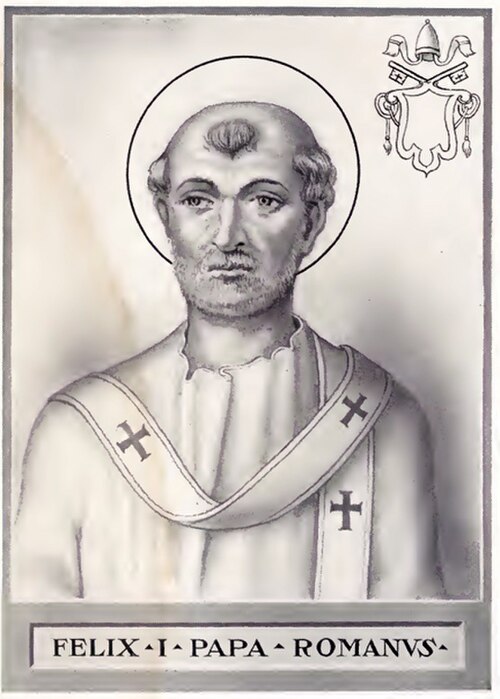
Saint
Felix I of Rome
Bishop of Rome
Bishop of Rome from 269 to 274, a Roman by birth, successor of Dionysius.
- Feast
- December 30old style January 12
- Reposed
- 2743rd century
- Place
- Rome
- Order
- Hierarchs
Life
Felix I of Rome was bishop of Rome from 5 January 269 until 30 December 274. A Roman by birth, he followed Dionysius in the see. Little is certain about his life, and some things later attributed to him are doubtful.
In his time Paul of Samosata, bishop of Antioch, who had been deposed by a synod for denying the divinity of Christ, refused to give up the church building to his successor Domnus. In 272 the case was brought before the emperor Aurelian, who ruled that the building should go to the man recognised by the bishops of Italy and the bishop of Rome, that is, to the party of Felix. The historian Eusebius tells the story. A letter on the unity of the person of Christ is also ascribed to him, and its text was later tampered with by followers of Apollinaris.
The Book of the Popes says he ordered the Liturgy to be celebrated over the tombs of the martyrs. Historians think he issued no such decree, and that the compiler credited him with a custom already in use in Rome.
He was buried in the catacomb of Callixtus on the Appian Way, on 30 December. Some late sources, among them the acts of the Council of Ephesus, call him a martyr, but scholars hold that this is a confusion with another Felix, a martyr buried on the Via Aurelia, and that the pope died a natural death. The old Roman calendar kept his memory on 30 May, a date probably due to a scribe's slip, and it is now kept on 30 December. He is a saint of the undivided Church; I did not find him in the Orthodox calendars consulted.
Commemorated the same day December 30
 TimonApostle · One of the Seven DeaconsDec 30
 Macarius of MoscowSaint · Metropolitan of MoscowDec 30
 Anysia of ThessalonicaMartyr · Virgin of ThessalonicaDec 30
 Egwin of EveshamSaint · Bishop of WorcesterDec 30
 Zoticus the Orphan-FeederMartyr · Feeder of orphans in ConstantinopleDec 30
- Anysius of ThessalonikiSaint · Bishop of ThessalonicaDec 30
- Theodora of CaesareiaVenerableDec 30
- Theodora of ConstantinopleVenerableDec 30
- Connla of RusgachSaintDec 30
- Daniel the WonderworkerSaintDec 30
- Elias of ConquesSaintDec 30
- Eugene of MilanSaint · Bishop of MilanDec 30