Venerable
Eupraxia of Constantinople
Nun of Constantinople
Nun of Constantinople, venerated after her death for her piety and example of charity; died in 410.
- Feast
- July 25old style August 7
- Reposed
- 4105th century
- Place
- Constantinople
- Order
- Venerables
Life
Venerable Eupraxia was a virgin and nun of Constantinople who spent nearly all her life in a monastery in Egypt and died around the year 410, at the age of thirty. The Church honours her for her humility, meekness and charity, and her name is commemorated on 12 July, which on the new calendar falls on 25 July.
Childhood
She was the only daughter of Antigonus, a nobleman of the court of the emperor Theodosius the Great and related to him, and of his wife, also named Eupraxia. The sources give her birth year as 380 or 383. When Antigonus died, his widow and the little girl went to Egypt and settled near a monastery of one hundred and thirty nuns. Monasticism had spread with astonishing speed by then, less than a century after Saint Anthony the Great founded his first monastery.
At the age of seven Eupraxia asked to become a nun. Her mother brought her to the abbess, and the child took an icon of the Lord in her hands, kissed it and said that by vow she gave herself to Christ. Her mother asked the Lord to receive the child under his protection, then fell ill and died soon after.
Another version of her life says that Eupraxia was raised at the court of Theodosius, and that her mother entered the monastery and Eupraxia followed her there as a child.
Her struggle
When he heard of her mother's death, the emperor sent for Eupraxia, since he had promised her in marriage to a young senator. She answered with a letter declining the marriage and asking that her estate be sold and divided among the poor, and that her slaves be freed. The emperor did as she asked before his death in 395. According to the second version, the order to marry came from Theodosius' successor Arcadius, and she was likewise allowed to remain a nun and give away her property.
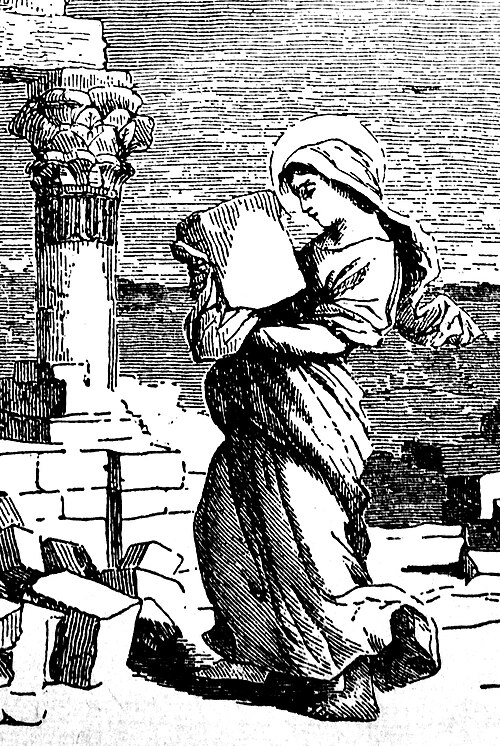
Eupraxia was known for humility, meekness and charity. When she was burdened with temptations, her abbess advised her to take up hard manual labour, and she carried heavy stones from one place to another, once for thirty days in a row. She departed to the Lord around the year 410, at the age of thirty (other sources give the year 413).
Miracles and veneration
She is said to have worked miracles both before and after her death. She is said to have healed a deaf, mute and crippled child and to have delivered a woman from possession by the devil. Before she died, the abbess of her monastery had a vision in which Eupraxia was carried to the throne of God, surrounded by angels.
She was greatly honoured in Kievan Rus, and princesses of Kyiv bore her name, among them Eupraxia Vsevolodovna, granddaughter of Yaroslav the Wise, and Eupraxia Mstislavna, granddaughter of Vladimir Monomakh. In 2009 her relics were brought from Egypt to Kyiv.
Commemorated the same day July 25
 AnnaRighteous · Mother of the TheotokosJul 25
 Olympias the DeaconessVenerable · Deaconess in ConstantinopleJul 25
 Macarius of UnzhaVenerable · Founder of monasteriesJul 25
 Lawrence I of MilanSaint · Archbishop of MilanJul 25
- Christopher of KoryazhmaVenerable · Founder of the Christopher HermitageJul 25
 Iraida TikhovaConfessor · Choir directorJul 25
- Attalus of LyonMartyr · Martyr of LyonJul 25
- Elias of ThessalonicaSaintJul 25
- Alexander SakharovHieromartyrJul 25
- Alexander the PhrygianMartyr · PhysicianJul 25
- Banthus of TrierSaint · Bishop of TrierJul 25
- Beatus of TrierVenerable · Monk of TrierJul 25