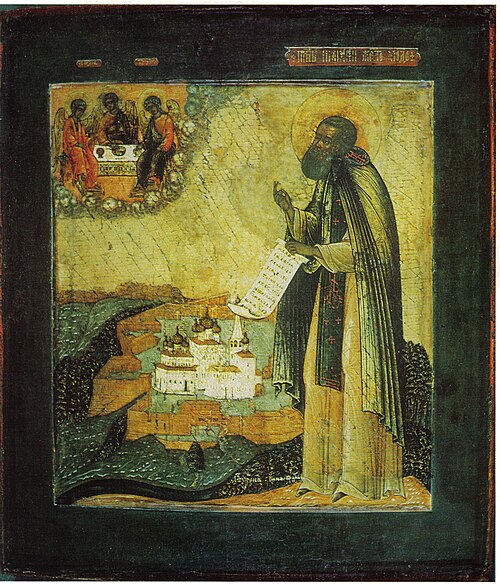
Venerable
Macarius of Unzha
Founder of monasteries
Russian monk credited with founding four monasteries, among them one at the Yellow Water Lake; died in 1444.
- Feast
- July 25old style August 7
- Reposed
- 144415th century
- Place
- Nizhny Novgorod
- Order
- Venerables
Life
Saint Macarius of Unzha, also called Macarius of the Yellow Water Lake, was a Russian monk born in 1349 in Nizhny Novgorod who reposed on 25 July 1444, in the ninety-fifth year of his life. Tradition counts him among the founders of four monasteries in the middle and upper Volga lands, and the Russian Church honours him as a wonderworker.
Childhood and calling
According to his life, he was born in Nizhny Novgorod of pious parents, John and Maria. He was baptized in the church of the Holy Myrrhbearers in their parish. It is told that as an infant he would cry whenever he heard the bells of the nearby church and grow quiet, smiling, as soon as he was brought to the service, so that his parents began to take him to every service. Growing up devout, he was drawn to the lives of the hermits of old.
At twelve he left home in secret and entered the Pechersky Ascension Monastery near the city, founded by Archimandrite Dionysius, who had come from the Kiev Caves Lavra. There he received the name Macarius and became one of the twelve disciples of Dionysius, known for the strictness of his fast and the fervour of his prayer. From his spiritual father he learned the common life and a love of hesychast stillness.
Hermit life and monasteries
In 1374 Dionysius was raised to archbishop of Suzdal and Nizhny Novgorod, and Macarius soon left the monastery, weighed down by the honour the brethren gave him. He wandered up the Volga, struggled for a time on the Lukh River, and then founded a monastery of the Epiphany near Reshma, today the Makaryev-Reshma Monastery.
Seeking complete solitude, he went down the Volga and chose the shore of the Yellow Water Lake, at the mouth of the Kerzhenets, in a wilderness between the Russian principalities and the Khanate of Kazan. He dug a small cave there and prayed day and night, but devout people came to him, some for a blessing, others to become his disciples. In 1434 he founded the Monastery of the Holy Trinity at the Yellow Water Lake, to which the Grand Prince of Moscow, Vasily the Blind, also gave gifts. His gentleness and love for people drew to him even pagans, Mordvins, Mari, Chuvash and Tatars, many of whom were baptized in the waters of the lake.
Captivity and Unzha
In 1439, when Khan Ulugh Muhammad of Kazan invaded, the monastery was destroyed and most of the monks killed. Macarius, then nearly ninety, was taken captive to Kazan. The khan, impressed by his life, released him with other Christians and allowed him to bury the dead, but not to remain there. The saint gathered the survivors and set out north to the forests of the Unzha River. On the way, the life says, the travellers were fed miraculously through his prayers, in what is called the miracle of the moose. On the Unzha he founded in 1439 the Makaryev-Unzha Monastery, now a convent. He is said to have lived there a few more years, healing the sick and driving out evil spirits from the possessed.
Relics and veneration
He fell asleep in the Lord on 25 July 1444, after eighty-three years of monastic life. His relics were found in 1671 and rest at the monastery on the Unzha, while his head has been kept since 2007 at the Holy Trinity Monastery at the Yellow Water Lake. His life ends with the account of twelve miracles, only one of them worked in his lifetime, the healing of the daughter of a man named Feodor. The others are posthumous, among them the healing of a voivode and appearances of the saint as defender of the towns of Unzha and Soligalich.
The Church commemorates him on 25 July, and on 23 January with the Synaxis of the Saints of Kostroma.
Commemorated the same day July 25
 AnnaRighteous · Mother of the TheotokosJul 25
 Olympias the DeaconessVenerable · Deaconess in ConstantinopleJul 25
 Eupraxia of ConstantinopleVenerable · Nun of ConstantinopleJul 25
 Lawrence I of MilanSaint · Archbishop of MilanJul 25
- Christopher of KoryazhmaVenerable · Founder of the Christopher HermitageJul 25
 Iraida TikhovaConfessor · Choir directorJul 25
- Attalus of LyonMartyr · Martyr of LyonJul 25
- Elias of ThessalonicaSaintJul 25
- Alexander SakharovHieromartyrJul 25
- Alexander the PhrygianMartyr · PhysicianJul 25
- Banthus of TrierSaint · Bishop of TrierJul 25
- Beatus of TrierVenerable · Monk of TrierJul 25