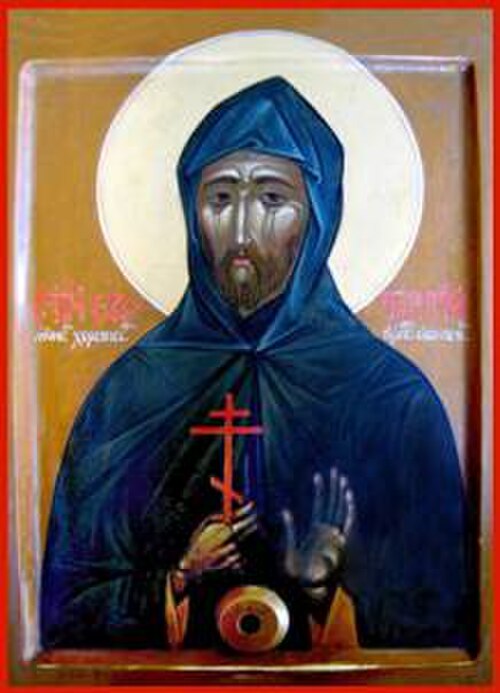
Venerable Martyr
Eustratius the Faster
Monk of the Kiev Caves
Monk of the Kiev Caves, taken captive and killed at Cherson in 1097 for confessing Christ.
Life
Venerable Martyr Eustratius the Faster, a monk of the Kiev Caves Lavra, was taken into captivity and killed at Cherson (Chersonesos, near modern Sevastopol) in 1097 because he would not renounce Christ. The Church's tradition places his death on 28 March 1097 and his commemoration on 28 March (old style). The Ukrainian source also gives commemorations on 11 October and 10 April. His relics rest in the Near Caves of the Caves Lavra. His story has a painful side, which we set out plainly below.
His life
According to the life in the Kiev Caves Paterikon ("The Tale of Blessed Eustratius the Faster"), Eustratius came from a wealthy family of Kiev. He gave all his property to the poor and, about 1076, was tonsured at the Caves Monastery, a disciple of Saint Anthony. For the self-restraint he had practised since youth he received the nickname of Faster. In 1096 (according to the Ukrainian source, on 20 July) the Polovtsians, under Khan Boniak, attacked Kiev, took the monastery, and sold Eustratius to a Jewish merchant of Cherson, together with other captives: thirty workers of the monastery and twenty other Kievans. The sources do not agree in detail: the Serbian one says that the monastery was plundered in 1097 and many Christians and monks were killed on that occasion.
According to the life, the master tried by ill treatment to make the slaves renounce Christ. Eustratius urged the others not to accept food and drink from people of another faith and not to yield: "Do not be, brothers, apostates from the faith; through death we shall gain eternal life." After their refusal the master subjected them to hunger, and all, except Eustratius, who had great experience of fasting, died within ten days. Eustratius lived without water and food for fourteen days (the Ukrainian source says he lived another fifteen days after the crucifixion).
Then the master crucified him on the day of the Jewish Passover and afterwards killed him by piercing him with a spear. Before this Eustratius, who thanked God for such a death, was mocked by the Jews, and he answered: "Vengeance will come on you for my blood and for the blood of the Christians you have tormented." According to the life, his body was thrown into the sea, whence it was taken out and buried in the Near Caves. The Ukrainian legend says the water carried it over the rapids of the Dnieper to the monastery. Parts of his relics are kept in the church dedicated to him in Ternovka, in Crimea.
The death of Eustratius, a man apparently known in the city, and of many others, caused unrest. The eparch of Cherson (a baptized Jew) was executed by the emperor's order, together with the merchant who had bought the monk. The historian Joshua Starr writes that the leaders of the Jewish community were also executed. The result was the expulsion from the city of all Jewish merchants and the confiscation of their property.
How scholars see the story
Academician G. G. Litavrin thought the compiler of the paterikon relied on two written sources: an old Russian one, about events in Kiev, and a Greek one, about events in Cherson, showing the sympathy of the Crimean Greeks for their Russian fellow believers. The Greeks of Cherson would have initiated Eustratius's inclusion among the saints. The historian V. Ya. Petrukhin also places the story in the Byzantine-Chersonese tradition, since only its beginning, the captivity, is linked with Rus. N. M. Bogdanova draws from the legend the conclusions that Jewish merchants came to Cherson for slaves and wintered there awaiting the opening of navigation; that the source, which may be biased on this point, says they monopolized the trade; and that the "Tale" condemns not the slave trade itself but the sale of Christians to people of another faith.
The Kiev researcher A. E. Bartosh notes that Byzantine Jews were forbidden to own Christian slaves, but in practice the law was often not observed, especially in remote provinces. Disputing this, the historian Ilya Sergeev holds that the eparch of Cherson really allowed Jewish merchants to buy Christians and enslave them, and regards their expulsion as a clearing of competitors from the slave market of Cherson and a means of filling the imperial treasury.
A number of scholars regard the legend in the life about Eustratius's killing by a Jew as the first case of the blood libel against Jews in Rus. The philologist A. A. Panchenko and the historian Petrukhin note parallels with the legend of William of Norwich, a Christian boy killed in England in 1144, about whom a rumour spread that he was ritually murdered by Jews, and who was long venerated as a local saint. Scholars connect these two legends, born at the same time at opposite ends of the Christian world, with the religious mood of the time of the first Crusades, with its emphasis on Christ's crucifixion and anti-Jewish ideology. Petrukhin thinks the Jewish pogrom in Kiev in 1113 was a consequence of such libels. At the end of the twentieth century proposals were made to decanonize Eustratius because of the clearly anti-Jewish stance of his life, which probably contains a blood libel; they came both from Jewish communities and leaders and from Christians. The Orthodox ecumenist priest Alexander Men argued for the decanonization of the saint in several articles. Eustratius nevertheless remains in the calendar of the Russian Orthodox Church.
Commemorated the same day March 28
 Guntram of BurgundyRight-Believing · King of BurgundyMar 28
 Proterius of AlexandriaHieromartyr · Patriarch of AlexandriaMar 28
 EnravotaMartyr · Son of Khan OmurtagMar 28
- Hesychius of JerusalemSaint · Priest and exegete of JerusalemMar 28
 Hilarion the NewVenerable · Abbot of the Pelekete MonasteryMar 28
- Gavrielia the Ascetic of LoveVenerable · NunMar 28
 Hilarion of GdovVenerableMar 28
- Abibas of PersiaMartyrMar 28
- Alexander of CaesareaMartyr · Martyr of Caesarea in PalestineMar 28
- Basil MalininHieromartyrMar 28
- CairnechSaintMar 28
- Cassan of LomdualSaintMar 28