Venerable
Gavrielia the Ascetic of Love
Nun
Greek nun, trained as a physiotherapist, known for her care of the poor and the sick.
- Feast
- March 28old style April 10
- Reposed
- 199220th century
- Place
- Leros
- Order
- Venerables
Life
Saint Gavrilia (in the world Avrilia Papayanni) was a Greek nun and spiritual mother of the twentieth century, called “the Ascetic of Love”. Born in Constantinople, she was one of the first women admitted to a Greek university, then a physiotherapist, and she left everything to serve the poor, lepers and the sick in India, Africa and many other lands. She became a nun after the age of sixty and ended her life as a great spiritual guide in Athens and on the island of Leros. Some have called her the Greek Mother Teresa. The Ecumenical Patriarchate numbered her among the saints in 2023.
Childhood in Constantinople
She was born on 15 October (2 October Old Style) 1897 in Constantinople, the fourth and youngest child of a wealthy Greek family with roots in Northern Epirus, living in the Phanar district. Her father, Elias Papayanni, represented a French shipping company, and her mother, Victoria, was the daughter of the physician Christakis, doctor to the sultan, and great-granddaughter of the priest and scholar Charisios Megdanis, a member of the Philiki Etaireia. Her elder siblings were Alexander, Vasiliki and Polina. She was baptised by Metropolitan Germanos (Strinopoulos), and her godfather was Vasileios Antoniadis, director of the Theological School of Halki and a friend of the family, who chose her name.
She attended the Zappeion Girls' School and had lessons at home in French, English, music and piano. A friend from her youth, Eleni Virvou, recalled that as a child she preferred daydreaming and play to reading, but at secondary school she became very studious. She came to love the ancient authors, above all Epictetus, who for many years was her daily reading and who, she said, prepared her for “Thy will be done”.
At fifteen a teacher told her that she lacked strength of character, because she loved good and bad people alike, without judging. Troubled, she went home, opened Sophocles' Antigone at random and came upon the line in which Antigone tells Creon that she was not born to hate but to love.
Studies and profession
She first completed a course in botany at a Swiss university. In 1923, in the population exchange between Greece and Turkey, her family was forced to move to Thessaloniki. There she entered the Aristotle University, the second woman ever admitted to a Greek university, and took a degree in philosophy.
From 1932 she lived in Athens, caring for the residents of an old people's home and working in hospitals. In 1937-1938 she went to England, where, despite many difficulties, she studied chiropody and physiotherapy, becoming a member of the Society of Chiropodists in 1946. She remained there until the end of the Second World War.
In 1945 she returned to Greece with the Quakers and worked in Thessaloniki with the American Farm School and the Friends Relief Service. In 1947 she opened a physiotherapy practice in Athens, on Massalias Street. She had a large and distinguished clientele, including even Queen Frederica, but she used her earnings to help the poor and those in need. She led no social life, going only to an occasional concert or, in summer, to the ancient tragedies.
Voluntary poverty and India
On 24 March 1954 her mother, whom she loved boundlessly, died. She then took a vow of poverty and gave away everything she owned, the equipment of her practice and her books. The following year she went to India without money, where she worked for four years among the poor and helped Baba Amte in his work with leper communities, giving free physiotherapy and witnessing to Orthodoxy by her life. Then she withdrew for eleven months into solitude as a hermit in the Himalayas.
At Landour she met the American Nella Graham Cook, who helped her reach the Holy Land, the Community of the Resurrection of the Lord at Bethany, led by Father Theodosius, at the Monastery of Saints Martha and Mary. She arrived there in 1959 or 1960 and, after three years of novitiate, was tonsured a nun with the name Gavrilia. At Bethany, with the Englishman E. Thomson, she translated into English the life of Saint Irene Chrysovalantou.
The missionary nun
In 1962 Ecumenical Patriarch Athenagoras sent her briefly to the Taizé Community in France. The same year, at the invitation of the American missionary Stanley Jones, she travelled through the United States and Canada, speaking in many states about the Orthodox faith. Also at that time she received the small schema on Patmos, at the Monastery of the Annunciation, from Elder Amphilochios (Makris), together with a blessing for mission and for travel to India.
After journeys to Denmark, Sweden, Germany, Switzerland and Austria, she left Athens for India on 8 May 1963 and stayed there until 4 October 1966. After an operation for cataract she recovered at the Evangelistria Monastery of New Jerusalem. In 1968 she left for Africa, for Nairobi, and worked for three years as a missionary in East Africa. To a friend, the Jewish writer Yehuda Hanegbi, she wrote that she had never thought of going to Africa, but that her poor mind had never played any part in God's guidance. She served for a time in Germany and then again for three years in India. She accompanied many mentally ill patients to hospitals in Europe.
The elder of Athens
In 1979 she was given an apartment in the centre of Athens, where she lived for ten years in semi-seclusion as a gerontissa, a spiritual mother. She received a multitude of people, guided her disciples and helped the sick. Those who knew her said that she had not lived shut away in a monastery, but that the whole world had been her monastery, and that she had shared with those around her her experience of the unceasing presence of God and of the angels.
Towards the end of her life she withdrew to a hermitage on the island of Aegina, but she developed Hodgkin's disease and returned to Athens. After a miraculous healing, two years before her death she moved to the island of Leros, to the Monastery of the Holy Angels, where she lived in stillness and received the great schema.
Repose and veneration
She reposed on Leros on 28 March 1992, at the age of ninety-four, and was buried in the church of Panagia tou Kastrou on Leros.
In 1996 her biography, “The Ascetic of Love”, was published in Greek, and was later translated into English (1999), Russian (2000), Arabic, French and Serbian; in Greek alone it has gone through fourteen editions. The Holy Synod of the Ecumenical Patriarchate numbered her among the saints in 2023. She is commemorated on 28 March, the day of her repose, and some calendars also remember her on 18 July. Portions of her relics are also venerated in the Greek church of the Prophet Elijah in Frankfurt.
Commemorated the same day March 28
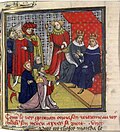 Guntram of BurgundyRight-Believing · King of BurgundyMar 28
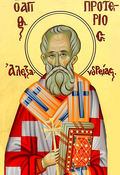 Proterius of AlexandriaHieromartyr · Patriarch of AlexandriaMar 28
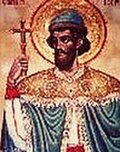 EnravotaMartyr · Son of Khan OmurtagMar 28
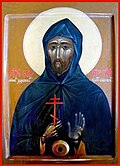 Eustratius the FasterVenerable Martyr · Monk of the Kiev CavesMar 28
- Hesychius of JerusalemSaint · Priest and exegete of JerusalemMar 28
 Hilarion the NewVenerable · Abbot of the Pelekete MonasteryMar 28
 Hilarion of GdovVenerableMar 28
- Abibas of PersiaMartyrMar 28
- Alexander of CaesareaMartyr · Martyr of Caesarea in PalestineMar 28
- Basil MalininHieromartyrMar 28
- CairnechSaintMar 28
- Cassan of LomdualSaintMar 28