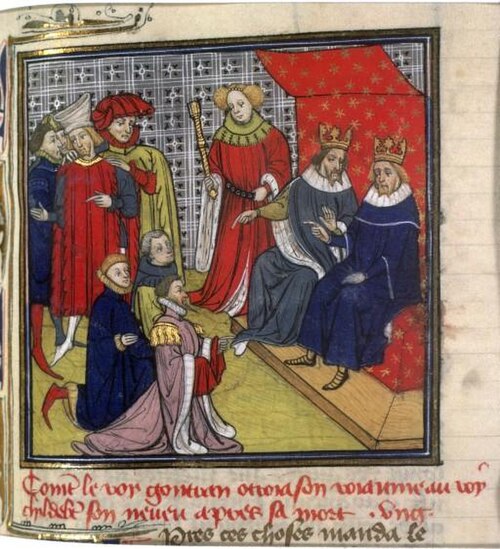
Right-Believing
Guntram of Burgundy
King of Burgundy
King of Burgundy from 561 to 592, known for his piety and almsgiving.
- Feast
- March 28old style April 10
- Reposed
- 5926th century
- Place
- Chalon-sur-Saône
Life
King Guntram of Burgundy (in French Gontran, in Latin Guntchramnus) was a Frankish king who ruled the kingdom of Orléans and Burgundy from 561 to 592 and is honoured as a holy king of the undivided Church in the West. He is remembered for his repentance, his almsgiving and his care for the poor and the sick. He is commemorated on 28 March, and Orthodox communities in the West keep his memory as a saint of the Church before the schism.
He was born around 532 at Soissons, a son of King Chlothar I and Queen Ingund. When Chlothar died in 561, the Frankish kingdom was divided among his four sons, Charibert, Guntram, Chilperic and Sigebert, and Guntram received the kingdom of Orléans with Burgundy. He made his capital at Orléans, though Chalon-sur-Saône is the city most tied to his memory. When Charibert died in 567, the surviving brothers shared his lands.
Gregory of Tours, the bishop and chronicler who knew the king and wrote the History of the Franks, often calls him "the good king Guntram." He does not hide the faults of the king's youth. Gregory records that Guntram had a concubine and then two wives, and that one of his queens, Marcatrude, poisoned his son Gundobad. He was a man of his time, and he could be harsh in his judgments. According to Gregory, however, he was later overcome with remorse for his past, and spent the rest of his reign in fasting, prayer and tears, trying to rule by Christian principles. He protected the oppressed, helped the sick, gave generously in times of plague and famine, and enforced the law without respect to persons. He forgave offences against himself, even two attempts on his life. Gregory also reports that miracles took place through him, some of which he claims to have seen.
In the wars among the Frankish kings he often defended his brother's family and supported the rights of his nephews. After his sons died of dysentery in 577, he adopted his nephew Childebert II, whom he had already helped to keep his throne, and named him as heir. The treaty of Andelot (587) confirmed this alliance between uncle and nephew. In 585 he called the council of Mâcon, which made decisions for the good order of the Church. He built and endowed many churches and monasteries, among them the church of Saint Marcellus at Chalon-sur-Saône.
Guntram died at Chalon-sur-Saône on 28 March 592 and was buried in Saint Marcellus, the church he had founded. His subjects at once proclaimed him a saint. His body was scattered by the Huguenots in the sixteenth century, but his skull was spared and is kept in a silver reliquary.
Commemorated the same day March 28
 Proterius of AlexandriaHieromartyr · Patriarch of AlexandriaMar 28
 EnravotaMartyr · Son of Khan OmurtagMar 28
 Eustratius the FasterVenerable Martyr · Monk of the Kiev CavesMar 28
- Hesychius of JerusalemSaint · Priest and exegete of JerusalemMar 28
 Hilarion the NewVenerable · Abbot of the Pelekete MonasteryMar 28
- Gavrielia the Ascetic of LoveVenerable · NunMar 28
 Hilarion of GdovVenerableMar 28
- Abibas of PersiaMartyrMar 28
- Alexander of CaesareaMartyr · Martyr of Caesarea in PalestineMar 28
- Basil MalininHieromartyrMar 28
- CairnechSaintMar 28
- Cassan of LomdualSaintMar 28