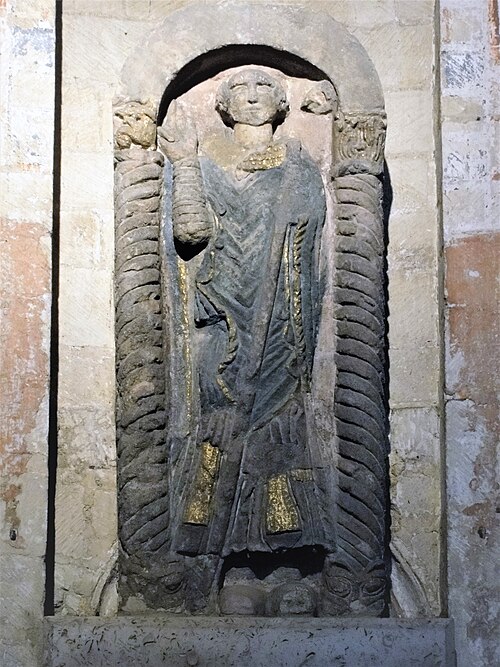
Saint
Felix of Dunwich
First Bishop of East Anglia
First bishop of the kingdom of East Anglia, credited with bringing Christianity there; died in 647.
Life
Saint Felix of Dunwich (Felix of Burgundy) was the first bishop of the kingdom of East Anglia, held to be the one who brought Christianity to that kingdom. He fell asleep on 8 March 647 or 648. His feast is on 8 March, and in the Russian Church also on 13 May.
Beginnings
Almost all that is known about him comes from Bede's Ecclesiastical History of the English People, completed around 731, and the Anglo-Saxon Chronicle. Bede says that Felix freed the whole province from long-standing evil and unhappiness. He was born in the Frankish kingdom of Burgundy, though his name does not let historians fix his nationality. According to Bede he was ordained in Burgundy. Historians suppose he had a link with the Irish mission in Francia, centred in Burgundy, associated above all with Columbanus and Luxeuil abbey; Columbanus had arrived in Francia around 590, leaving Bangor with twelve companions. Between the kingdom of East Anglia and Francia there were links at that time: at Sutton Hoo jewelled objects of Frankish workmanship were found in the royal grave, and the link between the Wuffingas dynasty and the Frankish abbess Burgundofara at Faremoutiers shows the ties of the Church in East Anglia with establishments in Francia. It is said that Felix may have come from Luxeuil, Châlons or the area around Autun; some historians have linked him with the Burgundian king Dagobert I, who had contact both with Sigeberht of East Anglia and with Amandus, a disciple of Columbanus. It is also supposed that a bishop Felix held the see of Châlons in 626-627 and was deprived of it after the death of King Chlothar II, in 629, so that he may have become a political fugitive.
Arrival in East Anglia
Felix is first mentioned in the Anglo-Saxon Chronicle, under the year 633; manuscript A says he preached the faith of Christ to the East Angles. Another version, manuscript F, of the eleventh century, says: Here there came from the region of Burgundy a bishop called Felix, who preached the faith to the people of East Anglia; called here by King Sigeberht, he received a bishopric in Dommoc, in which he remained for seventeen years. According to Bede, Felix was sent to promote Christianity among the East Angles by Archbishop Honorius of Canterbury, to whom he came from Burgundy and to whom he said what he desired. He was consecrated bishop around 630 or 631. Later sources differ: the Liber Eliensis, from Ely abbey (twelfth century), says Felix came to England with Sigeberht from Francia; according to a local tradition he arrived by sea at Babingley, in Norfolk. His arrival seems to have coincided with the start of a time of order under Sigeberht, after the murder of Eorpwald and three years of apostasy; Sigeberht had become a pious Christian in exile, in Francia, before becoming king.
The bishop
Sigeberht gave Felix a see at Dommoc, possibly at Walton, in Suffolk, near Felixstowe, or at Dunwich. According to Bede, Felix helped the king to found a school, where boys could be taught letters. He was bishop seventeen years. His relics were moved from Dommoc to Soham abbey, then to Ramsey. After his death he was venerated as a saint, and several English churches bear his name.
Commemorated the same day March 8
 Hunfrid of ThérouanneSaint · Bishop of ThérouanneMar 8
 Lazarus of MuromVenerable · Founder of the Murom MonasteryMar 8
 John of IlomantsiNew Martyr · Teacher and missionaryMar 8
 Michael of PereslavlFool-for-Christ · Fool for ChristMar 8
- ConainneSaintMar 8
- ApolloniusMartyrMar 8
 Apollonius and PhilemonHoly MartyrsMar 8
- Arian and companionsHoly MartyrsMar 8
- Athanasius of MuromVenerableMar 8
- BeatusMartyrMar 8
- Beoadh of ArdcarneSaint · Bishop of ArdcarneMar 8
- Brighit daughter of LeininSaintMar 8