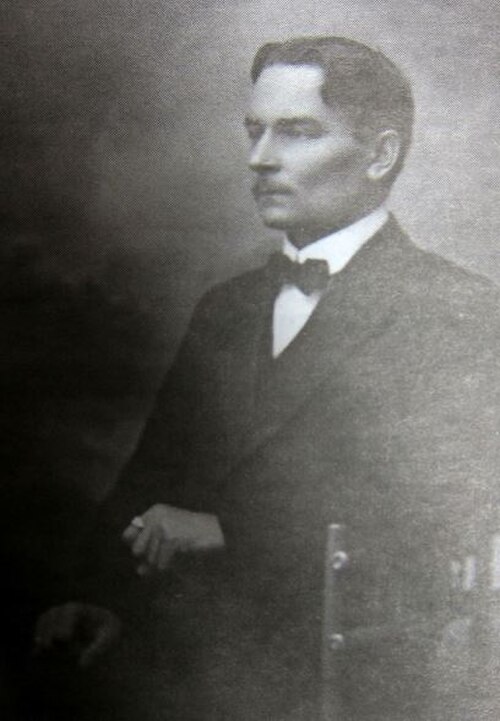
New Martyr
John of Ilomantsi
Teacher and missionary
Orthodox teacher and missionary from Finnish Karelia, killed by the White Guards in 1918; canonized in 2018.
Life
Saint John of Ilomantsi, known in the Orthodox Church also as John of Sonkajanranta, was an Orthodox teacher and missionary of Finnish Karelia, killed in 1918, during the Finnish Civil War, by the White Guards. He was born on 13 July 1884 and was canonized by the Ecumenical Patriarchate in 2018, a hundred years after his death, as a holy martyr and confessor. He is commemorated on 8 March.
Family and youth
Born Johannes Vasilinpoika Karhapää (in Russian, Ivan Vasilievich Karhapää), he came from the village of Sonkajanranta in the municipality of Ilomantsi in North Karelia, then part of the Grand Duchy of Finland in the Russian Empire. His parents were Vasili and Anastasia. He had two half brothers, Feodor and Ilja, and a younger brother, Jaakko. He married Katri Timola and they had two sons, Sergei, who died in infancy, and Aleksi. His wife died in 1910, and he married a second time, Anna, née Palviainen.
From childhood he held a strong Orthodox faith and took part in the youth association of the Brotherhood of Saints Sergius and Herman of Valaam. At the turn of the century the Sortavala Evangelical Society had begun a fervent campaign to bring Orthodox Christians over to Lutheranism, and in response the Karelian Brotherhood was founded in 1907 at Olonets, at the initiative of Hieromonk Cyprian, a future vicar bishop. The brotherhood quickly opened dozens of Russian-language schools in Karelia and published teaching materials for them. The schools became popular, partly because of the social benefits offered to pupils. The brotherhood's original aim was inner mission work, but under Governor-General Franz Albert Seyn, from 1909 to 1917, it was harnessed to the Russification of Karelia.
Work of enlightenment
Concerned by the growing Lutheran mission in his region, John wrote in 1906 to Archbishop Sergius of Finland (the future Patriarch of Moscow), asking for help in defending Orthodoxy and for a school at Sonkajanranta. As a result an Orthodox association was founded at Sonkajanranta as part of the Brotherhood of Saints Sergius and Herman, and the archbishop blessed it to open a church school together with the Karelian Brotherhood. The school, with Finnish as the language of instruction, was built the next year and by 1911 had four classes. Poor pupils and those from far away could live and eat there, and the building was also used for lessons, meetings and festivals for adults.
As a worker for the Sergius and Herman Brotherhood, John also served as catechist at Ilomantsi, travelling with Hieromonk Isaac of Valaam, selling Orthodox books and prints and holding Christian gatherings. In 1914 the Vyborg spiritual consistory, although he was self-taught, appointed him religion teacher for the whole province of Kuopio, with a salary from the Grand Duchy. His activity was greatest from the beginning of the First World War. At the same time he gained more and more enemies, and some called him a henchman of the tsarist regime and even a spy of the tsarist police. After Bishop Cyprian died in 1914 the Karelian Brotherhood weakened, but the next year a St Petersburg merchant donated ten thousand roubles to the school and to the building of a church beside it. The church, dedicated to Saint Anna the Prophetess, was consecrated in autumn 1915, to plans by Monk Gennady of Valaam, and remained under the care of the Brotherhood.
Slander and abandonment
His part in the school and church was great and for his zeal he received several distinctions. But from 1910 the newspaper Perä-Pohjolainen had suggested that he and his father supported Russia's anti-Finnish policy, calling them "miserable Finns". Many Fennomen saw in him a propagator of the "Russian faith", and he was hated especially because in 1912 he had received Governor Seyn at his home, who had advised him to ask the government for funds to build a road to the school. After the Russian Revolution of 1917 the attacks intensified: Fennoman papers called him "one of the dark powers of North Karelia" and accused him of sowing hatred and discord, of forcing Russification, of thinking himself a martyr, of ridiculing the faith and of deceiving simple people. The same was said of his father and brother. John did not answer these charges. Professor of church history Kauko Pirinen judged the criticism unjust, since his only motive was deep religious conviction.
In the end he began to be opposed among the Orthodox themselves: just before Easter 1917 a meeting of the Ilomantsi parish condemned the Sonkajanranta school as foreign oppression mixed with religion and demanded that he be removed from positions of trust and from the parish council. In autumn 1917 he also lost the support of Archbishop Seraphim and was dismissed as teacher, and a fierce nationalist teacher was put in the school. Left without support, he became practically an outlaw in the turmoil of the civil war.
Arrest and martyrdom
In March 1918 John and his brother Jaakko were summoned to the White Guard call-up at the Tuupovaara school. There they were arrested on a tip-off. The incriminating evidence was a small icon found in the pocket of John's coat, which he used in teaching. He was allowed to go home to say goodbye to his family, then taken at gunpoint to Joensuu. At a stop he told the woman of the house that his days were numbered. At Joensuu he and his brother were locked in the basement of the town hall with other prisoners, mostly Red Guards and Russian prisoners of war.
John was taken to the Siilainen district of Joensuu, where he was shot. At that time executions were carried out at random, without trial, often by drunken executioners. The condemned were lined up and five men fired a volley. It is said that John did not die at once and a second volley was needed. The date of death is uncertain: the database of the war victims of Finland gives 7 March, while the tombstone shows 8 August. Other data suggest he was executed some three weeks later, around Easter, or even on 14 April together with a hundred Russian prisoners.
His wife managed to recover the body only after months and recognized it by the stripes of its woollen socks. He was buried at the Kokonniemi cemetery at Ilomantsi, with a large crowd present, both Orthodox and Lutheran. The slander continued after his death, and the tombstone was twice thrown into the nearby lake, until it was cast in concrete. In 1958 an old man in a heavy coat came to his brother Jaakko and confessed that he had been one of John's executioners. Tormented by conscience, the sick old man talked with Jaakko, who let him stay the night at his house.
Canonization and veneration
His name came up when the Synod of Bishops of the Orthodox Church of Finland looked for Finns worthy of canonization. In March 2016 the synod proposed the canonization of John Karhapää and of Schema-Igumen John of Valaam. On 29 November 2018 the Holy Synod of the Ecumenical Patriarchate entered the two names in the Hagiologion of the Orthodox Church. The liturgical canonization took place on 12 and 13 July 2019 in the church of Saint Anna in Sonkajanranta. The name was first John of Ilomantsi and later specified as John of Sonkajanranta. His day of commemoration is 8 March. In 2008 Finnish television Yle aired a documentary about him, "The Rise and Fall of an Orthodox Man". The Sonkajanranta school burned down in the 1950s, and the church of Saint Anna is now one of the churches of the Joensuu Orthodox parish.
Commemorated the same day March 8
 Felix of DunwichSaint · First Bishop of East AngliaMar 8
 Hunfrid of ThérouanneSaint · Bishop of ThérouanneMar 8
 Lazarus of MuromVenerable · Founder of the Murom MonasteryMar 8
 Michael of PereslavlFool-for-Christ · Fool for ChristMar 8
- ConainneSaintMar 8
- ApolloniusMartyrMar 8
 Apollonius and PhilemonHoly MartyrsMar 8
- Arian and companionsHoly MartyrsMar 8
- Athanasius of MuromVenerableMar 8
- BeatusMartyrMar 8
- Beoadh of ArdcarneSaint · Bishop of ArdcarneMar 8
- Brighit daughter of LeininSaintMar 8