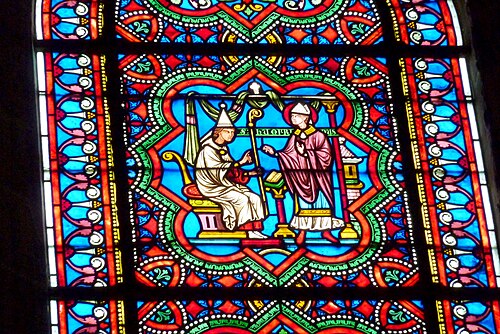
Saint
Hunfrid of Thérouanne
Bishop of Thérouanne
Benedictine monk of Prüm, bishop of Thérouanne from 856 and abbot of Saint-Bertin from 864 to 868.
Life
Saint Hunfrid was a Benedictine monk of Prüm Abbey who in 856 was elected Bishop of Thérouanne in northern Gaul and later, from 864 to 866 (or 868 by other sources), was also abbot of Saint-Bertin. He shepherded his people during the terrible Viking raids, when his city was plundered and burned twice, and the Church remembers him as the pastor who did not abandon his flock; some recent accounts call him the Bishop in the Storm. His feast is kept on 8 March, the day of his repose.
Origins and the years at Prüm
The sources differ about his family. According to his life, he was born in the valley of the Meuse and was entrusted as a child by his parents to Prüm Abbey to be raised for the service of the Church. Other sources link him to an aristocratic Carolingian family related to the founders of Hornbach Abbey: he was the son of Count Alberich and Huna, and his brothers were Henry, another Alberich and Heriric. The family held wide estates in East Francia and Lotharingia, and through its kinship with Count Werner it was connected to the families from which the Salian emperors would later descend.
At Prüm he received the Benedictine habit and lived as a devout monk, alongside Saint Ansbald, the future restorer of the abbey. His life says that the fame of his pure life reached many great men, among them Emperor Lothair I. In September 855 Lothair, old and gravely ill, came to Prüm to end his days among the brethren; he lived only six days more, and Hunfrid was among the monks who buried him with honour in the abbey church of the Holy Saviour.
Election as bishop
On 15 December 855 Saint Folcuin, Bishop of Thérouanne, died. Archbishop Hincmar of Reims, the metropolitan, feared that King Charles the Bald would again impose a man of his own on the vacant see without regard for the canons, and so he charged the Bishop of Laon with seeing that the election was properly conducted. Hunfrid was chosen and accepted the burden against his will. How the king came to approve him is not clearly known; it is thought that King Lothair II of Lotharingia interceded for him. The election was confirmed by Pope Nicholas I, and his enthronement took place in 856, according to his life amid the joy of the whole city and its clergy.
The Viking raids
The simple monk thus became shepherd of a diocese that the Vikings were laying waste without respite. The raiders sailed up the rivers as far as their ships could go and then poured over the countryside, burning fields, villages and towns and falling with particular ferocity on churches and monasteries.
In 860 Hunfrid took part in the Council of Tusey, but in 861, when a great Viking host approached Thérouanne, he had to flee for his life. Although the city had walls, the Northmen plundered it without resistance and burned most of it. At Pentecost they also seized the monastery of Saint-Bertin at Saint-Omer, looted it, set it on fire and tortured and killed four monks who had stayed behind. Almost immediately afterwards Thérouanne was plundered again, this time in the conflict between Charles the Bald and Baldwin Iron Arm, the future Count of Flanders.
Even while he had to hide, the bishop did not forget his flock: he comforted the stricken, sought shelter for those driven from their homes and laboured to hold together the scattered remnants of his diocese.
The letter of Pope Nicholas
Crushed by the ruin of his city, Hunfrid wrote to Pope Nicholas I asking leave to lay down his episcopal office and return to monastic life at Prüm. The pope replied with sympathy but firmly, and would not let him leave his see. Using an image, he reminded him that if it is wrong for a pilot to leave his ship in calm seas, it is far worse to desert it in a storm. He also told him that he had been right to flee his persecutors when his life was in danger, but urged him to be ready to return as soon as possible, to gather and encourage his scattered flock.
Rebuilding the city
Strengthened by the pope's letter, Hunfrid returned to Thérouanne and began to rebuild the twice-ruined city. Among the first buildings raised at his order was the cathedral. He encouraged the people to come back to their homes and rebuild their sanctuaries, and he sold the treasures of the church to feed them. The rebuilding was helped by the reconciliation in 863 between Charles the Bald and Baldwin, into whose domain Thérouanne passed.
In February 862 he was present at the Council of Aachen, which dissolved the marriage of King Lothair II and Theutberga. Tradition connects these years with an event on the feast of the Dormition: it is told that on 15 August 862, as a servant was ironing his master's shirt for Mass, blood began to flow from under the iron, and the bishop ordered the garment to be kept in the cathedral. Then, or in the following year, Hunfrid decreed that the feast of the Dormition of the Mother of God be kept with full solemnity throughout the diocese, which had not been done everywhere before.
Abbot of Saint-Bertin
Hunfrid worked with Abbot Adalard to restore the monastery of Saint-Bertin, and after Adalard's death, on 15 March 864, the brethren elected him abbot in his place. Being both bishop and abbot, he raised the abbey's estates from ruin after the raids, and in 866 he received several rich estates for it from Count Magenfrid. Soon, however, he was forcibly removed by King Charles the Bald, who installed as abbot a cleric named Hildwin, who had bought the office from the king for thirty solidi. The sources place this removal in either 866 or 868.
Councils and service in the Frankish Church
The documents of the time, preserved in the collections of Carolingian conciliar acts, show Hunfrid as a hierarch constantly present at the Church's councils, styled Bishop of the Morini after the ancient people of the Thérouanne region. His name appears in several spellings: Humfridus, Hunfridus, Huntfridus, Untfredi.
At the Council of Tusey (October-November 860), gathered from twelve provinces to address the predestination controversy and to support churches and monasteries ruined by the Vikings, he signed the conciliar acts and two charters for the abbey of Saint-Martin at Tours, one of which speaks of the devastation wrought by the Northmen. He signed again at the Council of Pîtres and Soissons in June 862 and a royal charter for Saint-Denis that same year, and in October 863 he was a witness at Verberie in the case of Bishop Rothad of Soissons.
In August 866 he took part in the Council of Soissons, convened at the request of Pope Nicholas I, where thirty-five bishops led by Hincmar of Reims examined the case of the clergy ordained by the deposed Archbishop Ebbo. He signed both synodal letters sent to the pope, one of which pleaded for bishops driven entirely from their sees by the savagery of the Northmen, a suffering he knew at first hand.
His name also appears in the royal capitulary of Quierzy of 857, in a copy addressed to him and to Counts Ingiscalc and Berengar. This copy survives in a luxury manuscript with initials in red, green and gold, produced around 875 and thought to have been intended for the court of Charles the Bald; it is now in the Beinecke Library at Yale University.
Last years
In 868 his brother Heriric, preparing for a pilgrimage to Rome, gave Prüm Abbey estates at Bingen, Weinsheim and on the river Glan for the salvation of his own soul, of his brothers Hunfrid, Henry and Alberich and of his parents Alberich and Huna. The gift was witnessed by fifty-five men, among them Bishop Hunfrid. He himself prepared to travel to Rome, to the tombs of the Apostles Peter and Paul, accompanied by the monk Guntbert as companion and scribe. Such journeys were dangerous, so he set his affairs in order beforehand, and on the way, near Bingen on the Rhine, he too gave an estate to Prüm, the abbey with which he remained bound all his life.
The sources disagree about his end. According to some, he reposed at Thérouanne on 8 March 869 at the age of eighty-seven and was buried in the cathedral he had rebuilt; according to others, he died at Prüm on 8 March 871, and the documents that name him run until 870. His successor at Thérouanne was appointed by Charles the Bald.
Veneration
Soon after his death Hunfrid began to be venerated as a saint at Thérouanne, and his cult then spread through northern France and Flanders; his life tells of many miracles at his tomb. On 13 April 1108 Bishop John of Thérouanne raised his relics and placed them in a new shrine on the altar of the cathedral.
After the armies of Emperor Charles V destroyed Thérouanne in 1553, the relics were divided: his head was taken to Saint-Omer and venerated there, while other relics went to Ypres. These were later desecrated and burned in the religious upheavals of the Dutch wars.
The Bollandist Acta Sanctorum records him together with other saints of the diocese of Thérouanne, and the canons of Saint-Omer honoured him alongside Saints Audomar (9 September), Erkembode (12 April) and Folcuin (14 September). Saint Hunfrid is commemorated on 8 March.
Commemorated the same day March 8
 Felix of DunwichSaint · First Bishop of East AngliaMar 8
 Lazarus of MuromVenerable · Founder of the Murom MonasteryMar 8
 John of IlomantsiNew Martyr · Teacher and missionaryMar 8
 Michael of PereslavlFool-for-Christ · Fool for ChristMar 8
- ConainneSaintMar 8
- ApolloniusMartyrMar 8
 Apollonius and PhilemonHoly MartyrsMar 8
- Arian and companionsHoly MartyrsMar 8
- Athanasius of MuromVenerableMar 8
- BeatusMartyrMar 8
- Beoadh of ArdcarneSaint · Bishop of ArdcarneMar 8
- Brighit daughter of LeininSaintMar 8