
Martyr
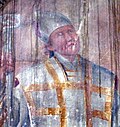
Fidentius of Padua
Martyr honored at Padua since the Middle Ages, traditionally set in the second century; nothing certain is known of him.
- Feast
- November 16old style November 29
- Reposed
- 2002nd century
- Order
- Martyrs
Life
Saint Fidentius of Padua (Fidentius the Armenian) is a saint whose veneration was kept at Padua in the Middle Ages. His commemoration is on 16 November. Nothing certain is known of him. He is placed by tradition in the second century and regarded as a martyr. According to a late hagiography, he was killed in the seventh year of Marcus Aurelius (168). His nickname shows that he was an Armenian, but another view says that he was from Eastern Europe, and his origin remains wrapped in mystery. He is a saint of the Roman Catholic Church; our sources mention no Orthodox veneration.
He is regarded as the third bishop of Padua, after Saint Prosdocimus and before Saint Maximus. When Baronius revised the Roman Martyrology (1586), he listed Fidentius as bishop of Padua, but in 2004 he was removed from the Martyrology. In the chronology of the bishops of Padua by Nicolò Antonio Giustinian, he is third, from 166 to 168.
His veneration was strengthened in 964, when, after several wonderful events, his body was found in the small town of Polverara, near Padua. His holy remains had been secretly buried in the countryside, on the outskirts of Padua, in 602, when the curia of Padua fled from the city to Malamocco because of the invasion of the Lombards. In 774 the high clergy of Padua returned to the city, and in 970 the then bishop of Padua, Gauslinus Transalgardo, ordered the relics to be moved to a village now called Meliadino San Fidenzio, on the southern border of the diocese. The reason for the move was, it seems, the wish of the diocese of Padua to show its influence in a region disputed between Padua and Verona. Perhaps it is not by chance that a church a few kilometres from Meliadino San Fidenzio was dedicated to Saint Zeno, the well-known saint of Verona. Since then the saint's body is kept in the crypt of the church that bears his name. The saint is greatly venerated in those regions.
Commemorated the same day November 16
 MatthewApostle · Apostle and EvangelistNov 16
 Othmar of St. GallVenerable · First Abbot of St. GallNov 16
- Philoumenos HasapisHieromartyr · Abbot of Jacob's WellNov 16
 Sergius of Malaya PinegaVenerable · HieroschemamonkNov 16
- Africus of CommingesSaint · Bishop of CommingesNov 16
 Michael AbramovHieromartyr · ArchpriestNov 16
- Akylina of DramaVenerable · Abbess in DramaNov 16
- Aelfric of AbingdonSaint · Archbishop of CanterburyNov 16
- AfanSaintNov 16
- Ananias BoykovMartyrNov 16
 Anianus of AstiSaint · Bishop of AstiNov 16
- AugustineMartyr · Martyr of CapuaNov 16