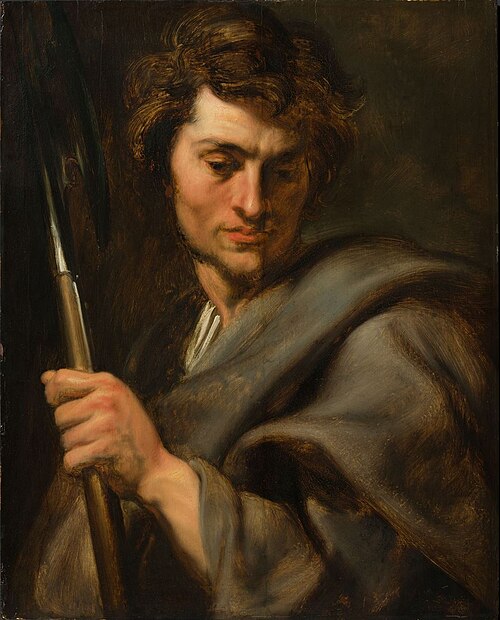
Apostle
Matthew
Apostle and Evangelist
A tax collector called by Christ to be one of the Twelve, author of the first Gospel.
- Feast
- November 16old style November 29
- Born
- 101st century
- Place
- Aethiopia
- Order
- Apostles
Life
The holy Apostle and Evangelist Matthew was a tax collector in Capernaum before Christ called him to be one of the twelve apostles. The Church honours him as the author of the first Gospel of the New Testament, written, according to tradition, for those of the Jewish people who had believed in Christ. According to tradition he preached in distant lands and died as a martyr.
The call of the tax collector
Matthew, also called Levi, was the son of Alphaeus, from Galilee, and according to Orthodox tradition the brother of the Apostle James the son of Alphaeus. He worked as a tax collector and sat at the customs house near Capernaum, a despised post, since the Jews regarded tax collectors as sinners and servants of Roman rule. When Jesus passed by, He said to him, "Follow Me". Matthew rose, left everything and followed Him.
In his house he gave a banquet to which he invited the Lord together with many tax collectors and sinners. The Pharisees and scribes were disturbed and murmured, and Christ answered that He had not come to call the righteous but sinners to repentance. His Gospel hides nothing of his past: in the list of the apostles he calls himself "Matthew the tax collector".
The apostle
Matthew witnessed the teaching and miracles of the Lord, His Passion, Resurrection and Ascension. He was among those gathered in the upper room at Jerusalem, and at Pentecost he received the Holy Spirit with the other apostles. He preached for several years in Palestine, and at the request of the Jewish converts at Jerusalem he wrote his Gospel, before leaving to proclaim the Word in distant countries.
The Gospel
The oldest tradition, attested by Bishop Papias of Hierapolis and by Origen, says that Matthew wrote in the language of the Hebrews, that is Hebrew or Aramaic, and that the text was translated into Greek. The text that has come down to us is in Greek. The Greek synaxarion places its writing around the year 64. The Gospel shows in Jesus the Messiah foretold by the prophets. It contains the Sermon on the Mount, with the Beatitudes and the Lord's Prayer, and many parables, and it teaches about the Kingdom of God and the Church. The Lord appears in it as Prophet and Lawgiver, as Master of the visible and invisible world, and as High Priest offered for the sins of the world.
Preaching and martyrdom
Fathers of the Church, among them Irenaeus and Clement of Alexandria, say that Matthew preached first in Judea and then in other countries, and almost all sources mention Ethiopia. According to the tradition kept in the synaxarion, he carried the Gospel to Syria, Media, Persia and Parthia and ended his preaching in Ethiopia, in a land of people with wild customs. He founded a Church and a temple in the city of Mirmena and set his companion Platon over it as bishop.
It is told that the Lord appeared to him in the form of a youth and gave him a staff, commanding him to plant it at the door of the church, from which a tree with fruit and a spring would grow, and those who washed in it and ate the fruit became gentle. The apostle healed the wife and son of the ruler Fulvian, and the ruler, angered that the people were abandoning the gods, condemned him as a sorcerer and ordered him to be burned. According to tradition the fire did not touch him, and Matthew departed to the Lord. Fulvian repented, was baptized by Bishop Platon and received the name Matthew. Another tradition says that he was killed at the altar by King Hirtacus after rebuking him for his desire for Ephigenia, the virgin consecrated to Christ. The place and manner of his death cannot be established with certainty, but the Church honours him as an apostle who ended his life in martyrdom.
Veneration
His relics are in the crypt of the cathedral of Salerno in Italy. The Orthodox Church celebrates him on 16 November, and on 30 June commemorates him together with all the twelve apostles. Western Churches usually keep his day on 21 September. In icons he is painted with an angel beside him, the symbol of the evangelist, shown as a winged man.
Commemorated the same day November 16
 Othmar of St. GallVenerable · First Abbot of St. GallNov 16
- Philoumenos HasapisHieromartyr · Abbot of Jacob's WellNov 16
 Fidentius of PaduaMartyrNov 16
 Sergius of Malaya PinegaVenerable · HieroschemamonkNov 16
- Africus of CommingesSaint · Bishop of CommingesNov 16
 Michael AbramovHieromartyr · ArchpriestNov 16
- Akylina of DramaVenerable · Abbess in DramaNov 16
- Aelfric of AbingdonSaint · Archbishop of CanterburyNov 16
- AfanSaintNov 16
- Ananias BoykovMartyrNov 16
 Anianus of AstiSaint · Bishop of AstiNov 16
- AugustineMartyr · Martyr of CapuaNov 16