Venerable
Othmar of St. Gall
First Abbot of St. Gall
Priest and monk, first abbot of the Benedictine abbey of St. Gall in Switzerland, who died around 759.
- Feast
- November 16old style November 29
- Reposed
- 7598th century
- Place
- Werd
- Order
- Venerables
Life
Venerable Othmar was a priest and monk, the first abbot of the monastery of St. Gall in what is now Switzerland. He was born about 689 or 690 into a noble Alemannic family and fell asleep in the Lord on 16 November 759, on the island of Werd in the Rhine, after an unjust imprisonment. He is honored as protector of the border lands between Germany, Austria and Switzerland and as one of the best loved saints of Switzerland.
Youth and abbacy
His place and exact date of birth are not known for certain. His parents were Alemannic nobles; orphaned young, he was sent to the cathedral school at Chur in Rhaetia. He was ordained priest and for a time led the church of Saint Florinus in Rhaetia, probably the same as the church of Saint Peter at Ramosch, where Florinus had served as a priest and been buried. His piety became known in the surrounding country.
In 720 (719 by some sources) Waltram of Thurgau placed him over the cell of Saint Gall and made him keeper of Gall's relics. Othmar gathered into one monastery the monks living around the cell, under the Rule of Saint Columban, and became their first abbot. He added a hospital and a school, on which the monastery's famous library was later built. Alemannic nobles made generous gifts to the monastery, which became again an important spiritual center. According to tradition he himself tonsured fifty-three monks.
In 747, as part of the movement to reform church institutions in Alemannia, he introduced the Rule of Saint Benedict, which remained in force until the monastery was secularized and closed in 1805. Despite the honor he enjoyed, Othmar lived very humbly and gave alms generously. He built an almshouse and the first leprosarium in what is now Switzerland, as well as others in France and Germany, and according to tradition he himself nursed the lepers by night.
When Carloman gave up his throne in 747 he visited the monastery of St. Gall and gave Othmar a letter to his brother Pepin, recommending the abbot and his monastery. Othmar carried it to Pepin in person and was kindly received. After the Franks subdued the Alemanni, the monastery accepted the protection of Pepin the Short and was spared from ruin.
Imprisonment and death
The wealth of the monastery troubled the neighboring landowners. In 759 Counts Warin and Ruodhart tried to seize some of its property, and Othmar resisted them fearlessly. They captured him on a journey to Constance and held him prisoner, first in the castle of Bodmann, then on the island of Werd in the Rhine. According to tradition he was also falsely accused of a shameful deed, and a sentence of death by starvation was commuted to life imprisonment through the intercession of Gozbert of Eschenz. He died there after six months of imprisonment and was buried on the island.
Tradition says that after ten years his innocence was proved: the slanderer, a monk named Lambert, struck with paralysis, confessed his lie.
Relics and veneration
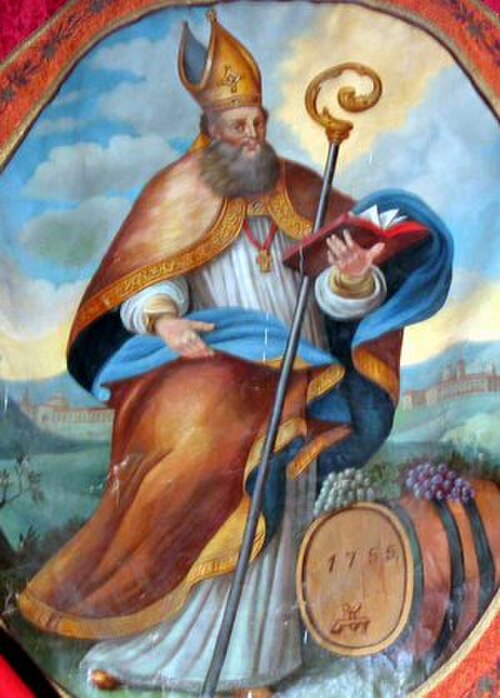
His veneration spread soon after his death. In 769 his body was moved to the monastery of St. Gall. The weather was very hot, and the men who rowed the body across the lake grew terribly thirsty; legend tells that the one barrel of wine they had never emptied, however much they drank. For this reason the wine barrel became the saint's attribute in icons, where he is shown as an abbot in priestly vestments, with a staff and sometimes the Gospel.
His veneration was officially recognized in 864 by Solomon I, bishop of Constance, and in 867 his relics were solemnly laid in the new church of Saint Othmar at St. Gall. The deacon Gozbert wrote his first life around 830, and Walafrid Strabo wrote another in 834-838. A chapel built in the tenth century on the island of Werd marks the place of his first burial, and the cathedral of St. Gallen is dedicated to Saint Gall and Saint Othmar. Pilgrimages to him remain alive in southern Germany and Switzerland. By an old custom, the clothes of sick children were blessed on his relics and then worn for nine days. The Catholic Church commemorates him on 16 November, and in the Russian Orthodox Church he has been locally venerated in the diocese of Berlin and Germany since 2006, on 29 November.
Commemorated the same day November 16
 MatthewApostle · Apostle and EvangelistNov 16
- Philoumenos HasapisHieromartyr · Abbot of Jacob's WellNov 16
 Fidentius of PaduaMartyrNov 16
 Sergius of Malaya PinegaVenerable · HieroschemamonkNov 16
- Africus of CommingesSaint · Bishop of CommingesNov 16
 Michael AbramovHieromartyr · ArchpriestNov 16
- Akylina of DramaVenerable · Abbess in DramaNov 16
- Aelfric of AbingdonSaint · Archbishop of CanterburyNov 16
- AfanSaintNov 16
- Ananias BoykovMartyrNov 16
 Anianus of AstiSaint · Bishop of AstiNov 16
- AugustineMartyr · Martyr of CapuaNov 16