Saint
Gennadius of Astorga
Bishop of Astorga
Benedictine monk, hermit and bishop of Astorga from 899 to 920, founder of monasteries in El Bierzo; died in 936.
Life
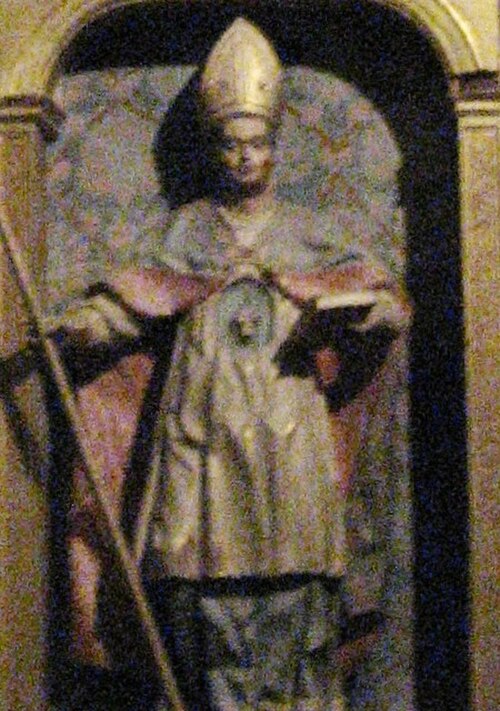
Saint Gennadius of Astorga was a Benedictine monk, hermit and bishop of Astorga from 899 to 920, founder of monasteries in El Bierzo, who died in 936. He is remembered on 24 May (until 1969, on 25 May).
He was born about the year 865, according to tradition in El Bierzo; he is sometimes thought to have been of the family of the kings of Asturias. He first struggled in a monastery at Ayoó de Vidriales, where he came to know the life of Saint Fructuosus, who had lived two centuries earlier (died 665) and who inspired him. He went to the Aquilianos mountains, harsh and sparsely inhabited, with deep snow in winter, where Fructuosus had laboured, and began to restore the monastery of San Pedro de Montes, linked with the name of Fructuosus. In its restoration the Mozarabic artistic style was much used, a synthesis of European and Islamic motifs. When the monastery was restored, Gennadius was appointed abbot, by decision of Bishop Ranulfus of Astorga. A year later he succeeded Ranulfus in the see, yielding to the request of King Alfonso the Great, a relative of his by some accounts. He is held to have lived very little at Astorga, continuing his struggle in the monastery. In his more than twenty years as bishop he restored or founded other churches and monasteries, among them Santiago de Peñalba, using the Mozarabic style.
He was a very learned man for his time. He gathered a library, which at his death he left to the churches and monasteries he had founded, to be used in common by their monks and clerics. He was also interested in chess and owned a chess set of which three ivory pieces survive, called the “Bolos de San Genadio,” in the sacristy of the church at Ponferrada, the oldest surviving chess pieces in Europe. In 920 he resigned the episcopate of his own will and withdrew into a cave in the mountains, at a place called the Valley of Silence (Valle del Silencio), where he spent sixteen years in prayer and solitude. He died in 936 at Peñalba de Santiago. His veneration came quickly, with pilgrimages to the caves where he lived, from which the faithful took earth believed to heal. His memory was removed from the calendar of saints in 1969, in the liturgical reforms, for lack of an official canonization. He is also regarded as the first saint associated with chess. He is honoured above all at Astorga and Ponferrada and at the monastery of San Pedro de Montes.
Commemorated the same day May 24
 Vincent of LérinsVenerable · Monk and writer at LérinsMay 24
 Simeon Stylites the YoungerStylite · of the Admirable MountainMay 24
 Donatian and RogatianHoly MartyrsMay 24
 Zvenislava of PolotskVenerable · Daughter of the Prince of PolotskMay 24
- Blandina of IașiConfessor · Teacher and confessorMay 24
- 318 Fathers of the First Ecumenical CouncilSaintMay 24
- AedesiusSaintMay 24
 Afra of AugsburgMartyrMay 24
- Afra of BresciaMartyrMay 24
- AgatharchusSaint · Bishop of LefkadaMay 24
- Aidhbe of Tir da GlassSaintMay 24
- Anđa SočicaNew MartyrMay 24