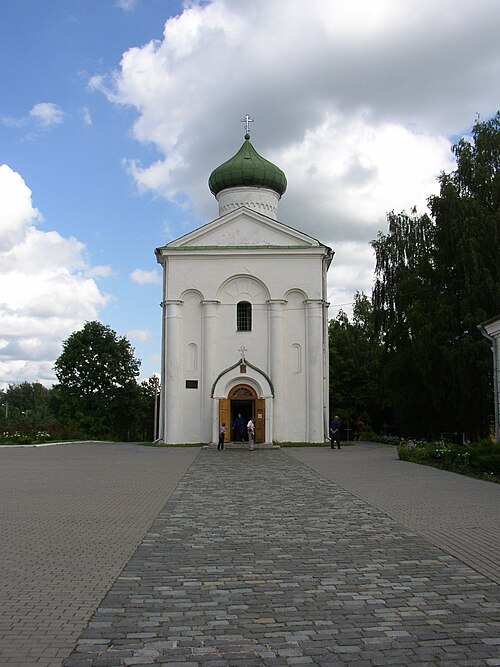
Venerable
Zvenislava of Polotsk
Daughter of the Prince of Polotsk
Only daughter of Prince Boris of Polotsk, an enlightener, who became a nun under the name Eupraxia.
- Feast
- May 24old style June 6
- Reposed
- 120213th century
- Place
- Polatsak
- Order
- Venerables
Life
Venerable Zvenislava of Polotsk (in monasticism Eupraxia, after 1110 or before 1127 until after 1173) was the only daughter of Prince Boris (Rogvolod) Vseslavich of Polotsk, an enlightener, tonsured in the Saviour monastery in Polotsk and disciple and helper of Saint Euphrosyne of Polotsk, whose Life she probably wrote. She is commemorated on 24 May (Old Style). The Russian source says only that, according to some data, she was canonized by the Orthodox Church; it gives neither the date nor the circumstances. Reports about her life are scanty.
Life
She was a few years younger than her cousins, Euphrosyne of Polotsk and Gordislava. After her father's death, in 1128, she was exiled with the princely family to Byzantium. Returning, under Euphrosyne's influence she was tonsured in the Saviour monastery at Polotsk, with the name Eupraxia, where she lived under her care and in time became helper of Abbess Euphrosyne. It is supposed that she directly led the work of the nuns in copying books and gave lessons at the school for the daughters of the people of Polotsk.
Later, about 1169, she went on pilgrimage to Jerusalem with Euphrosyne and her brother David Svyatoslavich, where Euphrosyne died in her arms in 1173. She took on the care of the burial. At Euphrosyne's request on her deathbed, Eupraxia brought home her cross, in which, with the blessing of the Patriarch of Jerusalem, had been inlaid particles of the Most Pure Blood and of the Life-giving Cross, a stone from the Tomb of the Mother of God and particles of the relics of Saint Stephen the first martyr, Saint Demetrius of Thessalonica and Saint Panteleimon.
Eupraxia is probably the author of the "Life of Euphrosyne of Polotsk", a hagiographic work of the twelfth century, begun perhaps soon after the burial. In the Life, wide space is given to the abbess's teachings to the sisters, her prayers rendered word for word and praise of her spiritual labours; it is clear from the work that a nun wrote it. In the part about the pilgrimage to Jerusalem many details are listed, so the author was present with Euphrosyne. Biographical dictionaries often give 1202 as Eupraxia's year of death, but the chronicle entry for that year concerns another person, and the date of her death is not known precisely.
Commemorated the same day May 24
 Vincent of LérinsVenerable · Monk and writer at LérinsMay 24
 Simeon Stylites the YoungerStylite · of the Admirable MountainMay 24
 Gennadius of AstorgaSaint · Bishop of AstorgaMay 24
 Donatian and RogatianHoly MartyrsMay 24
- Blandina of IașiConfessor · Teacher and confessorMay 24
- 318 Fathers of the First Ecumenical CouncilSaintMay 24
- AedesiusSaintMay 24
 Afra of AugsburgMartyrMay 24
- Afra of BresciaMartyrMay 24
- AgatharchusSaint · Bishop of LefkadaMay 24
- Aidhbe of Tir da GlassSaintMay 24
- Anđa SočicaNew MartyrMay 24