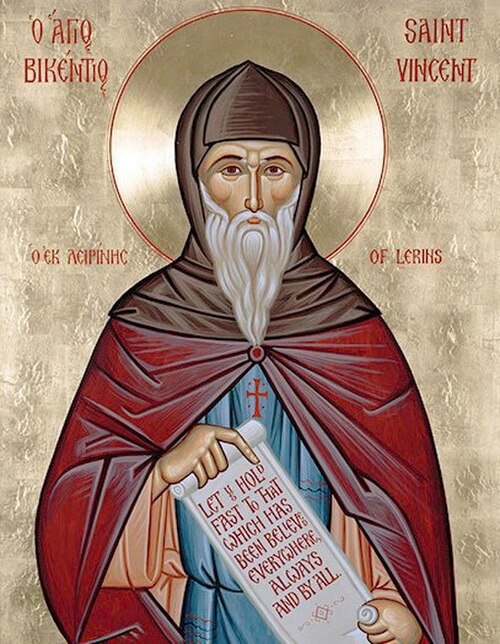
Venerable
Vincent of Lérins
Monk and writer at Lérins
Gallic monk of the fifth century, author of the Commonitorium, a work on preserving sound teaching.
- Feast
- May 24old style June 6
- Reposed
- 4455th century
- Place
- Lérins Islands
- Order
- Venerables
Life
Saint Vincent of Lérins was a monk and priest of Gaul in the fifth century, and the author of the Commonitorium, a short work on how to tell the faith handed down from the Fathers from heretical novelty. He is remembered as a saint of the undivided Church. His memory is kept on 24 May, and the Russian Orthodox Church added him to its calendar in 2017.
His life
Little is known of his life. The main source is Gennadius of Marseille, who wrote his book On Famous Men about the year 495. The sources disagree about Vincent's birthplace: the Orthodox Church in America names Toul in the north-east of Gaul, and others say Toulouse. He is believed to have been the brother of Saint Lupus of Troyes. Before the monastic life he served in what he himself calls the secular service, which probably means the army.
He entered the monastery of Saint Honoratus on the island of Lérins, off the southern coast of Gaul, a great centre of asceticism and study from which many bishops came. There he was tonsured and ordained a priest. Saint Eucherius of Lyons called him a holy man, conspicuous for his eloquence and knowledge. Vincent calls himself the least of all the servants of God. Gennadius says that he died in the reign of Theodosius II in the East and Valentinian III in the West, so in or before 450, and the Orthodox Church in America gives about 445. His relics are kept at Lérins.
The Commonitorium
About 434, three years after the Council of Ephesus, Vincent wrote the Commonitorium under the pen name Peregrinus. He wished to have in writing, for himself and others, a general rule by which to tell the truth of the Church from heresy. His best known sentence says that in the Church one must hold what has been believed everywhere, always and by all. He also defended the title Theotokos for the Mother of God against Nestorius, whose teaching Ephesus had condemned.
Vincent also wrote that the teaching of the Church grows without changing, as the body of a man grows over the years and stays the same body. The Russian Orthodox commentary on his life notes that, for the Orthodox, this need not mean a development of dogma in the Roman Catholic sense: the same faith is only put into other words as circumstances demand.
The question of grace
Vincent is often suspected of semi-Pelagianism. The monks of southern Gaul, Lérins among them, thought Augustine's teaching on predestination left no place for human effort. Semi-Pelagianism, which sought a middle way, was condemned at the Second Council of Orange in 529. Vincent's Commonitorium does not contain this teaching, though he does not name Augustine in his list of the teachers of the Church. Some scholars attribute to him the lost Objections of Vincent, to which Prosper of Aquitaine replied, but this is debated.
Commemorated the same day May 24
 Simeon Stylites the YoungerStylite · of the Admirable MountainMay 24
 Gennadius of AstorgaSaint · Bishop of AstorgaMay 24
 Donatian and RogatianHoly MartyrsMay 24
 Zvenislava of PolotskVenerable · Daughter of the Prince of PolotskMay 24
- Blandina of IașiConfessor · Teacher and confessorMay 24
- 318 Fathers of the First Ecumenical CouncilSaintMay 24
- AedesiusSaintMay 24
 Afra of AugsburgMartyrMay 24
- Afra of BresciaMartyrMay 24
- AgatharchusSaint · Bishop of LefkadaMay 24
- Aidhbe of Tir da GlassSaintMay 24
- Anđa SočicaNew MartyrMay 24