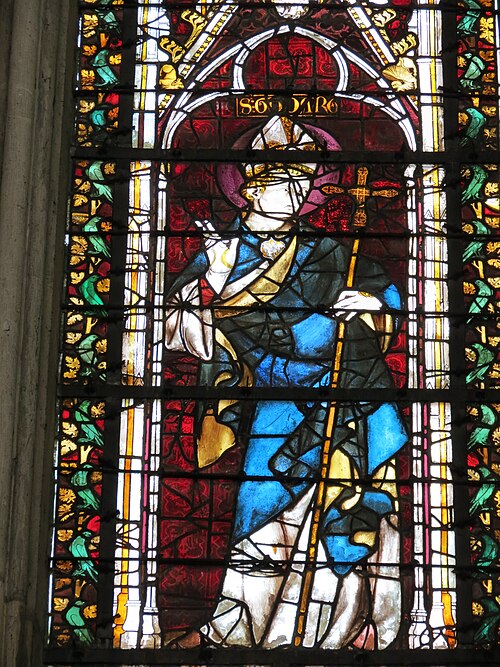
Saint
Gildard of Rouen
Bishop of Rouen
Bishop of Rouen from 488 to 525, closely linked with Saint Medard.
Life
Saint Gildard (Godard) was bishop of Rouen between 488 and 525 and is commemorated on 8 June as a confessor. His name is closely bound to that of Saint Medard, whom tradition regarded as his brother.
According to legend, Gildard and Medard were twins, born to the noble Frank Nectard and the Gallo-Roman Protagia, who brought her husband to Christianity. The story appears in the Life of Medard attributed to Pseudo-Fortunatus, from which it passed into later literature, sermons, hymns, martyrologies and the "Golden Legend". Earlier versions of the Roman Martyrology say that they were born on the same day, consecrated bishops on the same day and died on the same day, 8 June 560. The fact of kinship is as hard to prove as to refute; it does not fit the chronology, for in 511 Gildard attended the First Council of Orléans, convoked by Clovis I, while Medard was consecrated only in 530. Alban Butler says he governed the see of Rouen with great zeal for fifteen years.
He seems to have been bishop of Rouen from 488 to 525. The Brockhaus and Efron encyclopaedia says that he converted many pagans of his diocese and helped Saint Remigius to persuade King Clovis to accept baptism. The date of his death is uncertain, somewhere between 511 and 538. He was buried in the chapel of the Virgin Mary at Rouen, which was afterwards named after him, and then in Rouen Cathedral.
Between 838 and 841, because of the danger from the Normans, his relics were taken to the abbey of Saint-Médard at Soissons, where they remain. According to Felice Lifshitz, his veneration is due chiefly to the link with Medard: before the belief in brotherhood, there was no cult of Gildard and his relics lay in the church of Notre-Dame near Rouen without drawing attention. When the monks of Saint-Médard discovered the link, they persuaded King Charles the Bald that the brothers be united in death. The people of Rouen were not glad to lose their saint and proposed that the monks leave them the head of Gildard in exchange for the head of Romanus of Rouen or the whole body of Remigius of Rouen. At Soissons Gildard first received a written tradition and his cult was promoted. This move is thought to have given rise to the legend of their kinship.
Churches named for both include Saint-Médard-et-Saint-Gildard at Crépon (Calvados), of the twelfth to fourteenth century, the one at Fel (Orne), of the twelfth century, and the parish church of Little Bytham in Lincolnshire, dating from the Anglo-Saxon period, the only one in Britain that bears their name.
Commemorated the same day June 8
 Medard of NoyonSaint · Bishop of NoyonJun 8
 Clodulf of MetzSaint · Bishop of MetzJun 8
 Melania the ElderVenerable · Roman asceticJun 8
 Ephrem of AmidaSaint · Patriarch of AntiochJun 8
 Victorinus of CamerinoSaint · Bishop of CamerinoJun 8
 Theodore of RostovSaint · First Bishop of RostovJun 8
- CalliopeMartyrJun 8
- Heraclius of SensSaint · Bishop of SensJun 8
- Theodore of KveltaHieromartyr · Georgian priestJun 8
- AthreVenerableJun 8
- Bron of Cassel-IrraSaint · Bishop of Cassel-IrraJun 8
- Ermedhach of CongaVenerableJun 8