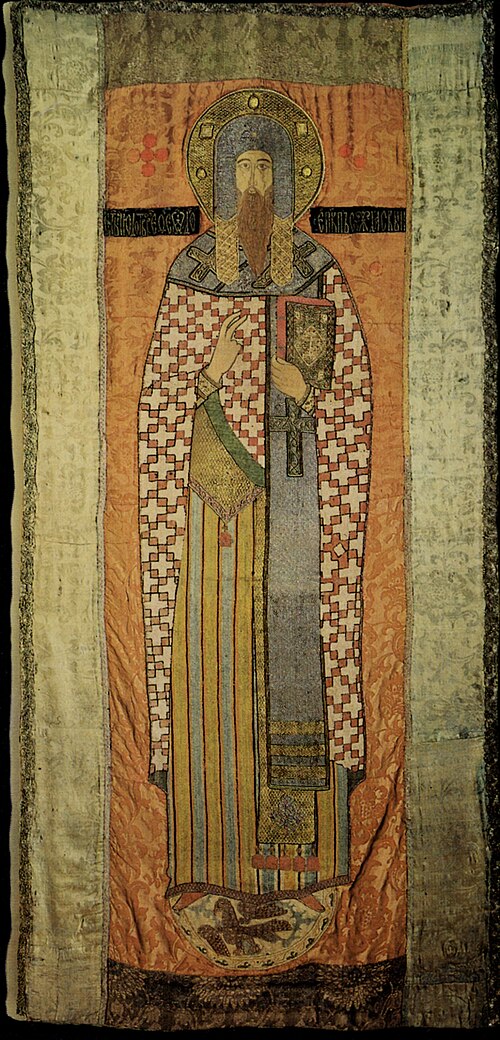
Saint
Theodore of Rostov
First Bishop of Rostov
First Bishop of Rostov and Bishop of Suzdal, who died before 1023; honored in the Synaxis of the Saints of Rostov and Yaroslavl.
Life
Saint Theodore I was the first bishop of Rostov and bishop of Suzdal, who died before the year 1023 (according to another testimony, around 1024). The Russian Church honours him among the hierarchs. He is commemorated on 8 June, on 23 May, in the Synaxis of the Saints of Rostov and Yaroslavl, and on 23 June, in the Synaxis of the Saints of Vladimir (by the old calendar).
Beginnings at Rostov
He was Greek by birth and came from Constantinople to Kiev in the retinue of the first metropolitan of Kiev, Michael. In 990 or 992 he was consecrated bishop of Rostov. He built an oaken church in the city in honour of the Dormition of the Mother of God. The preaching of Christianity which he began was received with hostility by the pagans. The Book of Degrees says that the saint grew weary because of the obstinate pagans and unbelieving people who would not accept baptism.
At Suzdal
The saint withdrew from Rostov to Suzdal, then a small settlement. An inscription of 1635 in the sacristy of the Nativity cathedral in Suzdal says that Saint Theodore, receiving the flock of rational sheep in the Suzdal land and seeing it darkened, began to sow the seed of the word of God, overthrowing the idol shrines and building and adorning holy churches to the glory of God. The people, seeing his God-pleasing life and meek character and hearing his God-inspired teaching, marvelled greatly, turned to the faith of Christ and received holy baptism.
In 1010, when Saint Boris became prince of Rostov, Theodore returned to Rostov. After the murder of Boris, the hierarch was driven out of the city again and returned to Suzdal, where he reposed around 1024.
Veneration
He was buried in the Nativity cathedral in Suzdal, and his relics were found before the invasion of Batu. It is not known when the local veneration of the saint began. In the second half of the sixteenth century his tomb was covered with a pall embroidered with a prayer addressed to him, in which he was called a great wonderworker.
In the middle of the eighteenth century doubts arose about the state of the relics. Bishop Porphyry (Kraisky) of Rostov asked the Holy Synod in November 1751 to carry out an examination, but on 27 August 1755 he received the answer that Theodore and John were Orthodox hierarchs, pious pastors in the Suzdal land, that after the end of their lives they had remained and still remained incorrupt, and that they had been honoured as saints by their successors and by the people throughout this time. For this reason no new examination was necessary, and the relics were to remain as they were.
In 1794 Theodore's relics were placed in a reliquary of gilded silver by the iconostasis of the Suzdal cathedral. On 20 August 1879 they were moved, by decision of the Holy Synod, into a new silver reliquary, and in honour of this a local feast was established. In 1998, because of the dangerous condition of the Nativity cathedral, the saint's relics were taken to the Kazan church in Suzdal. In 2023 the diocese of Vladimir solemnly celebrated one thousand years since the repose of Saint Theodore.
Commemorated the same day June 8
 Medard of NoyonSaint · Bishop of NoyonJun 8
 Clodulf of MetzSaint · Bishop of MetzJun 8
 Melania the ElderVenerable · Roman asceticJun 8
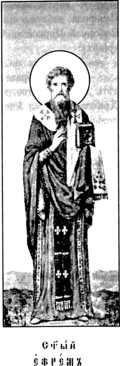 Ephrem of AmidaSaint · Patriarch of AntiochJun 8
 Gildard of RouenSaint · Bishop of RouenJun 8
 Victorinus of CamerinoSaint · Bishop of CamerinoJun 8
- CalliopeMartyrJun 8
- Heraclius of SensSaint · Bishop of SensJun 8
- Theodore of KveltaHieromartyr · Georgian priestJun 8
- AthreVenerableJun 8
- Bron of Cassel-IrraSaint · Bishop of Cassel-IrraJun 8
- Ermedhach of CongaVenerableJun 8