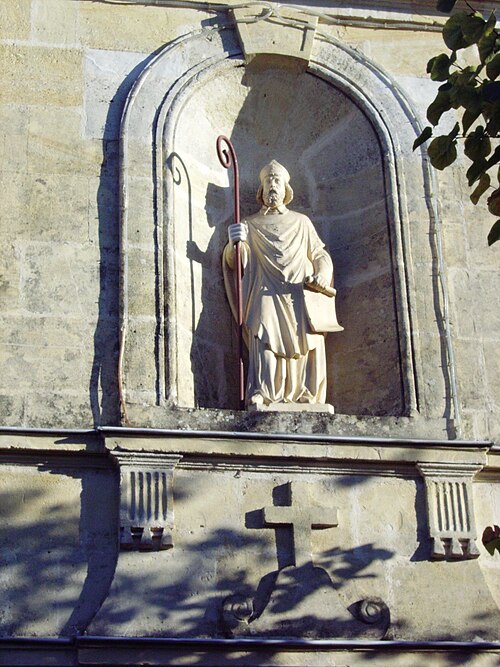
Saint
Medard of Noyon
Bishop of Noyon
Bishop who moved the seat of the diocese from Vermand to Noyon, much honored in his own time.
Life
Saint Medard of Noyon, hierarch, was a bishop who moved the seat of the diocese from Vermand to Noyon, among the most honoured bishops of his time. He is commemorated on 8 June.
Beginnings
Medard was born around 456 or 470, at Salency, in Picardy, the son of Nectarius, a noble of Frankish stock, and Protagia, Gallo-Roman and Christian, who brought her husband to the faith. From youth he was devout; according to tradition, once he gave his clothes to a blind man, and another time he gave a traveller his father’s horse. The villagers often came to him for counsel. At first he went to the village school, then studied at Vermand and Tournai. He lived in the time just after the fall of the Western Roman Empire; the Frankish king Clovis united in those times several Germanic states into a kingdom of the Franks.
Bishop
Medard was ordained at thirty-three, and his piety and learning, great for that time, led Bishop Alomer of Vermand to ordain him. When Alomer died, in 530, Medard was chosen bishop. He refused, but the people insisted and he accepted the responsibility. It is said that in 531 he moved the seat of the bishopric from Vermand, a little city without walls, to Noyon, the strongest city of the region. He was counsellor to King Clotaire, who dwelt at Soissons. In 532, at the death of Eleutherius, bishop of Tournai, he was called to direct that diocese also. He refused at first, but at Clotaire’s insistence accepted. The union of the dioceses of Noyon and Tournai lasted until 1146. Tournai was a center for preaching among the pagan Flemings. There he received Radegund of Thuringia as deaconess and nun, until she moved to her own foundation at Saix.
Repose
King Clotaire, who had paid him a last visit at Noyon, where the bishop died, had his body moved to his own manor at Crouy, at the gates of Soissons. There, over the tomb, was raised the celebrated Benedictine abbey that bears his name, Saint-Médard. His death is placed in 545, 558 or 560, on 8 June.
Veneration
Medard was one of the most honoured bishops of his time. His veneration spread first in northern France, then to Cologne and western Germany, and he became the hero of many legends. He is mentioned by Venantius Fortunatus and Gregory of Tours. In France fifty-eight places bear his name, and in Paris a church in the Latin Quarter. It is believed that the weather of his day, as with Saint Swithun, lasts forty days afterwards, unless it changes on the feast of Saint Barnabas, 11 June. He was often shown laughing, with his mouth wide open, and so is invoked for toothache. He is patron of vineyards, brewers, captives and prisoners, the mentally ill and peasants. Both the Catholic and the Orthodox Church honour him. A late legend makes Saint Gildard, bishop of Rouen, his twin brother.
Commemorated the same day June 8
 Clodulf of MetzSaint · Bishop of MetzJun 8
 Melania the ElderVenerable · Roman asceticJun 8
 Ephrem of AmidaSaint · Patriarch of AntiochJun 8
 Gildard of RouenSaint · Bishop of RouenJun 8
 Victorinus of CamerinoSaint · Bishop of CamerinoJun 8
 Theodore of RostovSaint · First Bishop of RostovJun 8
- CalliopeMartyrJun 8
- Heraclius of SensSaint · Bishop of SensJun 8
- Theodore of KveltaHieromartyr · Georgian priestJun 8
- AthreVenerableJun 8
- Bron of Cassel-IrraSaint · Bishop of Cassel-IrraJun 8
- Ermedhach of CongaVenerableJun 8