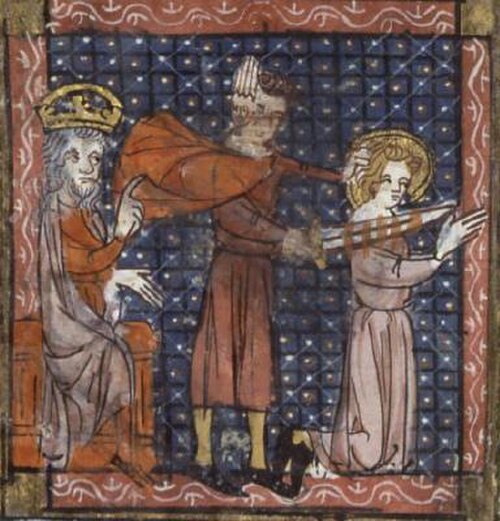
Martyr
Gordianus
Martyr of Rome
Roman martyr killed in 362 under Julian the Apostate; remembered on 10 May.
Life
The holy martyr Gordianus was a Christian of Rome, put to death in 362, in the time of the Emperor Julian the Apostate. He is commemorated by the Roman Catholic Church on 10 May, and in the Orthodox calendar on 9 May, together with Epimachus.
The inscription on his tomb contrasts his youth with his mature faith. Later Acts of his martyrdom make him a pagan and a judge. He was charged with forcing Januarius to make a sacrifice to the emperor, but instead was persuaded and converted to Christianity, with many of his household. Accused before his successor or, according to others, before the prefect of the city, Apronianus, he was tortured and finally beheaded. The Christians took his body and laid it in a crypt on the Latin Way beside the body of Epimachus of Alexandria, who had recently been buried there. The two saints gave their name to the cemetery and have been venerated together ever since. According to the historian David Farmer, these Acts are historically "worthless".
The Orthodox Synaxarion says that Epimachus and Gordianus were Romans who boldly confessed Christ, were compelled by the ruler of the city to sacrifice to idols and, refusing, were tortured and beheaded. Their synaxis is held in the church of the martyr Stratonicus.
Later the remains of Gordianus were moved to the Cyriaca cemetery, where they lay until the 1670s, when an Augustinian monk named Ambrose removed them and gave them to the Jesuit priest Christopher Anderson. They came to the Jesuit College of Saint-Omer, and when it moved to Stonyhurst in England, the remains travelled with it and are kept there beneath the altar of the Sodality Chapel. The bones were removed for a time in 2006, when the chapel was restored, and have since been returned. Other parts of the relics of the two saints were taken to Kempten in Bavaria, where the princely abbey founded in 752 was dedicated to the Virgin Mary, Gordianus and Epimachus; according to one tradition the move was made by Queen Hildegard, wife of Charlemagne. There is a church dedicated to Gordianus at Saint-Paul-d'Oueil in France.
Commemorated the same day May 9
 IsaiahProphet · The ProphetMay 9
 ChristopherMartyr · of LyciaMay 9
 Gerontius of CerviaSaint · Bishop of CerviaMay 9
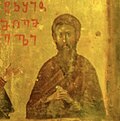 Shio of MgvimeVenerable · One of the Assyrian FathersMay 9
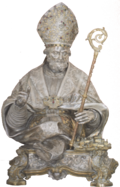 Priscus of NoceraSaint · First bishop of NoceraMay 9
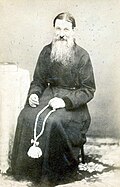 Joseph of OptinaVenerable · Elder of OptinaMay 9
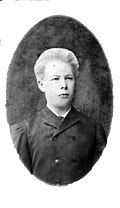 Demetrius VoskresenskyHieromartyr · PriestMay 9
- Hieronymos of SimonopetraVenerable · Monk of SimonopetraMay 9
- AdalgarSaint · Archbishop of Hamburg-BremenMay 9
- AquilinaMartyrMay 9
- BanbanVenerableMay 9
- Basil KolosovHieromartyrMay 9