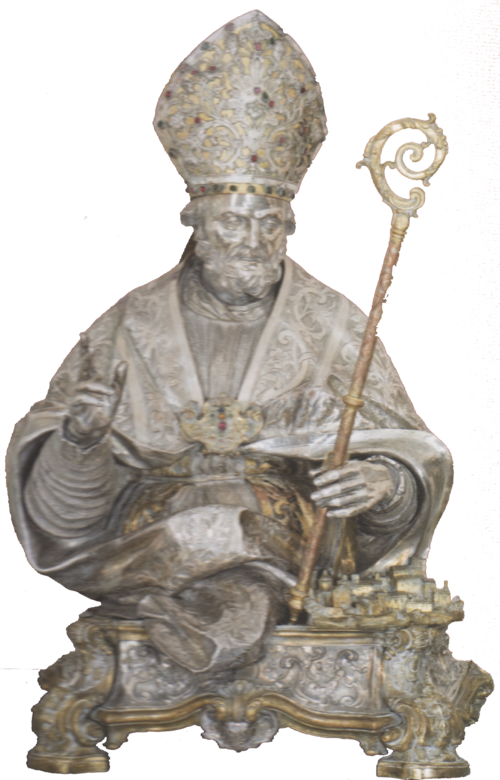
Saint
Priscus of Nocera
First bishop of Nocera
First bishop of Nocera, patron of Nocera Inferiore and its diocese, in the 3rd century.
Life
Saint Priscus (Prisco) of Nocera was, according to tradition, the first bishop of Nocera (Nuceria Alfaterna) in Campania, and is patron of the city of Nocera Inferiore and of the diocese of Nocera Inferiore-Sarno. He is venerated above all in the Roman Catholic Church and commemorated on 9 May, a day of great celebration in the city. The facts of his life are uncertain: a nineteenth-century scholar, Vincenzo D'Avino, says plainly that there is no certain proof of his life.
The sources
The first author who writes of his veneration is Bishop Paulinus of Nola, who in Poem 19 speaks of the cult of Saint Priscus being practised in 405 at Nola, as well as at Nuceria Alfaterna. His testimony is a terminus ante quem and helps to date the life of Priscus. Paulinus says that the day on which the holy font shone was the birthday into heaven of Priscus, whom Nola celebrates, though he was bishop in another city, Nuceria. Another author, Saint Ado of Vienne, mentions him in his Martyrology. On this basis some authors counted him among the seventy apostles, in whose house the Last Supper was held, and placed him in the first century, come directly from Jerusalem; but ten saints bear this name, and in the archdiocese of Capua the first bishop was also called Priscus. Another tradition, also of the first century, says he died around 68: according to the martyrology attributed to Jerome, in the time of Nero, on 12 October Felix of Nola, Felix of Nuceria and Constantia of Nuceria were killed, and a certain Priscus on 16 October. The most usual tradition places him in the third century. Giovanni Antonio Remondini and Gennaro Orlando also wrote of him, and Ludovico Antonio Muratori is cited by D'Avino.
Miracles of popular tradition
Popular tradition ascribes many miracles to him. Accused of heresy for having celebrated the liturgy at dawn, alone, he was taken while still vested and forced to go to Rome to clear himself before the pope. Having nothing to give the pontiff as a gift, he convinced some geese to follow him to Lazio, to make a gift to Peter's successor. Angels appeared before the pope, who exonerated him entirely. Impressed by the miracle, the pontiff gave Priscus a large marble fountain, which the saint carried to Nocera with the sole help of two cows. To quench the thirst of his companions, the saint made a doe appear from nowhere, who satisfied them with her milk, warming them with burning embers she kept under her tunic. Close to death, he decided to lie in the same tomb that had received his sisters and asked their bones to move aside to make room, which was done. Tradition also mentions the miracle of the splitting of a mountain, a pass (probably a Roman work) on the border between Nocera Inferiore and Castel San Giorgio, mentioned in the historical novel of Andrea Calenda di Tavani.
Veneration
He was first buried in a tuff tomb in one of the necropolises of Nuceria Alfaterna. His body, the object of growing popular attention and then of devotion, was moved west of the ancient city, to an area that took the name vescovado, first to a Benedictine abbey. With the restoration of the diocese in 1385-1386 the abbey church was raised to a cathedral, by Pope Urban VI. Archaeological research in the cathedral of Nocera Inferiore has made fully visible again the place where the saint's remains were buried, together with those of his two sisters, Marcia and Marina, also venerated as saints. The strigilated sarcophagus recalls models of the third to fourth century, and the osteological data suit an elderly and large man. Under the main apse of the cathedral the martyrium of Saint Priscus was discovered, a semi-annular crypt. His cult is kept also at Sant'Agnello on the Sorrento coast, where in 1827 a church dedicated to Saints Priscus and Agnellus of Naples was consecrated. Some relics of his sisters are kept in a chapel in the crypt of Salerno Cathedral, placed there in the Middle Ages by Bishop Alfano I.
On the celebration of the patron of Nocera Inferiore "bubbetella", a bean soup, is eaten. The diocesan museum of Saint Priscus was opened in 2008 on the initiative of Bishop Gioacchino Illiano and keeps the silver bust of the saint, made around 1771 by the artist Saverio Manzone at the command of Bishop Benedetto dei Monti Sanfelice, restored and shown again on 13 September 2019; on 8 May 2021 a new mitre for the saint's statue was presented.
Commemorated the same day May 9
 IsaiahProphet · The ProphetMay 9
 ChristopherMartyr · of LyciaMay 9
 Gerontius of CerviaSaint · Bishop of CerviaMay 9
 GordianusMartyr · Martyr of RomeMay 9
 Shio of MgvimeVenerable · One of the Assyrian FathersMay 9
 Joseph of OptinaVenerable · Elder of OptinaMay 9
 Demetrius VoskresenskyHieromartyr · PriestMay 9
- Hieronymos of SimonopetraVenerable · Monk of SimonopetraMay 9
- AdalgarSaint · Archbishop of Hamburg-BremenMay 9
- AquilinaMartyrMay 9
- BanbanVenerableMay 9
- Basil KolosovHieromartyrMay 9