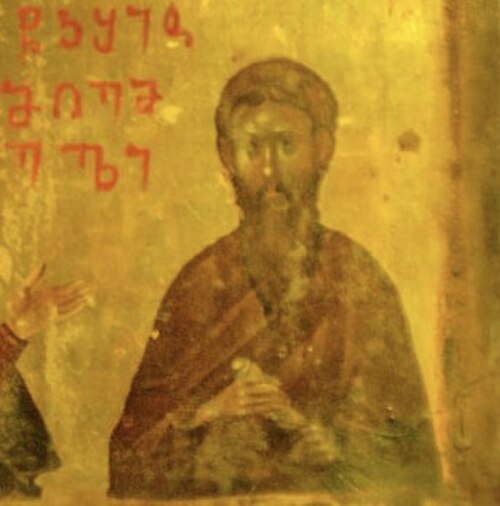
Venerable
Shio of Mgvime
One of the Assyrian Fathers
Georgian anchorite of the 6th century, one of the thirteen Assyrian Fathers, tied to Mgvime monastery.
- Feast
- May 9old style May 22
- Born
- 5506th century
- Place
- Shio-Mgvime monastery
- Order
- Venerables
Life
Saint Shio (Simeon) of Mgvime, also called Shio of the Cave (in Georgian “mgvime” means cave), was one of the thirteen Syrian (Assyrian) Fathers who came to Georgia in the sixth century. A hermit, wonderworker and founder of the famous Shio-Mgvime Monastery near Mtskheta, he is regarded as one of the founders of Georgian monasticism and one of the most beloved saints of the Georgian Church. His life has come down to us in the account of Arsen Separeli.
Childhood in Antioch
Shio was born at the end of the fifth century in Antioch in Syria (today Antakya in Turkey) to wealthy and devout parents whose names are unknown. His parents saw to his education themselves and gave him a fine Christian upbringing. By sixteen he knew Holy Scripture and the sacred books thoroughly. Fearing that too much study would harm his health, his parents often begged him to rest, and once they even took his books away, which grieved him greatly. After much pleading they gave them back, and from then on they did not restrict his freedom.
Disciple of Saint John
When he was twenty, Saint John, later known as John of Zedazeni, came to Antioch. On his advice Shio resolved to become a monk, but he feared his parents' opposition. During a Liturgy he persuaded his parents to embrace monastic life themselves. After they entered a monastery the young man gave away all the property: part to the poor, part to monasteries, and he set the slaves free. Then he went to Saint John in the desert near Antioch, where he laboured for twenty years and was ordained deacon.
Coming to Georgia
According to Church tradition, after those twenty years it was revealed to Saint John from on high that he should choose twelve disciples and go with them to Iberia (Georgia) to strengthen in the faith the Georgians converted by Saint Nino. After much prayer he chose twelve monks, Shio among them. Arriving at Mtskheta, they were warmly received by Catholicos Evlavius (533-544). They spent three years in Mtskheta and then went up Mount Zedazeni.
After two years on the mountain, according to tradition, the Mother of God appeared to Saint John together with Saint Nino and commanded him to send his disciples to different parts of the country to preach. John gathered his disciples, announced the command and took them to the catholicos for his blessing. The catholicos prayed over them and asked each to take a monk with him as helper. Only Shio, who loved the desert and solitude, asked his teacher for a blessing to live as a hermit, and John gave it.
The hermit of the cave
With the blessing of Saint John and of the catholicos, Shio set out west of Mtskheta into places made impassable by dense forest. He entered a deep, desolate and waterless gorge full of wild beasts and venomous snakes, shielded by sheer rock walls from the eyes of men. On the steep bank of the river Mtkvari (Kura) he found a narrow cave and settled there, taking no thought for food, drink or any human comfort. According to tradition he spent forty days there in fasting and prayer, eating only herbs and drinking a little water.
One day Evagrius, a courtier and commander of the fortress of Nasdaki, born of Christian parents, went hunting with his children and servants and came near the place where Shio lived. As he waited, he saw a dove carrying food in its beak and flying into a cave. The next day he saw the same thing again. Amazed, he approached the cave and saw a man praying on his knees with his hands raised to heaven.
After speaking with Shio, Evagrius gave his property to the poor and left the world and his family. Shio clothed him in the schema and taught him how to deny himself and follow Christ, when to pray, when to stand, when to work and when to rest, and then showed him a cave near his own where he should begin his struggle. From then on Shio's name became known throughout the region. Many came to him and became monks, each cutting a cave for himself near that of Evagrius. Shio came out to the brethren only on Sundays to teach them, and the rest of the time remained alone in his cave.
The spring and the church
Tradition tells that once a monk carrying water from far away fell and broke his jar, and stood weeping bitterly over it. Shio, full of compassion for his brother, saw an angel standing by the rock and digging as if with a spear, and water at once began to flow from the rock. There were then twenty-five brethren, and from then on they had water without toil.
The community grew, but the brethren had no church for common worship. When they asked his blessing to build one, Shio went up with them to the top of a nearby mountain to the east and prayed with tears, on his knees, that God would show them the place. After long prayer he asked for burning coals, placed them with incense in the palm of his left hand, signed them with the cross and told the brethren to raise their hands to heaven and sing “Kyrie eleison”. The singing lasted about an hour. The smoke of the incense rose high, then turned from east to west, towards the gorge with the monks' caves, and there rose again like a pillar.
Shio went ahead of the brethren to that place, holding the burning coals in his left hand. They understood that the Lord Himself had chosen the place for the church. The incense burned in the saint's palm for two hours; after censing the brethren he laid the coals down, struck the ground three times with a pick beneath the pillar of smoke and ordered the church to be built there. The first church raised was dedicated to Saint John the Baptist.
The royal foundation
King Pharsman VI (542-557) came to the desert to see his former favourite, Evagrius, and bowed with reverence before Shio. He gave land for the monastery and much money for building churches. Several churches were raised, the main one dedicated to the Dormition of the Mother of God. When they were finished Evagrius informed the king, who asked Catholicos Macarius (553-569) to come with the bishops at Pentecost to consecrate them. On the appointed day the king came with his nobles, along with Saint John of Zedazeni and other holy fathers, and the catholicos with the bishops consecrated the churches over the course of a week. The king and the whole assembly begged Shio to accept the priesthood, but he, a deacon since his days in the desert of Antioch, firmly refused. According to tradition the brotherhood grew to two thousand monks.
Seclusion
At one time Saint John of Zedazeni wished to visit his disciples to see how far each had advanced spiritually. He came with his disciple, the deacon Elias, to Shio's monastery, where the brethren met him and led him into the church of the Mother of God. After three days, assured of the height of their life, he returned to his mountain. Shio followed him up the mountain, fell at his feet and begged to be allowed to complete his struggle of stillness by shutting himself up in a cave. John blessed him.
Shio took leave of the brethren, asking them to remember him in their prayers, then went to Mtskheta, where he prayed with tears in the patriarchal church and asked the catholicos for his blessing. The catholicos sighed and wept, seeing the sacrifice he was offering out of love for the Lord. His disciples pleaded with him not to go down into the cave and leave them orphans, but he wrote them a hundred and sixty instructions, which are preserved to this day, and withdrew into a deep cave like a well, some twelve metres down.
There, according to tradition, he attained the perfection of the great ascetics. His body was worn away by fasting, labours, vigils and the dreadful damp of the cave; his face turned completely black and nothing remained of him but skin and bones. The historian Mikhail Sabinin believed that this was why so many pilgrims came, many of whom became monks.
Repose
According to Arsen Separeli, the Lord announced to him through an angel the day of his departure from the body. Learning this, Shio asked for a priest with the Holy Gifts, who was lowered into the cave on a rope. Saint John hastened to be with his beloved disciple in his last moments. Shio asked that his body be left in the cave where he had ended his life. The brethren lowered several devout elders, led by Saint John and Saint Evagrius, who clothed him in his own garments and buried him there with tears and prayers, while the other brethren, gathered from all the caves, prayed around the mouth of the cave. According to Serbian sources he reposed on 9 May 559.
The Shio-Mgvime Monastery
After his death the monastery quickly became a lively centre of cultural and religious life under the patronage of the catholicoi of Georgia. The cave in which he first lived was turned into a church around the ninth century. King David IV the Builder (1089-1125) made the monastery a royal domain and gave it a typikon in 1123. The fall of the united Georgian kingdom and continual invasions brought it into decline. King George VIII (1446-1465) granted it to the Zevdginidze-Amilakhvari family, who used it as their burial place until the 1810s.
The monastery was devastated by the Persians of Shah Abbas I (1614-1616), restored by Prince Givi Amilakhvari in 1678, destroyed again in 1720 during the Ottoman occupation, restored in 1733 and destroyed by the Persians once more less than two years later. Each time it was raised up again.
Veneration
The relics of Saint Shio were kept in the monastery, in the church of the Nativity of Saint John the Baptist, until the establishment of Soviet power, when most of them were burned by the godless. What remains is venerated to this day as the protection of the monastery. The Georgian Church commemorates him on 9 May (22 May in the New Style) and honours him together with the other Syrian Fathers as a founder of Georgian monasticism and of the strict hermit life.
Commemorated the same day May 9
 IsaiahProphet · The ProphetMay 9
 ChristopherMartyr · of LyciaMay 9
 Gerontius of CerviaSaint · Bishop of CerviaMay 9
 GordianusMartyr · Martyr of RomeMay 9
 Priscus of NoceraSaint · First bishop of NoceraMay 9
 Joseph of OptinaVenerable · Elder of OptinaMay 9
 Demetrius VoskresenskyHieromartyr · PriestMay 9
- Hieronymos of SimonopetraVenerable · Monk of SimonopetraMay 9
- AdalgarSaint · Archbishop of Hamburg-BremenMay 9
- AquilinaMartyrMay 9
- BanbanVenerableMay 9
- Basil KolosovHieromartyrMay 9