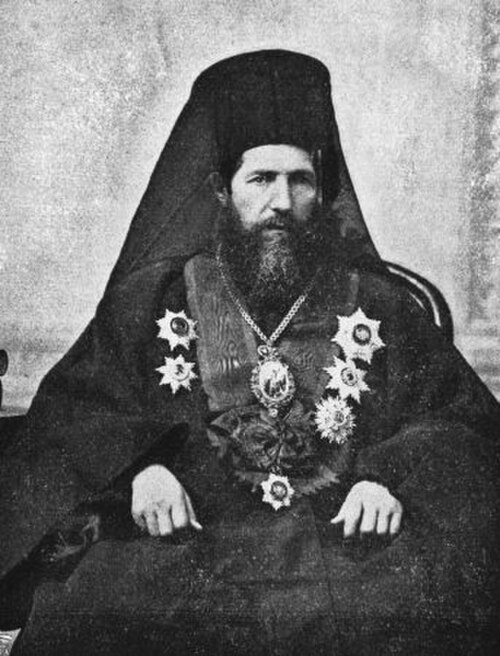
Venerable
Gregory Kallidis
Venerable of Thessaloniki, born in 1844 and died in 1925.
- Feast
- June 29old style July 12
- Reposed
- 192520th century
- Place
- Thessaloniki
- Order
- Venerables
Life
Saint Gregory Kallidis (1844 to 1925) was a Greek hierarch from Eastern Thrace, successively metropolitan of Trebizond, of Thessaloniki, of Ioannina and, last, of Heraclea and Rhaidestos. He lived in the time when the Ecumenical Patriarchate, under Ottoman rule, had to keep the Orthodox Greeks safe against the Uniates and the Bulgarian Exarchate. He fell asleep at Thessaloniki and was numbered among the saints by the Ecumenical Patriarchate in 2003. His relics, taken up in 1979, are fragrant and are venerated in the church of Saint Demetrius at Thessaloniki.
Childhood and studies
He was born on 24 January 1844 at Chrysamvelo (Koumbao), in the district of Heraclea in Eastern Thrace, today in Turkey. From childhood he showed an inclination to the priesthood and entered the service of Metropolitan Meletios Theophilidis, first of Selymbria, then of Serres. He finished his elementary studies at Serres, and on 26 February 1862 he was ordained deacon, at the church of the Holy Theodores at Serres, by his confessor and teacher, Metropolitan Meletios. He completed his studies at the Rizarios school and at the Faculty of Theology of the University of Athens. At Athens, Metropolitan Theophilos Vlachopapadopoulos named him his archdeacon, valuing his personality and qualities.
The bishop
In 1873 he was at Rhaidestos, and in 1874 he was protosyncellus of Metropolitan Panaretos of Heraclea and preacher, until he received the third degree of priesthood, as bishop of Nazianzus, on 24 March 1875, consecrated on 30 March by Metropolitan Zacharias of Selymbria together with Bishops Gregory of Myriophyton and Dositheos of Metra. In 1879, in the time of the Bulgarian Exarchate, he was sent by the Patriarchate to Adrianople as exarch. After three months he was elected, on 12 May 1879, metropolitan of Trebizond. There he took measures to defend the faithful against newly settled Turkish refugees and to ease their taxes. He succeeded in taking over the management of the three formerly stavropegial monasteries, Soumela, Vazelon and Peristereota.
On 29 December 1884 he was elected metropolitan of Thessaloniki, and on 20 March 1885 he was enthroned. At the time the so-called "communal question" of Thessaloniki was at its height, with fierce quarrels, which led to his transfer after a short time. Metropolitan Gregory, resigning, put himself at the disposal of the Great Church. On 28 September 1889 he was elected metropolitan of Ioannina, where he was from 1889 to 1892, then at Constantinople, as chairman of the board of the printing house, of the board of monastic properties, member of the board of the seminary at Halki and chairman of the church court. In May 1894 he returned to Ioannina. In the Greco-Turkish war of 1897, together with the Greek consul general, he succeeded in saving the city of Ioannina from plunder.
On 22 May 1902 Ecumenical Patriarch Joachim III transferred him to the ancient metropolis of Heraclea and Rhaidestos, with seven votes against Metropolitan Anthimos of Amasia (four) and Constantius of Berroia (one). At Rhaidestos he showed great activity for the development of education. He also protected the Greek population from the danger of the Union, which had appeared in the region from the middle of the nineteenth century, as well as from the activity of the Bulgarian Exarchists. From 1903 to 1906 he had as assistant bishop Germanos Sakellaridis of Nazianzus, from Asia Minor, later a martyr at Philippi, as metropolitan of Eleftheroupolis. On 7 July 1920 Gregory received the liberating Greek army. After the exchange of populations in 1922 he settled, with the other refugees, in Greece, at Thessaloniki.
His repose
He fell asleep at Thessaloniki, at midnight on Thursday, 23 July 1925 (some sources give 25 July). The funeral service was held in the church of Holy Wisdom, and the coffin was carried in procession to the Evangelistria cemetery.
Glorification
On 20 October 1979 (by one source, 20 July) Metropolitan Pantaleimon II of Thessaloniki took up the relics. They were seen to give off a pleasant fragrance. Since then people have received healings beside the shrine with the relics. Through his efforts to the Holy Synod of the Church of Greece and to the Ecumenical Patriarchate, the official canonization took place by a patriarchal and synodal act of 22 May 2003. The act was brought by Ecumenical Patriarch Bartholomew himself, with a patriarchal retinue, who presided in the church of Saint Demetrius over the service of doxology entering Saint Gregory in the Church's calendar, on 29 May 2003. The Holy Synod of the Russian Church entered him in the Russian calendar on 6 October 2003, with commemoration on 12 July, as established in the Church of Constantinople.
His memory is kept on 25 July, the day of his repose, and on 20 October, the day of the taking up of the relics. The holy relics are kept in a silver shrine in the church of Saint Demetrius at Thessaloniki. Small parts of them were given by the Metropolis of Thessaloniki to the church of Zitsa, Ioannina, which the saint had consecrated as metropolitan of Ioannina, and to the church of the Holy Theodores at Serres, where he had been ordained deacon.
Commemorated the same day June 29
 PaulApostle · Apostle to the GentilesJun 29
 PeterApostle · Chief of the ApostlesJun 29
 Paisios of Mount AthosVenerable · Monk of Mount AthosJun 29
 Xenia YuryevnaRight-Believing · Princess of TverJun 29
 Cassius of NarniSaint · Bishop of NarniJun 29
- BeataMartyrJun 29
- Caenchomhrac of Disert Chinn-chlairSaintJun 29
- CiwgVenerableJun 29
- CochaVenerableJun 29
- Connan of Tigh ConnainSaintJun 29
- CyrilMartyrJun 29
- EurgainSaintJun 29