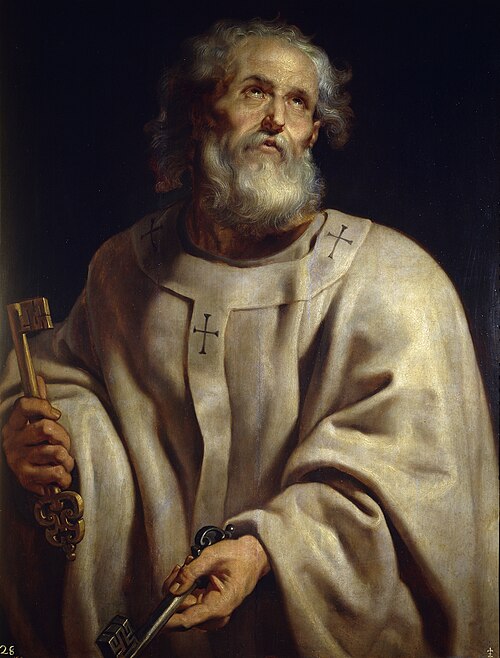
Apostle
Peter
Chief of the Apostles
Galilean fisherman and one of the Twelve, who confessed Christ and died a martyr in Rome.
Life
The holy Apostle Peter, called by the Church the first among the apostles, was a fisherman from Galilee, a disciple of Christ and a witness to His Resurrection. He preached the Gospel to Jews and Gentiles, left two catholic epistles and, according to tradition, received a martyr's death at Rome under Nero. The Church commemorates him together with Saint Paul on 29 June as two pillars of the faith.
The call
His name was Simon, son of Jonah, from Bethsaida in Galilee, and he was the brother of the Apostle Andrew the First-called. He lived by fishing on the Lake of Gennesaret and later dwelt at Capernaum, where the Lord healed his mother-in-law. The Lord gave him the name Cephas, which in Aramaic means "rock", in Greek Peter. Called to be a fisher of men, he left his nets and followed Him. The Greek synaxarion describes him as spontaneous and impetuous, and the Lord took him, with James and John, to the Transfiguration and to the raising of Jairus's daughter.
When Christ asked the disciples who He was, Peter confessed: "You are the Christ, the Son of the living God." The Fathers of the Church see in this confession the rock on which the Lord built His Church. On the sea Peter stepped onto the water toward his Master and began to sink for want of faith.
Denial and forgiveness
On the night the Lord was seized, Peter, who had boasted that he would never deny Him, denied Him three times in the courtyard of the high priest Caiaphas, out of fear of the Jews. At the crowing of the cock he wept bitterly, and after many tears he received full forgiveness. After the Resurrection, on the shore of the Sea of Tiberias, Christ asked him three times whether he loved Him and entrusted His flock to him again: "Feed My sheep."
Preaching
At Pentecost Peter spoke to the crowd gathered at Jerusalem, and that day nearly three thousand were baptized. Through him a lame man was healed at the gate of the Temple. He was imprisoned, and an angel led him out of prison. After the revelation at Joppa he baptized the centurion Cornelius and so opened the entrance of the Gentiles into the Church. He took part in the apostolic council at Jerusalem.
According to the synaxarion, after the Ascension he preached in Judea, at Antioch, and in Pontus, Galatia, Cappadocia, Asia and Bithynia. He reached Rome, where he suffered under Nero. Two epistles are attributed to him, and tradition holds that the Gospel of Mark rests on his preaching.
Martyrdom
According to tradition, Saint Peter died at Rome under Nero, between 64 and 68 (the sources give 64, 66 or 67). The Acts of Peter, a work of the second century, says that, thinking himself unworthy to die as the Lord had, he asked to be crucified head downward. Tradition places his tomb on the Vatican hill, where a basilica was later built. The Greek synaxarion notes that these details are not firmly confirmed by historical sources.
Veneration
The Church celebrates him on 29 June, together with Saint Paul. The Greek synaxarion records that his chains are kept in the basilica of San Pietro in Vincoli in Rome, his head in the basilica of Saint John Lateran, and parts of his relics in the monasteries of Iviron and Saint Panteleimon on Mount Athos. In Romanian tradition his name appears in the folk form Sânpetru.
Commemorated the same day June 29
 PaulApostle · Apostle to the GentilesJun 29
 Paisios of Mount AthosVenerable · Monk of Mount AthosJun 29
 Xenia YuryevnaRight-Believing · Princess of TverJun 29
 Cassius of NarniSaint · Bishop of NarniJun 29
 Gregory KallidisVenerableJun 29
- BeataMartyrJun 29
- Caenchomhrac of Disert Chinn-chlairSaintJun 29
- CiwgVenerableJun 29
- CochaVenerableJun 29
- Connan of Tigh ConnainSaintJun 29
- CyrilMartyrJun 29
- EurgainSaintJun 29