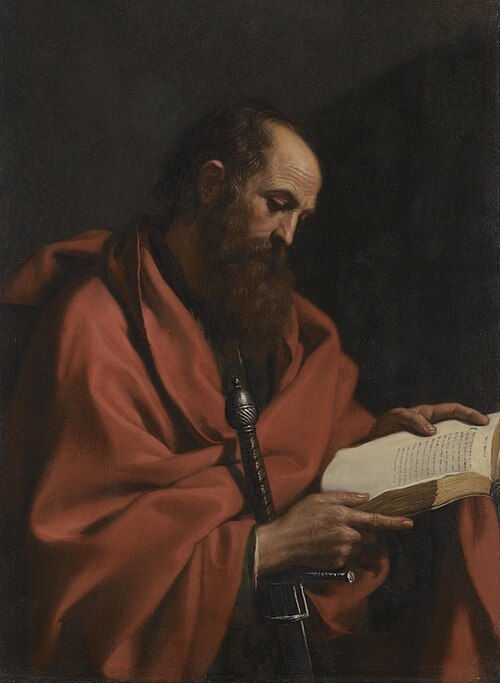
Apostle
Paul
Apostle to the Gentiles
Former persecutor of Christians who became a missionary and wrote fourteen New Testament epistles.
Life
The holy Apostle Paul, called the Apostle to the Gentiles, began as a fierce persecutor of Christians and became the greatest missionary of the early Church. He lived in the first century, founded Churches in Asia Minor, Macedonia and Greece, and left fourteen epistles that form part of the New Testament. The Church honours him, together with the Apostle Peter, as one of the two pillars of the faith.
From Saul to Paul
He was born at Tarsus in Cilicia, of the people of Israel and the tribe of Benjamin, and bore the name Saul. He was a Pharisee, a Roman citizen by birth, and studied the Law at Jerusalem at the feet of Gamaliel. He also knew the trade of tentmaking, by which he would support himself on his journeys.
Zealous for the Law, he was present at the stoning of Saint Stephen the Archdeacon and set out to persecute the disciples of Christ. On the road to Damascus a light from heaven surrounded him, and he fell to the ground and heard the voice of the Lord: "Saul, Saul, why are you persecuting Me?" He remained blind for three days, until Ananias, a disciple of the Lord, laid hands on him and baptized him. From then on he began to proclaim in the synagogues that Jesus is the Son of God.
The beginnings of the mission
After some time in Arabia and at Damascus, he went up to Jerusalem, where Barnabas brought him before the apostles. He then preached in Tarsus and at Antioch, from which the Church there sent him with Barnabas on his first missionary journey, through Cyprus and Asia Minor. At Lystra he healed a lame man, and the crowd wanted to worship him as a god; shortly after he was stoned and left for dead.
At the apostolic council of Jerusalem, about the year 50, Paul upheld that the Gentiles who come to the faith are not bound to keep the Law of Moses. The decision of the apostles was the one he had preached.
Journeys and epistles
On the second and third journeys, accompanied by Silas, Timothy, Luke and others, Paul founded or strengthened the Churches of Philippi, Thessalonica, Berea, Corinth, Ephesus and Galatia. At Athens he spoke on the Areopagus about "the unknown God". At Corinth he stayed a year and a half, and at Ephesus almost three years.
For years he endured beatings, prisons, shipwrecks and countless dangers, which he recounts himself in the second epistle to the Corinthians. He left fourteen epistles: to the Romans, two to the Corinthians, to the Galatians, Ephesians, Philippians, Colossians, two to the Thessalonians, two to Timothy, to Titus, Philemon and the Hebrews. They are the foundation of the teaching on grace, faith, the Church and love. Paul left Titus as bishop in Crete and Timothy at Ephesus.
Arrest and martyrdom
About the year 57 he was arrested at Jerusalem and spent two years in prison at Caesarea. As a Roman citizen he asked to be tried by the emperor and was sent by sea to Rome. A storm and shipwreck held him on the island of Malta, where he was unharmed by the bite of a viper. At Rome he lived two years in a rented house, guarded by a soldier, and preached without hindrance.
According to tradition he was released, preached further, and was arrested again in the persecution of Nero. As a Roman citizen he received the crown of martyrdom by beheading, at Rome, sometime between the years 64 and 67, and was buried on the Ostian Way. The Apostle Peter suffered at about the same time, by crucifixion; the synaxarion itself leaves the details of both deaths to tradition, as they are not firmly confirmed by historical sources.
Veneration
The Church celebrates Saint Paul on 29 June, together with the Apostle Peter, and on the following day the Synaxis of the Twelve Apostles is kept. The Greek synaxarion calls him the founder of the Church of Greece, since he preached at Philippi, Thessalonica, Berea, Athens and Corinth.
His relics are honoured at Rome: his head is kept in the basilica of Saint John Lateran and part of his relics in the basilica of Saint Paul outside the Walls. A fragment is at Koutloumousiou Monastery on Mount Athos.
Commemorated the same day June 29
 PeterApostle · Chief of the ApostlesJun 29
 Paisios of Mount AthosVenerable · Monk of Mount AthosJun 29
 Xenia YuryevnaRight-Believing · Princess of TverJun 29
 Cassius of NarniSaint · Bishop of NarniJun 29
 Gregory KallidisVenerableJun 29
- BeataMartyrJun 29
- Caenchomhrac of Disert Chinn-chlairSaintJun 29
- CiwgVenerableJun 29
- CochaVenerableJun 29
- Connan of Tigh ConnainSaintJun 29
- CyrilMartyrJun 29
- EurgainSaintJun 29