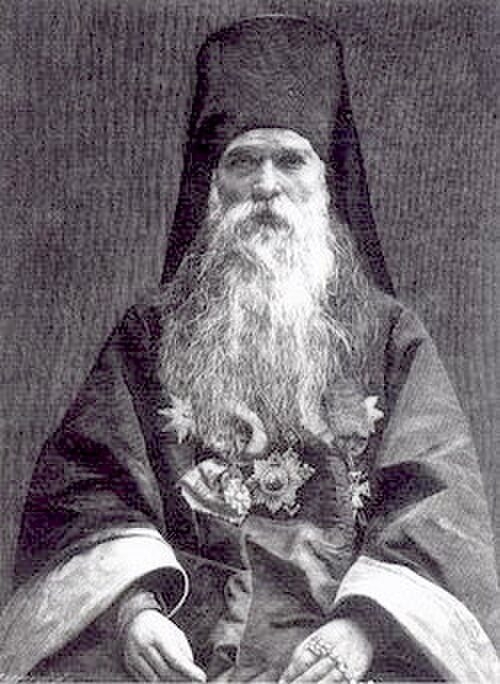
Saint
Gury Karpov
Archbishop of Taurida and Simferopol
Archbishop of Taurida and Simferopol, born at Saratov in 1814, who died at Simferopol in 1882.
- Feast
- December 15old style December 28
- Reposed
- 188219th century
- Place
- Simferopol
- Order
- Hierarchs
Life
Saint Gury Karpov, the Hierarch (in the world Grigory Platonovich Karpov, 1814 to 1882), was archbishop of Taurida and Simferopol, after serving eight years as head of the Russian Mission in Beijing. He translated the New Testament into Chinese, founded in the Crimea the theological seminary and schools, cared for the clergy and preached among Jews, Tatars and sectarians. The Ukrainian Orthodox Church glorified him as a locally venerated saint in 2008.
Youth and monasticism
He was born in 1814 at Saratov, to the priest Platon Karpov. In 1836 he graduated from the Saratov seminary, and in 1837 entered the Saint Petersburg Theological Academy. On 12 July 1838 he was tonsured a monk, with the name Gury, on 4 August ordained hierodeacon and on 20 November 1839 hieromonk. In 1839 he graduated from the academy with the degree of candidate in theology and on 23 December that year was named a member of the Russian Mission in Beijing.
The mission in China
He lived eighteen years in China, first as a member and then as head of the mission, which partly served as an embassy. He spent much strength and energy to fulfil his charge. Difficulties were constant, but he loved his work and was persistent and patient. He had to learn the craft of stoves himself and teach others to build Russian stoves, so as not to suffer from cold in winter. He had to take up bow and violin to form a choir for services from the Albazinians.
He learned Chinese perfectly, speaking and writing it freely. He translated into Chinese the New Testament in two volumes, the Gospel, the Psalter, sacred history and several books connected with Orthodox worship. On 21 February 1851 he was raised to archimandrite, on 12 October that year named supervisor of the Alexandrovsky theological school, and on 17 August 1855 received the degree of master of theology. On 25 August 1856 he was named head of the Beijing Mission and remained in that post until 1864.
Bishop at Kazan
On 13 September 1865 he was named abbot of the Simonov monastery in Moscow, and on 26 January 1866 rector of the Russian embassy church in Rome. On 5 July 1866 he was consecrated bishop of Cheboksary, vicar of the diocese of Kazan. Because of the grave illness of Archbishop Athanasius (Sokolov) he in fact governed the diocese. He took care of the restoration and adornment of the cathedral in the Transfiguration monastery in Kazan. In 1867 he founded and headed the brotherhood of Saint Gurias of Kazan, remaining a member until his death. He worked in mission among the Tatars together with N. I. Ilminsky.
Bishop of Taurida
From 15 December 1867 he was bishop of Taurida and Simferopol. From his first days of governing he cared for the education of the clergy. The fruit of his labours was the opening of the theological seminary and two theological schools, one for boys and one for girls. He succeeded in improving the material situation of the clergy of the diocese. He carried out intense missionary work for the conversion of Jews, Karaites, Old Believers, Khristovtsy, Skoptsy and Stundists, and tried to preach among the Crimean Tatars. In 1868 he supported the founding of the Alexander Nevsky brotherhood in Simferopol, and in 1869 helped the beginning of the diocese's official publication, the "Tauride Diocesan Gazette", over whose editing he had great influence. During the Russo-Ottoman war of 1877 and 1878 he strengthened, through this gazette, propaganda against Islam, against the Turks and against the West.
From 1876 he was an honorary member of the Church Archaeological Society and of the Kyiv Theological Academy. On 21 April 1881 he was raised to archbishop. He fell asleep on 17 March 1882 at Simferopol and was buried in the crypt of the Alexander Nevsky cathedral, destroyed in 1930. In 1929 his remains were moved to the cemetery beside the church of All Saints.
Glorification
The Holy Synod of the Ukrainian Orthodox Church numbered him among the locally venerated saints on 18 May 2008, with the day of commemoration 17 March. On 1 July 2008 Metropolitan Lazar (Shvets) served a memorial service at Archbishop Gury's grave beside the church of All Saints in Simferopol. On 2 July, in the grounds of the church of All Saints, the saint's relics were found and moved into the church. On 4 July Metropolitan Lazar made a procession with the relics to the seminary church of the Three Hierarchs, built by Saint Gury. On 22 and 23 August 2008 the glorification celebrations took place, led by Metropolitan Vladimir of Kyiv. On 7 June 2016 the shrine with the relics was moved from the cathedral of Saints Peter and Paul to the Alexander Nevsky cathedral, in the lower church consecrated in his honour.
Of his writings there remain his master's thesis on the divine institution of the episcopal rank (1853), letters from Beijing on the successes of Orthodoxy in China, the report on the state of the mission, a text on the teaching of the Skoptsy (1877) and sermons.
Commemorated the same day December 15
 Tryphon of PechengaVenerable · Founder of Pechenga MonasteryDec 15
 UrbiciusVenerable · Hermit of the Aragon PyreneesDec 15
 Eleutherius and AnthiaHoly Hieromartyrs · Bishop of Illyricum and his motherDec 15
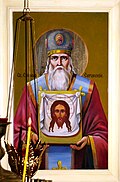 Stephen of SurozhSaint · Archbishop of SugdeaDec 15
- Offa of EssexRight-Believing · King of EssexDec 15
 Susanna the DeaconessVenerable Martyr · Deaconess of PalestineDec 15
- Paul of LatrosVenerableDec 15
 Nectarius of BitolaSaintDec 15
- Pardus the HermitVenerableDec 15
- Gurius of PechengaHieromartyr · Abbot of Pechenga MonasteryDec 15
- DrosisMartyrDec 15
 Eleutherius of IllyriaHieromartyr · Bishop of IllyricumDec 15