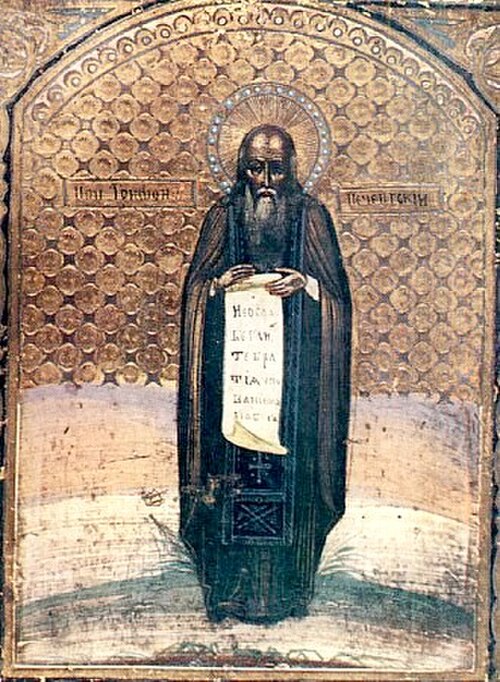
Venerable
Tryphon of Pechenga
Founder of Pechenga Monastery
Russian monk and ascetic of the sixteenth century, founder of Pechenga Monastery in the far north, who died in 1583.
- Feast
- December 15old style December 28
- Reposed
- 158316th century
- Place
- Pechenga
- Order
- Venerables
Life
Saint Tryphon of Pechenga (Tryphon of Kola), a venerable father, was a Russian monk of the sixteenth century, an ascetic on the Kola peninsula and in Lapland, the founder of Pechenga Monastery and called the "Enlightener of the Sami." He was born in June 1495 and fell asleep on 15 December 1583, aged 88. His feast is on 15 December (Old Style), and he is venerated in the synaxes of the saints of Kola, of Karelia, of Novgorod and of Tver.
The sources
His known Life was written in the second half of the seventeenth century, on the basis of brief notes kept at Pechenga monastery. Unable to restore a full biography, its author brought the scattered notes into the form of a conventional life, filling the gaps with standard phrases about the pious life of the saint. There are, however, other testimonies, which present his repentance in a different light. In the Report on the Land of the Lapps, the Dutch merchant Simon van Salingen relays a story told by Tryphon himself about his youth, when he had been the leader of a band of robbers but repented: it is said that he had been a fearsome warrior to his enemies, had robbed and ruined many people on the border and shed much blood, for which he repented and grieved bitterly; therefore he vowed never to wear linen in his life, but to make himself a hoop about his waist and to repent in the wilderness, far from men, among wild beasts.
Youth
He was named Mitrofan and was the son of a priest of the land of Novgorod, from Torzhok. He was of enormous strength and good health. In youth he served a boyar, then entered military service; according to some sources, he was trained as a military engineer, and he became the leader of a band of robbers that struck fear into the "Kayan Germans" (Finns), reaching in his raids as far as the "Kayan sea" (the Gulf of Bothnia). According to the Life, he had an unbridled temper and one day, in rage, killed his beloved. Then, repenting, he went north, to the Kola peninsula, to the river Pechenga.
The missionary
Five years of wandering in wild forests, full of dangers, cold and hunger, ended with a meeting with Saint Theodorit of Kola, who had come from beyond the Volga to enlighten the pagan tribes there. After five years of working together, Mitrofan, having learned the language of the Lapps, set out to preach on his own, in the land of his wanderings, on the river Pechenga. The missionaries met fierce opposition from the local sorcerers, but had success, above all because Mitrofan took time to study their beliefs and languages. The need for churches and for priests for the newly baptized Lapps took them to Novgorod, to Archbishop Macarius; in 1530 Theodorit and Mitrofan set out, and returned with craftsmen, service books and church vessels. With them came the hieromonk Elias of Novgorod.
In 1532, where the river Mana flows into the Pechenga, Mitrofan founded the monastery of the Holy Trinity. The church was consecrated by the hieromonk Elias, who also tonsured him a monk with the name Tryphon. Because he had shed blood, Tryphon could not accept the priesthood; the services were served by the hieromonk Jonah, who had earlier been priest of the church of Saint Nicholas in Kola.
Troubles and end
In the famine year of 1548 the brethren of the monastery of Saint Theodorit at Kola, demanding a relaxation of the rule and, as Prince Kurbsky writes, possession of lands and holdings, beat and drove out their abbot, then came to Pechenga, to Saint Tryphon. The arrival of so unruly a community forced Tryphon too to leave the monastery; his canon says his life was threatened by "wicked men." Barlaam of Keret, who came to Pechenga after a penitential voyage, foretold to Tryphon of the brethren: "There will be people and villages quite unruly, like wild beasts, like your own anger and sharp temper." Tryphon set out with a small group of monks on eight years of wandering, collecting alms, which he sent to the monastery. In his absence the brethren who remained moved the monastery of their own will nearer the river mouth, to a place better for fishing and trade. In 1556 Tryphon returned with a new abbot, Gurias, and a royal charter granting the monastery privileges. From then on he guided his brethren to the end. The Lapps he had baptized always saw in him a teacher in the Christian life and a defender against the oppression of "wicked men." To have occasion for prayer in solitude, he built on the bank of a stream, which later took his name, a church of the Dormition of the Mother of God, to which he often withdrew for meditation and silence.
Shortly before his death Tryphon foretold to his brethren death by the sword and the ruin of the monastery. After six years the "Swedish Finns" laid the monastery waste.
Veneration
Russian seamen traditionally pray to Saint Tryphon when in danger. He is little known in the wider Orthodox tradition, but remained beloved in the regions of Lapland; it is said that his popularity is due to the skilful way he blended Orthodoxy with some pagan customs. In 1894 the painter Konstantin Korovin painted a picture of the place that bears his name.
Commemorated the same day December 15
 UrbiciusVenerable · Hermit of the Aragon PyreneesDec 15
 Eleutherius and AnthiaHoly Hieromartyrs · Bishop of Illyricum and his motherDec 15
 Stephen of SurozhSaint · Archbishop of SugdeaDec 15
- Offa of EssexRight-Believing · King of EssexDec 15
 Susanna the DeaconessVenerable Martyr · Deaconess of PalestineDec 15
 Gury KarpovSaint · Archbishop of Taurida and SimferopolDec 15
- Paul of LatrosVenerableDec 15
 Nectarius of BitolaSaintDec 15
- Pardus the HermitVenerableDec 15
- Gurius of PechengaHieromartyr · Abbot of Pechenga MonasteryDec 15
- DrosisMartyrDec 15
 Eleutherius of IllyriaHieromartyr · Bishop of IllyricumDec 15