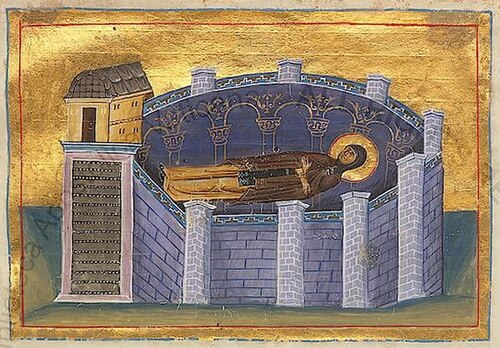
Venerable Martyr
Susanna the Deaconess
Deaconess of Palestine
Deaconess of 4th-century Palestine who devoted herself wholly to Christ and died a martyr.
- Feast
- December 15old style December 28
- Reposed
- 3003rd century
- Place
- Eleutheropolis
- Order
- Martyrs
Life
Holy Martyr Susanna the Deaconess was, according to the tradition about her, a deaconess in Palestine in the fourth century, and received a martyr's death at Eleutheropolis, in the early fourth century. The Orthodox Church commemorates her on 15 December. Her story rests on hagiography, so we present her as a saint of tradition. Our record gives the years 260 and 300, which do not fit the story.
According to the hagiography, she was born in Palestine in the reign of the emperor Maximian (286 to 305). Her mother, Martha, is said to have been Hebrew, and her father a Greek pagan priest, Artemius. She was pious from youth, converted willingly, and was catechized and baptized by a priest named Silvanus. After the death of her parents she sold all that she had, gave her whole fortune to the poor and decided to join a male monastery in Jerusalem. Disguised as a man, she cut her hair and took the name "John". She stood out by her piety and was in the end made archimandrite.
Her life in the monastery went relatively quietly for about twenty years. Then she was accused by a female visitor of attempting to force her. The hagiographies assert her innocence, saying that the truth was that the accuser herself had tried to tempt her and, failing, had resolved to accuse her instead. It is said that she accepted the accusation and even asked pardon. But when the bishop of Eleutheropolis visited the monastery to investigate, she revealed to two virgin nuns that she was a woman. The bishop, moved by her faith, decided to consecrate her deaconess and invited her to accompany him to Eleutheropolis.
In that city she is said to have been martyred later by a man named Alexander, because she would not "sacrifice to the idols". After cruel tortures, which the hagiography shows healed by God, she was forced to drink molten lead, and when even this did not kill her, she was beaten and then put to death by burning at the stake. Anastasius Quaestor and (or) Balbos, two famous Byzantine hymnographers of the ninth century, composed several canons in her honour.
Commemorated the same day December 15
 Tryphon of PechengaVenerable · Founder of Pechenga MonasteryDec 15
 UrbiciusVenerable · Hermit of the Aragon PyreneesDec 15
 Eleutherius and AnthiaHoly Hieromartyrs · Bishop of Illyricum and his motherDec 15
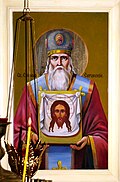 Stephen of SurozhSaint · Archbishop of SugdeaDec 15
- Offa of EssexRight-Believing · King of EssexDec 15
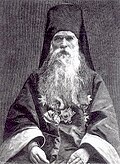 Gury KarpovSaint · Archbishop of Taurida and SimferopolDec 15
- Paul of LatrosVenerableDec 15
 Nectarius of BitolaSaintDec 15
- Pardus the HermitVenerableDec 15
- Gurius of PechengaHieromartyr · Abbot of Pechenga MonasteryDec 15
- DrosisMartyrDec 15
 Eleutherius of IllyriaHieromartyr · Bishop of IllyricumDec 15