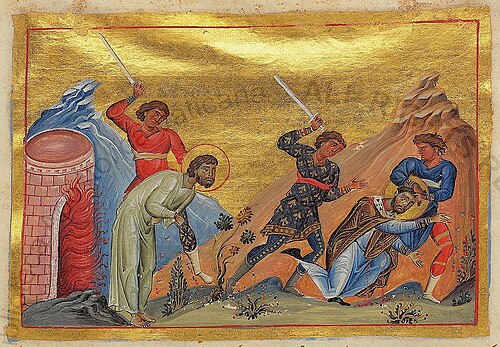
Holy Hieromartyrs
Eleutherius and Anthia
Bishop of Illyricum and his mother
Eleutherius, bishop of Illyricum, and his mother Anthia, put to death for Christ in the 2nd century.
- Feast
- December 15old style December 28
- Era
- unknown
- Order
- Martyrs
Life
Saint Eleutherius, Hieromartyr, bishop, and his mother Saint Anthia (Antia), Martyr, are honoured as martyrs of the second century, put to death for Christ in the time of the emperor Hadrian. According to tradition, Eleutherius was a Roman, was made bishop at twenty and died together with his mother, and with them is also commemorated an official who tormented him and then believed. The Orthodox Church celebrates them on 15 December and the Catholic Church on 18 April. In Greece Saint Eleutherius is the protector of expectant mothers. Historians know very little of their lives, and the accounts of them do not fully agree with each other.
Birth and youth
According to tradition, Eleutherius was born in Rome, to the consul Eugenius and his wife Anthia. A Greek source older than the fifth century calls Anthia the widow of a consul named Eugenius. His father died when he was a child, and his mother took him to Anicetus, bishop of Rome, who taught him the Holy Scriptures. He was ordained deacon, then priest, and at twenty, bishop. The Serbian source says he was a deacon at fifteen and a priest at eighteen, and at twenty was chosen bishop of Illyria.
The sources say different things about his see. The Greek text, used also by Cardinal Baronius in the Roman Martyrology, calls him bishop of Messana and of Illyricum, settled at Aulon (now in Albania). The Latin translation of about the eighth century, on the other hand, says Anicetus sent him to Aeca (Aecae), in Apulia. The Russian source also writes of Aeca. The scholar Hippolyte Delehaye regarded the link with Aeca as an error, and Florus had thought "Apulia Aecana" a mistaken writing for Messina, but the link with Messina is not certain either. It is also noted that the tradition may come from a confusion with Pope Eleutherius, who may have been a deacon under Pope Anicetus (around 154 to 164), which does not fit the time of Hadrian. Since the name Eleutherius means "liberator", in Latin it was rendered Liberator or Liberalis, and he seems to have been mixed up with other saints named Liberalis. Messina claims him as a native and says he was born there on 18 April 121.
His fame reaches Britain
According to the Greek synaxarion, the fame of his virtue was so great that it reached Britain, and the ruler there, Lucius, wrote to him saying that he and his people wished to become Christians, and Eleutherius at once sent two missionaries. This story comes from the Greek tradition and cannot be verified.
Persecution and tortures
In the time of Hadrian's persecution Eleutherius was seized and imprisoned by a comes named Felix, whom he later drew to the faith, and then, with Anthia, he was taken to Rome to be judged by the emperor, who could not make them renounce their faith. The Greek synaxarion tells of the tortures: Hadrian ordered him laid on a heated bronze bed, but God sent them coolness and eased their pains. He was then put on a red-hot grill, under which coals burned, but the fire went out and the grill cooled. Angered, the emperor ordered him put into a great cauldron of tallow, wax and pitch and boiled alive, but again the cauldron cooled. Then the eparch of Rome, Corebus (in the sources, Koremon), at Hadrian's command made a bronze oven with sharp spikes inside, heated it and was ready to throw Eleutherius in. Then a miracle happened: Corebus became a Christian and, instead of Eleutherius, was himself put in the oven by the emperor's order. Unharmed, he was nevertheless beheaded. Then it was Eleutherius's turn at the oven with spikes, but the fire went out and the spikes bent, so as not to harm his body.
Hadrian, furious, ordered him locked up and left to die of hunger, but in the cell God sent him food by a dove. The emperor then ordered him tied behind two wild horses, so that his flesh would be torn, but an angel of the Lord calmed the horses, freed him and led him to a mountain, where he stayed praying among wild beasts, which he managed to tame. Some hunters saw him and told the emperor, who sent soldiers to seize him. The beasts rushed at the soldiers, but the saint ordered them to calm down and go back to their dens, then followed the soldiers, teaching them Christianity, and some believed in Christ.
On 15 December, arriving at Rome, he was led into the arena to be torn by beasts. A lioness and a lion that approached him began to kiss his feet. Seeing the behaviour of the lions and hearing the cry of the crowd, "Great is the God of the Christians", the emperor ordered his head cut off. His mother, Anthia, watched the scene and ran to embrace her dead son one last time, but did not manage it, for the executioners beheaded her too. Other sources say both were condemned to death on 15 December, he killed with clubs, Anthia beheaded with the sword, and others (such as the Russian source) that he died in 121 or 120. The two executioners who beheaded him believed in Christ as well and were put to death.
Relics and veneration
According to one tradition their bodies were buried at Rome, in the church of Santa Sabina, then moved to San Giovanni della Pigna, near the Pantheon, with the relics of Genesius of Rome, and Christians of Rieti are said to have carried them to their city, where they are still claimed. The church of Sant'Eleuterio outside the walls of Rieti was built around the fifth century and, according to tradition, received the relics of Eleutherius and Anthia, brought from Rome by Bishop Primus. In the fifth or sixth century the Benedictine Stephen of Rieti founded a monastic community beside their tomb. On 13 August 1198 Bishop Adolphus Secenari and Pope Innocent III moved the relics to the cathedral. Many churches in Italy were dedicated to him, among them one at Rome, on the Via Labicana, and the famous monastery on the Maiella (San Liberatore a Maiella, which, however, is dedicated to the Saviour the Liberator). His name appears in ancient Greek calendars, in the Hieronymian Martyrology, in the Marble Calendar of Naples and in Mozarabic calendars.
The Orthodox Church commemorates them on 15 December, together with the martyr Corebus and the two executioners who believed. In Greece Saint Eleutherius is held to be the protector of expectant mothers, and his name was given to a district of Athens, Agios Eleftherios. In Albania he is called Shën Lefter, and Anthia Shën Anthi.
Commemorated the same day December 15
 Tryphon of PechengaVenerable · Founder of Pechenga MonasteryDec 15
 UrbiciusVenerable · Hermit of the Aragon PyreneesDec 15
 Stephen of SurozhSaint · Archbishop of SugdeaDec 15
- Offa of EssexRight-Believing · King of EssexDec 15
 Susanna the DeaconessVenerable Martyr · Deaconess of PalestineDec 15
 Gury KarpovSaint · Archbishop of Taurida and SimferopolDec 15
- Paul of LatrosVenerableDec 15
 Nectarius of BitolaSaintDec 15
- Pardus the HermitVenerableDec 15
- Gurius of PechengaHieromartyr · Abbot of Pechenga MonasteryDec 15
- DrosisMartyrDec 15
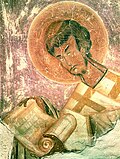 Eleutherius of IllyriaHieromartyr · Bishop of IllyricumDec 15