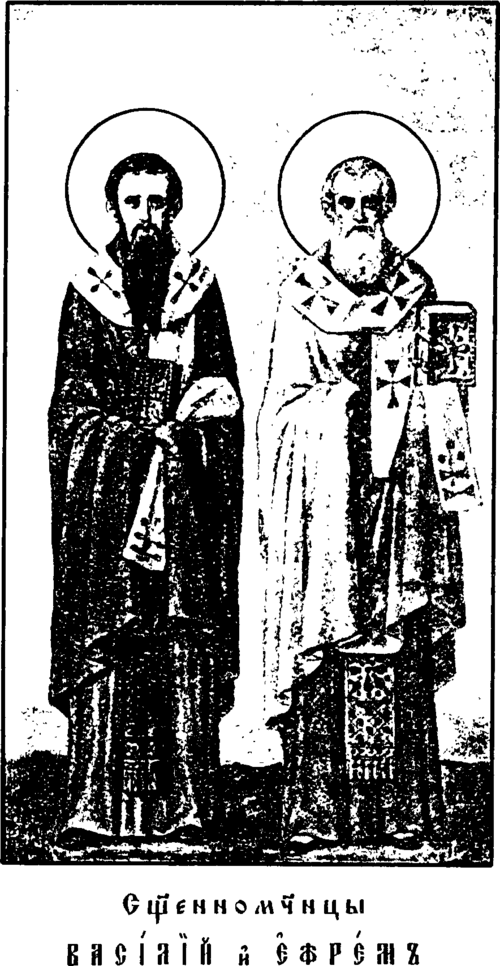
Holy Hieromartyrs
Hieromartyrs of Cherson
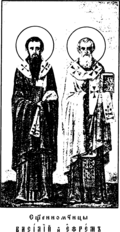
Group of bishops of Cherson in Crimea, martyred in the early fourth century in the persecution of Diocletian.
Life
The Hieromartyrs of Cherson are seven bishops of Tauric Chersonesos in Crimea: Ephraim, Basil, Eugene, Elpidius, Agathodorus, Aetherius (Etherius) and Capito, who preached Christianity in the still pagan city. They are commemorated in the Orthodox Church on 7 March (20 March by the new calendar). They did not die together, but came one after another, sent by the bishop of Jerusalem, and were killed in succession, except Aetherius, who died in peace.
History
In the fourth century an episcopal see was established at Cherson. According to the Life of the Bishops of Cherson, in the time of Emperor Diocletian, around 300, that is, before the start of the persecution in 303, Bishop Hermon of Jerusalem (300-314) sent many bishops to different lands to preach the Gospel. Two of them, Ephraim and Basil, reached Cherson. Then Ephraim went to preach on the Danube, and Basil was killed. Learning of Basil's death, Eugene, Elpidius and Agathodorus left their preaching in the Hellespont region and came to Cherson to continue his work. They were killed, beaten with stones by pagans, like their predecessor. The city became a spiritual centre in which in 988 Prince Vladimir received holy baptism.
Brief lives
Basil (died 309) raised, according to tradition, the son of a prince, which enraged some enemies, who accused him. According to the Serbian source, he was tied by the feet and dragged through the streets until he gave up his soul; according to the Ukrainian, he was stoned and thrown to wild beasts, which did not touch him, and at night a star shone over him. Ephraim went to the peoples of the Danube, where he bore many hardships, and in the persecution was beheaded. Eugene, Elpidius and Agathodorus suffered under Maximian Galerius, stoned in 311. Aetherius came from Jerusalem under Constantine the Great, governed the Church in peace, built a great church at Cherson, and departed to the Lord on the return journey from Constantinople, on the island of Alos, after thanking the emperor.
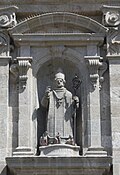
Capito (died after 326) was sent as bishop by Emperor Constantine. The Christians received him with joy, but the pagans demanded a sign from him in order to believe in the God he preached. With all his hope in the Lord, Capito entered in episcopal vestments a kindled fire or, according to the Serbian source, a heated furnace, prayed long in the fire and came out unharmed, with burning coals in his phelonion. Many unbelievers then saw the power of the God of the Christians. The miracle became known to Saint Constantine and to the Holy Fathers at the First Ecumenical Council in Nicaea in 325. A few years later, on his way to Constantinople, the ship was caught by a storm and driven to the mouth of the Dnieper, and the local pagans sank all aboard, among them Capito, on 21 December. More recent sources also link to the group the saints Nestor and Arcadius, who are thought to have been martyred in Cyprus.
Commemorated the same day March 7
 EubulusApostle · One of the SeventyMar 7
 Catherine KonstantinovaVenerable Martyr · Novice of the Sorrows ConventMar 7
 Lavrentios of MegaraVenerableMar 7
 Basil of ChersonesusHieromartyr · Bishop of ChersonesusMar 7
- AemilianusVenerableMar 7
- Agathodorus of ChersonesusHieromartyr · Bishop of ChersonesusMar 7
- Anna GorokhovaVenerable MartyrMar 7
- Antonina NovikovaVenerable MartyrMar 7
- Ardo SmaragdusVenerableMar 7
- Artaxus of ThraceSaintMar 7
- Bishops of TremithusSaintMar 7
 CapitoSaintMar 7