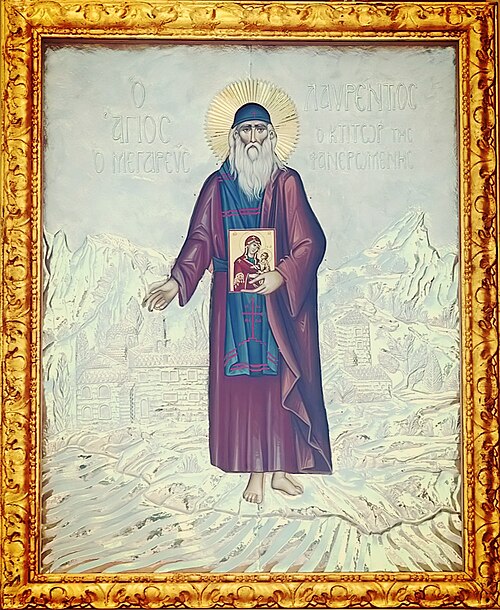
Venerable
Lavrentios of Megara
Greek saint of Megara, born around 1650 and died in 1707.
- Feast
- March 7old style March 20
- Reposed
- 170718th century
- Place
- Megara
- Order
- Venerables
Life
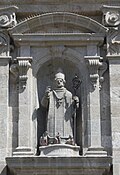
Venerable Lavrentios (Lambros Kanellos-Papastamatis) of Megara was a peasant and craftsman of Megara in Attica, then a monk and abbot of the Phaneromeni Monastery on the island of Salamis, where, according to tradition, he found the wonderworking icon of the Mother of God Phaneromeni (Neophaneisa). He is venerated as a saint in Greece. He fell asleep on 7 March 1707 (the sources differ on the time of his life: the years 1650-1707, while one source says the second half of the eighteenth century). Our sources show no act of canonization.
The calling
According to tradition, Lambros Kanellos-Papastamatis worked as a farmer and builder at Megara. He was the son of Demetrios and Kyriake, was married to Vasilo and had two sons, John and Demetrios. The pious peasant saw in his sleep three times the Mother of God, who urged him to go to the island of Salamis and build a church that stood there in ruins. The repeated visions disturbed his soul and tested his faith. After the third, in the fear of God, he went to Megalo Pefko, looking for a way to cross to Salamis to fulfil the command. Finding no vessel, he prayed deeply from his heart, and then the voice of the Mother of God said to him like a sweet melody: throw your cloak into the sea, step onto it, you will sail safely and come ashore unharmed on the far coast of the island. With full faith he used his cape as a raft and crossed the sea from the shore of Megara to the north side of Salamis, safely and completely dry.
The Phaneromeni Monastery
Thanking the Theotokos with all his soul for the miracle, he devoted himself wholly to her. He received the monastic habit and was named Hieromonk Lavrentios, continuing to carry out the command. Searching with toil, he was counted worthy to find among the ruins of the old church, buried and blackened by damp, the wonderworking icon. In the following years he worked at building and restoring the holy monastery, with the help of pious Christians. The newly founded monastery was given the name Phaneromeni or Neophaneisa, she who was revealed. He lived there and was also its abbot. He lived in strict asceticism, with fasts, vigils and good works, and passed on his piety to his family: his wife, Vasilo, followed him and took monastic life with the name Vassiani, and one of the sons, John, was ordained hieromonk with the name Joachim and succeeded him as abbot.
When the years passed and weariness overcame him, he left his beloved monastery for the south, on a steep peak of the mountain. He lived in a small, humble cell dedicated to the Prophet Elijah, where he carved a rock and collected rainwater, feeding on the herbs of the rocky mountain. There he knew the stillness of the wilderness, received and consoled the afflicted and healed the sick to the end of his life. He fell asleep on 7 March 1707, without living to see the rich painting of the monastery church, completed under the abbacy of his son Joachim. His relics were buried, according to some in the diaconicon of the katholikon of the chapel of Saint Charalambos, according to others in that of the chapel of Saint Nicholas. The head, jaw and part of a hand were separated, and the rest of the bones buried in the diaconicon. The head is placed for veneration beside the wonderworking icon.
Commemorated the same day March 7
 EubulusApostle · One of the SeventyMar 7
 Hieromartyrs of ChersonHoly HieromartyrsMar 7
 Catherine KonstantinovaVenerable Martyr · Novice of the Sorrows ConventMar 7
- Basil of ChersonesusHieromartyr · Bishop of ChersonesusMar 7
- AemilianusVenerableMar 7
- Agathodorus of ChersonesusHieromartyr · Bishop of ChersonesusMar 7
- Anna GorokhovaVenerable MartyrMar 7
- Antonina NovikovaVenerable MartyrMar 7
- Ardo SmaragdusVenerableMar 7
- Artaxus of ThraceSaintMar 7
- Bishops of TremithusSaintMar 7
 CapitoSaintMar 7