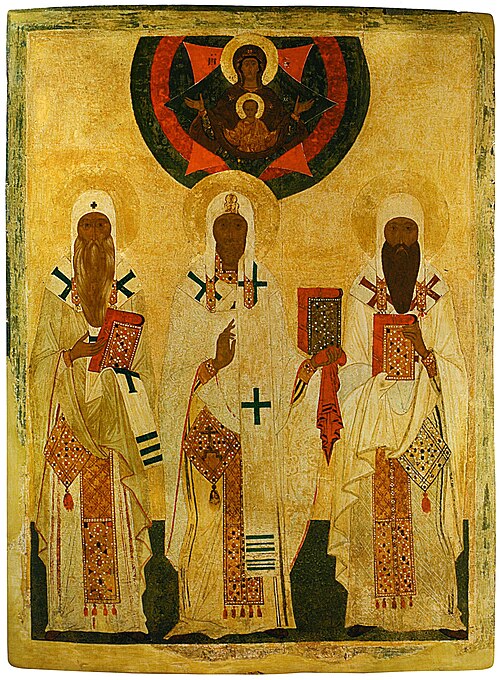
Saint
Ignatius of Rostov
Bishop of Rostov
Bishop of Rostov in the thirteenth century, a wonderworker, who died in 1288.
Life
Saint Ignatius was bishop of Rostov in the thirteenth century, a wonderworker, who died on 28 May 1288. He is commemorated on 28 May (10 June by the Gregorian calendar, according to the Serbian source), with a six-fold service, and in the Synaxis of the Saints of Rostov; the record also gives 23 May.
At first he was a cleric at the church of the Mother of God in Rostov, then laboured at the Epiphany monastery of Rostov. In 1261, while archimandrite of this monastery, Grand Prince Alexander Nevsky appointed him assistant to Bishop Cyril of Rostov, and after the latter's death, on 19 September 1262, Metropolitan Cyril installed Ignatius as bishop on the see of Rostov. The chronicle mentions under the years 1266, 1269, 1271 and 1276 to 1278 his participation in weddings and burials of members of the princely family. In 1274 he was at the council of Vladimir, gathered by Metropolitan Cyril to end disorders in the Church and the clergy. He took part in the enlightenment of the Beloozero region with Christianity.
In 1278 he buried Prince Gleb Vasilkovich in the Dormition cathedral of Rostov, and after nine weeks, it is not known why, he ordered the body taken from the grave at midnight and buried in the Saviour monastery, for which Metropolitan Cyril laid him under a prohibition. It seems, however, that Ignatius had grounds in this obscure matter, as shown by the quick forgiveness from the metropolitan and the remark of one chronicle that the metropolitan punished Ignatius on account of a slander. In 1280 he took part at Pereslavl in the burial of Metropolitan Cyril, who had died there. In the same year he covered with tin and paved with red marble the church of the Mother of God in Rostov. In the following year, 1281, he acted as peacemaker between the brothers, the princes of Rostov Dmitry and Konstantin Borisovich, who had quarrelled over lands; he went to Vladimir and asked Grand Prince Dmitry Alexandrovich to come to Rostov and reconcile the brothers. In memory of this reconciliation the saint laid the foundation of the church of Boris and Gleb in Rostov. In 1282, not for the first time, he went to the Horde to intercede for the clergy.
Saint Ignatius died on 28 May 1288 and, according to his biographers, even before burial he was glorified by miracles. When at the funeral they wanted to put an absolution paper into his hand, he himself raised his hand and took the paper; those present, struck with terror, did not dare to give his body to the earth, and his relics lay open in the Dormition cathedral of Rostov, in a silver shrine (since 1795). The Serbian source says that he governed the Church for 26 years with great love and mercy and that at his death some saw him rise from the coffin, ascend above the church and bless the people and the city from on high, then return into his coffin. The oldest known copy of his service is of the second half of the fourteenth century or the beginning of the fifteenth, and the earliest copy of his life is of 1420.
Commemorated the same day May 28
 William of GelloneVenerable · Duke of Toulouse, monkMay 28
 Germain of ParisSaint · Bishop of ParisMay 28
 Justus of UrgellSaint · Bishop of UrgellMay 28
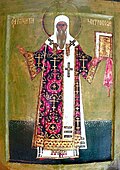 Gerontius of MoscowSaint · Metropolitan of MoscowMay 28
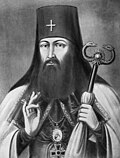 Barlaam of TobolskSaint · Archbishop of TobolskMay 28
 Emilian of CagliariHieromartyr · Bishop of CagliariMay 28
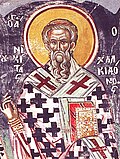 Nicetas of ChalcedonConfessor · Archbishop of ChalcedonMay 28
 Podius of FlorenceSaint · Bishop of FlorenceMay 28
 Elena of DiveevoVenerable · Virgin at DiveevoMay 28
 Helikonis of CorinthMartyr · Martyr of CorinthMay 28
- HelladiusHieromartyr · Bishop and martyrMay 28
- Helladius, Crescentius, Paul and DioscoridesHoly MartyrsMay 28