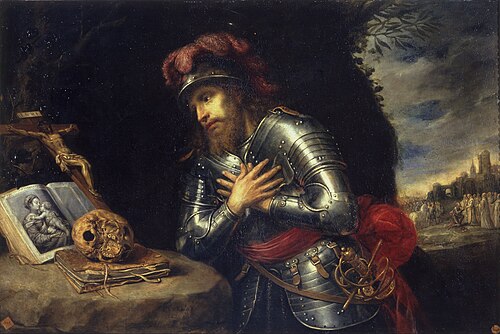
Venerable
William of Gellone
Duke of Toulouse, monk
Duke of Toulouse, founder of the abbey of Gellone in 804, where he became a monk.
- Feast
- May 28old style June 10
- Reposed
- 8139th century
- Place
- Saint-Guilhem-le-Désert
- Order
- Venerables
Life
Saint Guillaume of Gellone, venerable, was count of Toulouse and a good soldier of Charlemagne, then a monk in the monastery he founded at Gellone, today Saint-Guilhem-le-Désert. He fell asleep in 812 or 814. He is commemorated on 28 May.
The soldier
He was born in northern France of today, around 755, a son of Thierry, count of Autun, and Aldana. He was a relative of Charlemagne and spent his youth at his court. In 788 Count Chorso of Toulouse was captured by the Basques and forced to swear fealty to the duke of Gascony; after his release Charlemagne replaced him, in 790, with his cousin Guillaume, who succeeded in subduing the Gascons. In 793 the emir Hisham proclaimed a holy war against the Christians of the north, and half of his army penetrated Languedoc as far as Narbonne. Guillaume faced it and defeated it, and then, meeting it again near the river Orbieu, was defeated, but his obstinate resistance exhausted the Muslim army so much that it withdrew to Spain. In 801 he commanded, with Louis, king of Aquitaine, a great expedition that captured Barcelona.
The monk
In 804 he founded the monastery at Gellone, near Lodève, endowed it with property and placed it under the general guidance of Benedict of Aniane, whose monastery was nearby. Among his gifts was a piece of the True Cross, received from his cousin Charlemagne, who had it, according to the Life, from the patriarch of Jerusalem. In 806 he retired as a monk to Gellone and died there, in 812 or 814. It is said that at his death the bells of Orange rang of themselves. His will of 28 January 804 names his two wives, Cunegonde and Witburgis, his dead parents, his brothers and sisters, four children and a nephew. He was numbered among the saints in 1066 by Pope Alexander II.
Veneration
So many pilgrims came to Gellone that his body was taken from its humble place in the narthex and set in a place of honour under the choir, to the displeasure of the abbey of Aniane. The abbey was a major stop on the road to Santiago de Compostela. His legend grew in the twelfth century and gave rise to a whole cycle of songs of deeds, in which he is called Fièrebrace and the margrave with the short nose. His life was set forth as an example of fidelity to the emperor.
Commemorated the same day May 28
 Germain of ParisSaint · Bishop of ParisMay 28
 Justus of UrgellSaint · Bishop of UrgellMay 28
 Gerontius of MoscowSaint · Metropolitan of MoscowMay 28
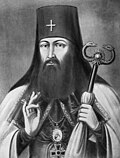 Barlaam of TobolskSaint · Archbishop of TobolskMay 28
 Emilian of CagliariHieromartyr · Bishop of CagliariMay 28
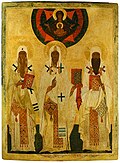 Ignatius of RostovSaint · Bishop of RostovMay 28
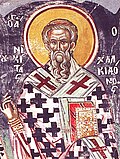 Nicetas of ChalcedonConfessor · Archbishop of ChalcedonMay 28
 Podius of FlorenceSaint · Bishop of FlorenceMay 28
 Elena of DiveevoVenerable · Virgin at DiveevoMay 28
 Helikonis of CorinthMartyr · Martyr of CorinthMay 28
- HelladiusHieromartyr · Bishop and martyrMay 28
- Helladius, Crescentius, Paul and DioscoridesHoly MartyrsMay 28