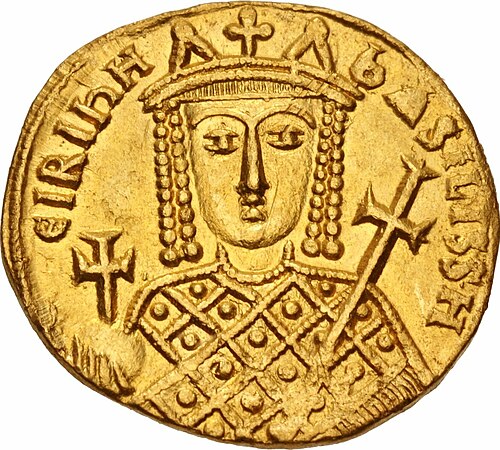
Right-Believing
Irene of Athens
Byzantine Empress
Byzantine empress under whom the veneration of icons was restored at the Seventh Ecumenical Council in 787.
- Feast
- August 9old style August 22
- Reposed
- 8039th century
- Place
- Lesbos
Life
The Holy Right-Believing Empress Irene of Athens was a Byzantine empress, wife of Leo IV and mother of Constantine VI. After her husband's death she governed the empire as regent, and then as empress in her own right from 797 to 802. The Church remembers her because, through her efforts and those of Patriarch Tarasios, the Seventh Ecumenical Council met at Nicaea in 787 and decreed the veneration of the holy icons.
Early years
She was born at Athens between 750 and 756, in the noble Sarantapechos family, which held weight in central Greece. She was left an orphan early, and an uncle or cousin, the patrician Constantine Sarantapechos, is known from the sources. It is not clear why she was chosen as bride for the heir to the throne.
Irene reached Constantinople on 1 November 769. She was betrothed on 3 November, crowned on 17 December and married to Leo, son of Emperor Constantine V Copronymus. On 14 January 771 she bore her only child, Constantine.
Leo and his father were iconoclasts, but Irene kept a love of icons in her heart. Late chroniclers tell that her husband found two icons hidden in her chamber and from then on no longer shared her bed. Historians doubt this detail, which resembles a story told of another empress. Leo died on 8 September 780, and Irene remained regent for her nine-year-old son.
The Seventh Council
Irene quickly put down the plots that sought to raise Nikephoros, Leo's half-brother, to the throne. She had him and his brothers ordained priests, which barred them from ruling. In 784 she raised to the throne of Constantinople Tarasios, a layman and former imperial secretary, who agreed to work for the restoration of the icons.
A first council, gathered in 786 in the church of the Holy Apostles at Constantinople, was scattered by iconoclast soldiers of the guard. Irene moved the troops away and rebuilt the guard from provincial soldiers. The council met the next year at Nicaea, with legates of Pope Hadrian I and with bishops numbered by Orthodox sources at about three hundred and sixty-seven.
The Fathers decreed that the icons are owed veneration (timitiki proskynesis), while true worship (latreia) is given to God alone. The honour paid to an icon passes to the one depicted, so it is not idolatry. With this the first iconoclast period, from 730 to 787, came to an end.
Reign and fall
As Constantine grew, he wished to escape his mother's authority. In 790 the army proclaimed him sole ruler, but in 792 Irene was restored as empress beside him. In 797, in a conspiracy she organised, her son's eyes were put out; he was imprisoned and probably died soon after. Irene remained sole ruler, a status without precedent for a woman in Roman and Byzantine history.
In 800 Pope Leo III crowned Charlemagne at Rome, claiming that the imperial throne was vacant because a woman held it. On the military side, Irene had to pay tribute to the Abbasid caliphs. In October 802 a group of officials led by the finance minister Nikephoros overthrew her. On 31 October Nikephoros was crowned by Tarasios.
Irene was sent first to the island of Prinkipo and then, suspected of new plots, to Lesbos, where she earned her living by spinning wool. She fell asleep in the Lord on 9 August 803. According to the sources, her remains were later moved to the church of the Holy Apostles in Constantinople.
Veneration
Saint Theodore the Studite praised her as a saint for her zeal in restoring the icons and the monasteries and for relieving the widows of soldiers. The chronicler Theophanes the Confessor judges her harshly, disliking the involvement of a woman in affairs of state. The Seventh Council remains the deed for which the Church remembers her; the blinding of her son is a wound that not even the chroniclers conceal.
We know of no synodal act of canonization. Orthodox sources nevertheless commemorate her: the Menaion published by the Moscow Patriarchate carries her service, and the Greek, Athonite, Serbian and Romanian calendars place her on 7 August (old style), with some Byzantine calendars adding 9 August, the day of her repose. The current Russian calendar does not include her, and some Western sources speak of her as a saint without this resting on an act of the Orthodox Church. In hymnography she is called the crowned Irene, venerator of the holy icons and protector of the poor.
Commemorated the same day August 9
 MatthiasApostle · Apostle chosen in place of JudasAug 9
 Sava of OhridSaint · Disciple of Saints Cyril and MethodiusAug 9
 Romanus OstiariusMartyr · Doorkeeper of the church in RomeAug 9
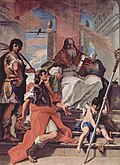 Firmus and RusticusMartyr · Martyrs of VeronaAug 9
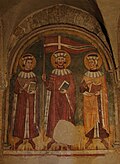 Secundianus, Marcellianus and VerianusHoly Martyrs · Martyrs of ItalyAug 9
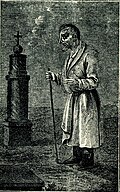 Anthony MonkinFool-for-ChristAug 9
- Jacob of SolovkiVenerable · Abbot of Solovki MonasteryAug 9
- Marcellus of VologdaSaint · Archbishop of VologdaAug 9
- Adrian of SolovkiVenerable · HermitAug 9
- Alexis of ConstantinopleMartyrAug 9
- Alexis of SolovkiVenerable · HermitAug 9
- AmorSaintAug 9