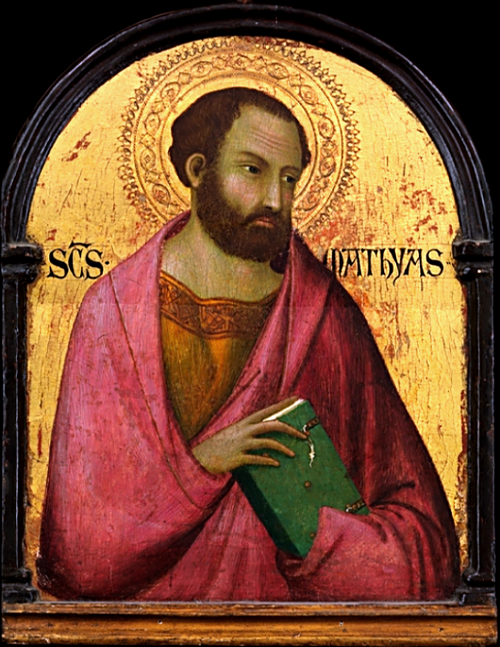
Apostle
Matthias
Apostle chosen in place of Judas
Chosen by lot from the disciples to take the place of Judas among the Twelve.
Life
Matthias is the apostle chosen by lot by the disciples, after the Ascension of the Lord, to take the place of Judas Iscariot and be numbered with the Eleven. According to the tradition of the Church he was one of the Seventy disciples, preached the Gospel in Judea and in far-off lands, and died a martyr. The Orthodox Church keeps his feast on 9 August, and together with all the apostles in the Synaxis of the Twelve Apostles, on 30 June.
The choice by lot
The Gospels do not mention the name of Matthias in the lists of the apostles. From the Acts of the Apostles we learn that he had been with the Lord from the Baptism by John until the Ascension. In the days after the Ascension, Saint Peter rose in the midst of the brethren, about a hundred and twenty gathered, and spoke of Judas, who had fallen from the apostolic ministry. The disciples put forward two men: Joseph called Barsabbas, surnamed Justus, and Matthias.
Then they prayed: Thou, Lord, who knowest the hearts of all, show which of these two Thou hast chosen to take the place of this ministry and apostleship. They cast lots, and the lot fell on Matthias, who was numbered with the eleven apostles. Saint Clement of Alexandria writes that the apostles were not chosen for any particular quality of nature, since Judas too was chosen, and that Matthias, though chosen later, showed himself worthy to be an apostle.
The tradition of his life
The New Testament says no more about him, and the later sources are uncertain and sometimes contradict one another, even about his name. According to the tradition set out in the Synaxarion, he was born at Bethlehem, of the tribe of Judah, and learned the Law from childhood under the guidance of Saint Symeon the God-Receiver. When the Lord Jesus appeared, he believed in Him as the Messiah and was numbered among the Seventy sent two by two before His face. After Pentecost he preached at Jerusalem and in Judea with the other apostles.
From Jerusalem, the Synaxarion tells us, he went with the Apostles Peter and Andrew to Syrian Antioch, then to Cappadocia, to Tyana and to Sinope. At Sinope he was thrown into prison, but Saint Andrew the First-Called brought him out by a miracle. He was then at Amasea, on the seashore, and on Andrew's third journey he was with him at Edessa and Sebaste. According to tradition he preached in Pontic Ethiopia, that is, western Georgia today, and in Macedonia. The Greeks speak of preaching in Cappadocia and on the coasts of the Caspian Sea, at a place called Hyssus, and a Coptic writing, the Acts of Andrew and Matthias, places him in a city of cannibals in Ethiopia.
The accounts say that he was often in danger of death, but the Lord preserved him. Pagans once forced him to drink poison; he drank it, remained unharmed and healed the other prisoners blinded by the drink. When he came out of prison, the pagans sought him in vain, for he had become invisible to them. Another time, when they rushed to kill him, the earth opened and swallowed them.
Martyrdom
There are several traditions about his end. According to the most widespread, he returned to Judea and taught the Jews from the prophets that Jesus is true God and Messiah. The high priest Ananias, the same who had ordered James, the brother of the Lord, thrown from the roof of the Temple, ordered him seized and brought before the Sanhedrin. Condemned for preaching Christ as the Son of God, he was stoned, and when he was already dead his head was cut off, as an enemy of Caesar. The Synaxarion gives the year 63. Other sources say that he died crucified in Colchis. Hippolytus of Rome says that he died a natural death at Jerusalem.
Georgian tradition says that he was buried in the fortress of Gonio, called Apsaros, in Adjara, where a marker shows his tomb. A Byzantine synaxarion, the Synopsis of Dorotheus, speaks of a death at Sebastopolis, near the temple of the Sun. An online encyclopedia gives 80 as the year of his repose.
Relics
It is said that Empress Helena brought the relics of the apostle to Rome and part of them to Trier. Since 1127 they have rested in the Benedictine abbey of Saint Matthias at Trier, the only tomb of an apostle north of the Alps, and a portion is at Padua, at Santa Giustina. According to Greek sources, they lie in the fortress of Gonio in Georgia. The scholar Bollandus doubted whether the relics at Rome belong to the apostle rather than to a bishop of Jerusalem of the same name, around the year 120.
Veneration
The Orthodox and the Greek Catholic Churches commemorate him on 9 August, the Roman Catholic Church kept him on 24 February and since 1969 on 14 May. The troparion asks: Holy Apostle Matthias, entreat the merciful God to grant our souls forgiveness of transgressions. The name Matthias comes from the Hebrew Mattityahu, which means gift of the Lord.
Commemorated the same day August 9
 Irene of AthensRight-Believing · Byzantine EmpressAug 9
 Sava of OhridSaint · Disciple of Saints Cyril and MethodiusAug 9
 Romanus OstiariusMartyr · Doorkeeper of the church in RomeAug 9
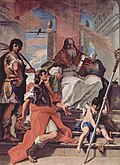 Firmus and RusticusMartyr · Martyrs of VeronaAug 9
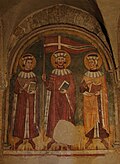 Secundianus, Marcellianus and VerianusHoly Martyrs · Martyrs of ItalyAug 9
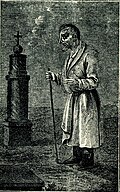 Anthony MonkinFool-for-ChristAug 9
- Jacob of SolovkiVenerable · Abbot of Solovki MonasteryAug 9
- Marcellus of VologdaSaint · Archbishop of VologdaAug 9
- Adrian of SolovkiVenerable · HermitAug 9
- Alexis of ConstantinopleMartyrAug 9
- Alexis of SolovkiVenerable · HermitAug 9
- AmorSaintAug 9