Martyr
Ismail of Persia
A martyr of Persian origin, commemorated at Chalcedon.
Life
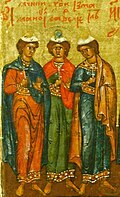
Holy Martyr Ismail of Persia suffered in the year 362, together with his brothers Manuel and Savel, in the time of the Emperor Julian the Apostate. The Church commemorates them on 30 June (new style).
The three brothers came of a noble Persian family. Their father was a pagan, their mother a Christian, who baptized them and raised them in firm faith in Christ. Grown to manhood, they entered the army. As envoys of the Persian king Alamundar they were sent to conclude peace with the Emperor Julian the Apostate (361-363). Julian received them with due honour, but when the brothers refused to take part in a pagan sacrifice, the emperor, angered, broke the law and imprisoned them like criminals. At the trial he told them that if they despised his gods, neither agreement nor peace between the countries could be had. The brothers answered that they had been sent by their king on a state mission, not to discuss the gods. Seeing their unshaken faith, the emperor ordered them subjected to harsh tortures: they were hung, their hands and feet nailed to a tree, nails were driven into their heads and sharp splinters thrust under their nails. During the torments the holy soldiers glorified God and prayed as if they felt no pain. At last their heads were cut off with the sword.
Julian ordered their bodies burned, but suddenly there was an earthquake, the earth opened and received the bodies of the martyrs. After two days, at the earnest prayer of the Christians, the earth gave back the bodies of the brothers, from which a sweet fragrance came forth. Many pagans, witnesses of the miracle, believed in Christ and were baptized. The Christians buried with honour the relics of the martyrs Manuel, Savel and Ismail, in the year 362, and from then on they have been glorified by miracles.
Learning of the killing of his envoys and of Julian's great army coming against him, King Alamundar gathered an army and stood at the border of his land. In a great battle the Persians defeated the Greeks, and Julian the Apostate was killed by the Holy Great Martyr Mercurius. After thirty years the pious Emperor Theodosius the Great († 395) built a church in Constantinople in honour of the holy martyrs, and Saint Germanus, patriarch of Constantinople, while still a hieromonk, wrote a canon in memory and praise of the holy brothers.
Commemorated the same day June 17
 Hervé of BrittanySaint · Breton saintJun 17
- Hypatius of BithyniaVenerable · Abbot near ChalcedonJun 17
 Hilarion TroitskyHieromartyr · Archbishop of VereyaJun 17
 ManuelMartyrJun 17
 Himerius of CremonaSaint · Bishop of CremonaJun 17
- Manuel, Sabel and IsmaelHoly MartyrsJun 17
 Shalva of AkhaltsikheMartyr · Duke of AkhalkalakiJun 17
 PapinusSaintJun 17
- Averky SeverovostokovHieromartyr · Priest of UfaJun 17
- Ananias of NovgorodVenerable · Icon painter of Antoniev MonasteryJun 17
- PiorVenerableJun 17
- Joseph the AnchoriteVenerableJun 17