Hieromartyr
John Kuminov
A hieromartyr of the Russian Church, commemorated in the Orthodox calendar.
Life
Holy Hieromartyr John Kuminov, a priest, was born in 1865 in the village of Kulikovskoe, Tyukalinsk district, Tobolsk province, in the family of the peasant Ivan Kuminov. In 1877 the family moved to Omsk. There Ivan Ivanovich graduated from the teachers' seminary and, after an examination at the Omsk classical gymnasium, was appointed inspector of the people's schools of the Tara district. He remained in the post until 1922, when he was ordained priest. He served in churches of the Omsk diocese, and in 1928 he was sent to the church of the Theophany in the village of Malokrasnoyarka. He was shot on 28 February 1930 together with the priest Michael Pyataev.
At the end of 1929 collectivization began in Siberia, with arrests and the driving out of peasant families, and with them arrests of the clergy. At the beginning of 1930 the warden of the Theophany church, Peter Borodin, asked the authorities to allow the procession to the Jordan on 19 January, at Theophany, as always. Father Michael inquired how the re-registration of the community was done and asked for the bulletin in which the instructions were published. He asked that the assembly of the community, for re-elections, be held on 5 January and asked what to do if the members of the village council raised obstacles. One of the believers, Dorofei Grishmanov, took word to the village council that the priest Pyataev had sent people at night to make some registration. The village council drew up on 5 January an act which regarded the priests' night visits as suspicious, in connection with collectivization.
On the feast of the Nativity of the Lord the service was celebrated by Father John Kuminov, and Father Michael directed the choir. At the end of the Liturgy Father John gave a sermon, in which he urged the young people and their parents to come more often to church and pray to God: "Send your children to church and let them pray there to God. Do not listen to whoever tells you this or that, they have crushed you enough with impossible taxes and now they agitate and want to deceive you." Father Michael felt then that something bad could follow. A parishioner, Daria Barkova, said in the village that Father John had given an anti-Soviet sermon, and when questioned later she testified falsely that Kuminov systematically carried on anti-Soviet agitation. After Christmas the OGPU plenipotentiary began to question the peasants, but most refused to lie against the priests; the chairmen of the village council and of the collective farm and their wives gave testimony.
Father Michael had realized that the authorities meant to arrest him. He had a childhood friend in the Moscow militia, who had written to him: "Michael, I am very sorry... you were a teacher, now you are a priest. Do not think ill, I tell you this not because I have anything against the clergy, but now is not the time for servants of the cult. I propose that you come to Moscow and take up teaching again. I will help you find work and lodging." Two days before the arrest, his wife, Euphrosyne, reminded him of the letter and begged him to go. He said: "No, Euphrosyne, I am going nowhere, I took an oath. How can I betray God and the people? Never. I know that I go to certain death, but this is the will of God. You will raise the children and, with God's help, educate them, you will lose none." At that time they had seven children; the eighth, the daughter Yulia, was born after her father's execution.
The priests were arrested soon after Christmas and taken to the prison in Kainsk. There those under investigation were cruelly tortured: teeth with gold crowns were torn out with pliers, they were beaten without mercy, and the investigator mockingly ordered the contents of the latrine bucket poured on Father Michael. In spite of the torments, the pastors refused to give false testimony and to sign that the priests and the members of the church council were organizing the peasants against the collective farms and Soviet power. Father John declared at the interrogation that at Christmas he had preached a sermon devoted only to the Nativity of Christ, to which he had added counsel of a sober life and of going more often to church: six days one works, the seventh is God's; that at the end he had urged obedience to the laws and said nothing anti-Soviet, nor against collectivization. On 7 February 1930 the decision of accusation was read to them, which Father John refused to acknowledge, noting that the woman Barkova had distorted his sermon. On 21 February the OGPU troika sentenced the priests Michael Pyataev and John Kuminov to death and their families to exile in the north. Father Michael was allowed to see, through a grating, his daughter Anna, and asked for her braid, and she held it out to him. The priests were shot at night, on 28 February 1930, and buried in an unknown common grave in Kainsk.
The Church commemorates him on 28 February, the day of his death, in the new style, on 26 February in the Synaxis of the Saints of Omsk, on the movable day of the synaxis of the new martyrs, and on 1 March (a movable day) in the Synaxis of the Saints of Novosibirsk.
Commemorated the same day April 18
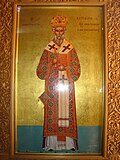 Cyril VI of ConstantinopleHieromartyr · Patriarch of ConstantinopleApr 18
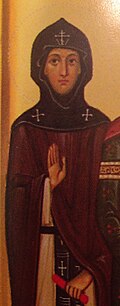 Anthousa the YoungerVenerable · Abbess, daughter of Emperor Constantine VApr 18
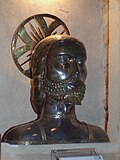 CalocerusMartyr · Martyr of BresciaApr 18
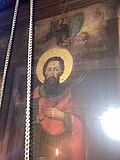 John the New of IoanninaNew MartyrApr 18
- Cosmas the ConfessorConfessor · Bishop of ChalcedonApr 18
- Vissarion SelininHieromartyr · PriestApr 18
- Abraham of the High MountainVenerableApr 18
- Acindynus of NicomediaMartyrApr 18
- Auxentius of ChalcedonVenerableApr 18
 Aye of HainautVenerableApr 18
- Basil RatishviliVenerableApr 18
- Bitheus and GenocusHoly VenerablesApr 18