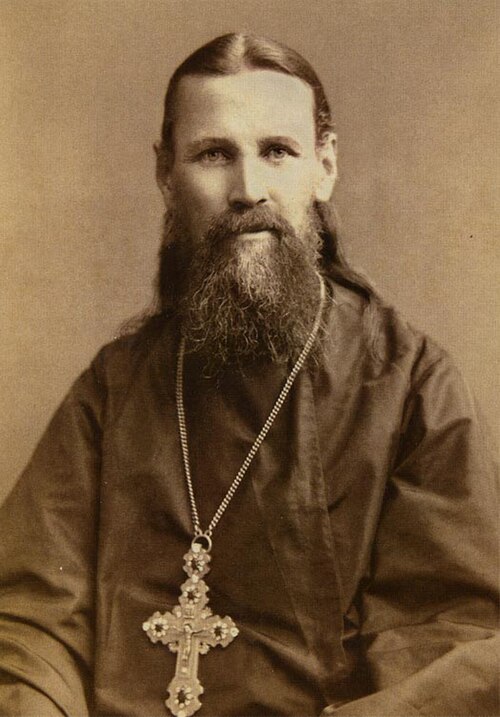
Righteous
John of Kronstadt
Archpriest at Kronstadt and preacher
Russian priest at Kronstadt, known for his preaching, daily Liturgy, and charity toward the poor.
- Feast
- June 1old style June 14
- Reposed
- 190820th century
- Place
- Kronstadt
- Order
- The Righteous
Life
Saint John of Kronstadt, the Righteous, whose baptismal name was Ivan Ilyich Sergiev, was an archpriest of the Russian Orthodox Church, for fifty-three years a servant of Saint Andrew’s Cathedral in Kronstadt. He was known for mass confession, for serving the Liturgy daily, for miracles and for his works of mercy toward the poor. The Russian Orthodox Church Outside Russia canonized him in 1964, and the Russian Orthodox Church in 1990. He is commemorated on 20 December and on 1 June, old style.
Youth
He was born on 19 October (old style) 1829, in the village of Sura in the Arkhangelsk region, near the White Sea, into a poor family from a line of village clergy; his father was a sexton (dyachok) at the village church of Saint Nicholas. Being weak at birth, he was baptized the same day and named Ivan, in honour of Saint John of Rila. By his own account, he went to the parish school, but at first study seemed too hard; he prayed fervently, received enlightenment and became first in his class. He went on to the seminary at Arkhangelsk (finished in 1851), then, at the state’s expense, to the Theological Academy in Saint Petersburg, which he finished in 1855 with the degree of candidate in theology. His fellows remembered that he always spoke of humility.
During his studies he wished to be a missionary. But, as he tells it, in a dream he saw himself in priestly vestments serving in the cathedral of Kronstadt, and some days later he was proposed as husband to the daughter of the archpriest of that cathedral. He accepted. In 1855 he was ordained deacon and then priest, at Saint Andrew’s Cathedral in Kronstadt, where he served the rest of his life, until death. In 1875 he was raised to archpriest, in 1894 became rector of the cathedral, and in 1899 mitred archpriest. The marriage was without children; according to the official Life of the Moscow Patriarchate, the couple took on the ascetic labour of virginity. They raised the wife’s nieces as their own children.
The Father of Kronstadt
John lived in prayer and repentance and visited the poor, whom he helped with clothes and money. He served the Liturgy every day and taught children at school. Kronstadt was a naval port where workers, convicts and homeless people lived. For them he set up in 1882 the “House of Industry”, with a church, a school for boys and girls, an orphanage, a hospital for anyone who came, a boarding house, a free public library, a shelter for the homeless (which lodged 40,000 people a year), workshops where the poor could earn money, a cheap canteen that gave out about 800 free meals on holidays, and a hostel for travellers.
By the early 1890s John had become very well known, and every day thousands came to him from all Russia. He practised mass confession, in which crowds confessed their sins with tears. He became known especially after an open letter in the newspaper Novoe Vremya, in 1883, in which sixteen people told of their healing through his prayers. Publication in a secular newspaper, without the approval of the church censor, was seen by the hierarchy as a breach of obedience. The Church did not know what to do with a man who showed himself a wonderworker in life (since the gift of healing was thought to belong to relics). The matter was discussed by the Holy Synod, and Metropolitan Isidore, his direct superior, was displeased. In 1894 Tsar Alexander III summoned him to Livadia, in the Crimea, to his deathbed; John did not heal him by prayer, but after that summons he seemed untouched by the criticism of the authorities. He was regarded as a saint even in his lifetime. In 1906 he was named a member of the Holy Synod, but did not attend its sessions. He held monarchist and conservative views, and was one of the figures of the Union of the Russian People.
Death and veneration
He departed this life on 20 December 1908 (2 January 1909 new style). His relics were taken to the convent at Karpovka in Saint Petersburg, founded by him. He wrote several books, of which the best known is “Thoughts on Prayer”. Saint John of Shanghai had an important part in his canonization.
Commemorated the same day June 1
 Justin MartyrMartyr · Christian apologistJun 1
 Simeon of TrierVenerable · Recluse at TrierJun 1
 Agapetus of the Kyiv CavesVenerable · Physician of the Kyiv Caves LavraJun 1
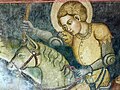 CrescentinusMartyr · Patron of UrbinoJun 1
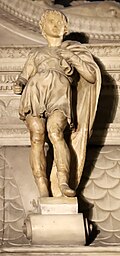 Proculus of BolognaMartyr · Martyr of BolognaJun 1
- WigstanRight-Believing · Prince of MerciaJun 1
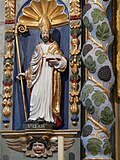 Clarus of AlbiSaint · First bishop of AlbiJun 1
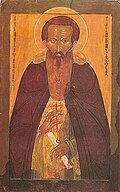 Dionysius of GlushitsaVenerable · Icon painter and monastery founderJun 1
 Reverianus of AutunHieromartyr · Bishop of AutunJun 1
 Fortunatus of SpoletoSaint · Parish priest near SpoletoJun 1
- Thespesius of CappadociaMartyrJun 1
- Ammon, Zeno, Ptolemy, Ingenuus and TheophilusHoly Martyrs · Martyrs of AlexandriaJun 1