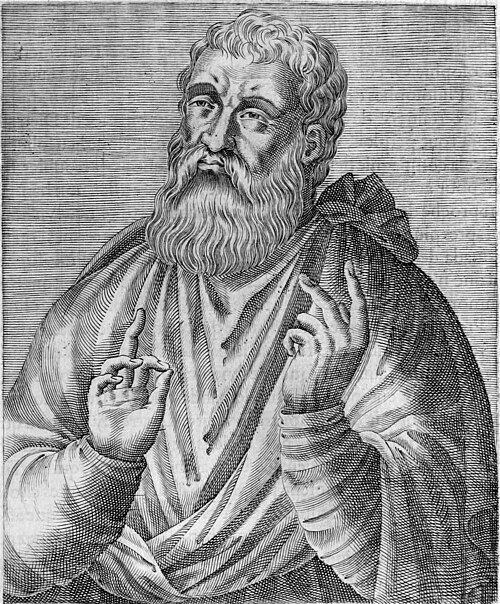
Martyr
Justin Martyr
Christian apologist
A philosopher who became a Christian, author of the Apologies, killed in Rome around 165.
Life
Justin Martyr and Philosopher was a Christian apologist of the second century, a man of Greek education who passed from pagan philosophy to faith in Christ and died a martyr at Rome around 165. His two Apologies, addressed to the rulers of Rome, are among the oldest defences of Christianity that have survived. The Orthodox Church keeps his feast on 1 June, together with the martyr disciples who suffered with him; he is also honoured in the Roman Catholic Church and in other Churches.
The search for truth
He was born into a family of pagan Greeks at Flavia Neapolis, the ancient Shechem in Samaria, now Nablus. His grandfather had a Greek name, Bacchius, and his father a Latin one, Priscus. He says himself that he was uncircumcised and counted himself among the Gentiles. The year of his birth is not certain: the sources give dates between 90 and 114.
He tells the story of his conversion himself, at the beginning of the Dialogue with Trypho the Jew. He went in turn to a Stoic, who could not explain to him what God is, to a Peripatetic, who was in a hurry to ask for his fee, and to a Pythagorean, who wanted first to set him to mathematics, astronomy and music. In the end he stayed with a Platonist, whose teaching about incorporeal things attracted him.
One day on the seashore he met an old man, perhaps a Christian from Syria, who questioned him about the soul. The old man advised him to read the prophets, older than any philosopher and filled with the Holy Spirit, and told him to pray above all that God would open to him the gates of light. Justin said later that a flame was kindled in his soul. He remained with love for the prophets and for the friends of Christ. The steadfastness of Christians in the face of death moved him, and he received Baptism, according to tradition around the age of thirty, probably at Ephesus.
The Christian philosopher
From then on he kept the philosopher's cloak and travelled from place to place to teach, judging Christianity the only sure and profitable philosophy. In the time of Antoninus Pius he came to Rome and opened a school, where Tatian was among his pupils. At Ephesus, according to the tradition kept in the Synaxarion, he held the debate with the Jew Trypho.
The First Apology, written between 147 and 161 to Antoninus Pius, his sons Marcus Aurelius and Lucius Verus, and the Senate, defends Christians against unjust charges: they cannot be condemned for the mere name they bear. The Synaxarion says that around 155 he asked the emperor for mercy for two Christians condemned without cause, Ptolemy and Lucius, and a third whose name is unknown. In the Apology Justin describes the service of Baptism and the Sunday assembly, with the reading of the memoirs of the apostles or the prophets, the word of the one presiding, prayer, bread, wine and water, while those absent receive the gifts through the deacons. It is one of the oldest descriptions of the Liturgy.
The Second Apology is addressed to the Roman Senate. The Dialogue with Trypho the Jew is also his, and in it he shows from the prophets that Christ is God and Messiah, and that Christ is the Word (Logos) of the Father. He taught that seeds of the Word were present in the ancient philosophers, such as Socrates and Plato, who lived according to reason, and that philosophy can be a preparation for the Gospel. About the soul he taught that it is not immortal by its own nature but by the will of God. Several works put under his name are not his, while others, such as Against Marcion and the Refutation of all Heresies, are lost. Fragments remain of the book On the Resurrection.
Martyrdom
At Rome he held disputes with the Cynic philosopher Crescens, whom he defeated several times. Crescens denounced his Christianity, as Tatian and Eusebius relate, and Justin was imprisoned and tried by the prefect Junius Rusticus, together with his disciples: Chariton, Euelpistus, Hierax, Paeon, Valerian, Justus and Charito, a woman.
The acts of the martyrdom preserve the exchange of the trial. The prefect ordered him to sacrifice to the gods, and Justin answered that no one in his right mind gives up piety for impiety. When the prefect asked whether he thought he would go to heaven after the tortures, he said that he not only thought so but knew it and was fully assured. The prefect ordered that those who would not sacrifice to the gods be scourged and beheaded, and the martyrs were led to the customary place and received the crown of martyrdom, glorifying God. The exact year is not known, but it falls between 162 and 168, the years of Rusticus as prefect, and 165 is generally accepted. The Synaxarion gives 165 or 166.
Veneration
The relics of the saint rest at Rome. Tatian, Irenaeus, Tertullian, Hippolytus and Eusebius wrote of him with honour. The Orthodox Church commemorates him on 1 June, with the martyrs who suffered with him. In the Russian Church he is honoured above all in churches that bear his name, and he is invoked by those who seek help in their studies. His name has remained tied to the conviction that truth is found in Christ, the Word who enlightens every man.
Commemorated the same day June 1
 John of KronstadtRighteous · Archpriest at Kronstadt and preacherJun 1
 Simeon of TrierVenerable · Recluse at TrierJun 1
 Agapetus of the Kyiv CavesVenerable · Physician of the Kyiv Caves LavraJun 1
 CrescentinusMartyr · Patron of UrbinoJun 1
 Proculus of BolognaMartyr · Martyr of BolognaJun 1
- WigstanRight-Believing · Prince of MerciaJun 1
 Clarus of AlbiSaint · First bishop of AlbiJun 1
 Dionysius of GlushitsaVenerable · Icon painter and monastery founderJun 1
 Reverianus of AutunHieromartyr · Bishop of AutunJun 1
 Fortunatus of SpoletoSaint · Parish priest near SpoletoJun 1
- Thespesius of CappadociaMartyrJun 1
- Ammon, Zeno, Ptolemy, Ingenuus and TheophilusHoly Martyrs · Martyrs of AlexandriaJun 1