
Hieromartyr
Joseph of Astrakhan
Metropolitan of Astrakhan
Metropolitan of Astrakhan and Terek, born in Astrakhan, killed in 1671 by the Cossacks of Vasily Us.
Life
Saint Joseph of Astrakhan, the Hieromartyr (1597 to 1671), was metropolitan of Astrakhan and Terek, the first Astrakhan hierarch raised to the rank of metropolitan. He was killed on 11 May 1671 by the Cossacks of Vasily Us, left at Astrakhan by Stenka Razin, because he refused to join the rebellion and defended the tsar's letters. The Local Council of the Russian Church canonized him in April 1918. He is commemorated on 11 (24) May.
Childhood and episcopate
Joseph was born in 1597 at Astrakhan, to parents named Clement and Varvara. When the turmoil stirred by the presence of the partisans of the False Dmitry I shook the city, Cossacks burst into his parents' house and one of them struck the boy on the head with a stone, because of which his head shook all his life. On 15 December 1659 he was consecrated, from archimandrite of the Holy Trinity monastery, archbishop of Astrakhan (the Serbian source gives 1656 as the start of his rule). On 8 June 1667 he was named metropolitan, being the first Astrakhan hierarch raised to this rank, and was given the third place among the Russian hierarchs. On 2 June that year he performed in Moscow the rite of the procession on the donkey. In 1667 he took part in the Council in the case of Patriarch Nikon.
Razin's rebellion
In June 1670 Astrakhan fell under the power of the rebels of Stepan Razin. Much blood was shed, but the metropolitan was spared. At the end of 1670 he received proclamations of the tsar, addressed to him personally, to the people of Astrakhan and to the Cossacks, with the instruction that the metropolitan read them before all and call all to submit to the tsar's mercy. Joseph ordered at least three copies made and sent one to the rebel leaders, who refused to accept it. Then he gathered the townspeople and ordered the keeper of the keys to read it aloud. After the reading the rebels raised a shout and took the letter from the keeper, who had managed to read it to the end. The metropolitan angrily rebuked the townspeople, calling them heretics and traitors, and they answered with insults and threats of death, but only took the letter. The next day the rebels seized the keeper Fyodor and tortured him to learn where other copies of the letter were, and took three copies from the metropolitan.
A few months later, in April 1671, in Holy Week, the metropolitan had a clash with the rebels in the bazaar. To Joseph's exhortations to submit to the approaching army of the tsar the rebels answered with foul abuse. The next day, Great Saturday, Cossack captains came several times to the metropolitan's court, demanding that the tsar's letters be handed over. In reply Joseph wished to read them in the cathedral church, but "the thieves did not listen to the sovereign's letters" and went out of the church to their circle. The metropolitan followed the Cossacks, accompanied by clergy, and ordered two letters of the tsar read in the circle, one "to the thieves", the other "to him, the hierarch". The assembly answered with shouts and threats against the metropolitan. He called on the townspeople to seize the Cossacks who ruled the city under Vasily Us and put them in prison. The Cossacks took one letter from the metropolitan, but he refused to give the one addressed to him personally, returned to the cathedral and hid it there.
A week after Easter the rebels seized and tortured the metropolitan's keeper of keys and other close associates, wanting to learn where the letters and copies were hidden. The keeper was killed but did not tell where the letters were. After that they demanded that the metropolitan sign a paper of loyalty to Razin, to which he answered with refusal.
Martyrdom
On 11 May the Cossacks interrupted the service the metropolitan was celebrating and demanded that he come to them in the circle. The metropolitan put on his full vestments, took the cross and appeared in the circle. To the rebels' question whether it was true that he was in contact with the voivodes, he answered by reproaching them for rebelling against the tsar. The Cossacks wanted to kill him at once. One of them, Miron, began to restrain his comrades from such a deed, but was himself killed on the spot. Then the Cossacks ordered the priests accompanying the metropolitan to divest him; they obeyed, and the saint kept complete calm of spirit. When the sacred vestments were taken off and he remained in a simple cassock, the Cossacks tortured him by stretching him over a fire. They asked about his links with the tsar's voivodes and wished to learn where the letters and treasures were. The metropolitan bore the torment firmly and said nothing. After the torture the rebels threw the metropolitan from the rampart and he was killed in the fall. Sympathetic eyewitnesses note that when the saint's body fell there was a great noise and fear, so that even the rebels in the circle were frightened and fell silent, standing with heads bowed for about a third of an hour.
The next day his body was buried with the funeral service, and ten days later laid in the cathedral.
Glorification
The canonization of the saint was carried out by the Local Council of the Russian Church in April 1918. On 24 May 1919 a procession organized by Metropolitan Mitrofan (Krasnopolsky) in connection with the glorification of the saint was stopped by gunfire. The procession had been directed to the Astrakhan Kremlin, since the Dormition Cathedral, in which the saint's relics lay, was part of the Kremlin. In the Kremlin was the Red Army headquarters, which gave occasion to regard the procession as a provocation. Metropolitan Mitrofan and Bishop Leontius, his vicar, were arrested and shot in June 1919. Metropolitan Mitrofan was numbered among the saints by the Russian Church in 2001. In 1997 a church dedicated to Saint Joseph of Astrakhan was consecrated in the Dimitrievsky cemetery in Volgograd.
Commemorated the same day May 11
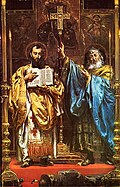 Cyril and MethodiusHoly Equal-to-the-Apostles · Apostles to the SlavsMay 11
 Rastislav of MoraviaRight-Believing · Prince of MoraviaMay 11
 Mamertus of VienneSaint · Bishop of VienneMay 11
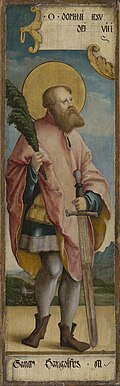 Gangulphus of BurgundyMartyrMay 11
 Mocius of AmphipolisHieromartyr · Priest of AmphipolisMay 11
 Anthimus of RomeHieromartyr · Priest of RomeMay 11
 Nikodim I of PećSaint · Archbishop of the SerbsMay 11
 Argyrios of EpanomiNew MartyrMay 11
- Nepotian of AltinumVenerableMay 11
- Blessed KristesiaSaintMay 11
- OlympiaMartyrMay 11
 Anastasius of LleidaMartyrMay 11