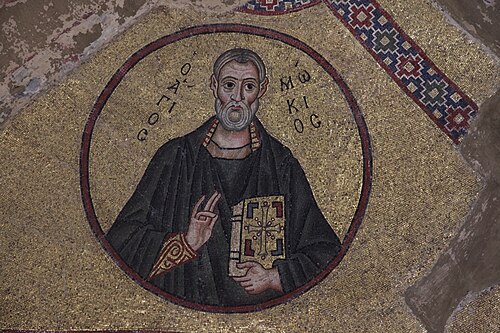
Hieromartyr
Mocius of Amphipolis
Priest of Amphipolis
Priest of Roman descent at Amphipolis in Macedonia, who died a martyr between 288 and 295.
Life
Saint Mocius of Amphipolis, the Hieromartyr, was a priest in the city of Amphipolis, in Macedonia, of Roman descent, and received martyrdom at Byzantium in the time of the persecution of Diocletian, between 288 and 295. He is commemorated in the Synaxaria of the Church on 11 May, together with the feast of the renewal of Constantinople, in the Orthodox and in the Catholic Church. His relics were placed by Constantine the Great in a church built in his honour, and a cistern of Constantinople took his name.
Life and preaching
According to the Synaxarion, Mocius was born at Rome, in the noble and rich family of Euphratius (in some sources Eutratius) and Eustathia, and heard Holy Scripture from childhood. He moved to Thrace (or Macedonia), to the city of Amphipolis, near the river Strymon, where he was a priest. He laboured ever in teaching, preached Christ and counselled all to guard against the error of idols, above all against the cult of Dionysus (Bacchus) and the revels with which it was celebrated.
One source says that in the days of Emperor Diocletian and of Laodicius, proconsul of Europe, while the proconsul was offering sacrifice to the false god Dionysus and the worshippers of idols had gathered, the saint came forward, overturned the altar and scattered the incense before all. The English source says he smashed a statue of the god, and the Serbian that he brought down the statue by prayer, and so embittered some of the pagans and brought others to Christianity. A Bulgarian source adds that he was tried by the governor (anthypatos) of Apollonia, who was then visiting the city.
Martyrdom
At the trial Mocius confessed Christ the true God and, to threats, answered that death for Christ was a great gain for him. The Greek sources say he was subjected to various and cruel torments. He was hung on a tree and torn with iron claws. According to the Synaxarion he was thrown into a red-hot furnace, in which he remained unharmed, while the flames that came out of the furnace burned Laodicius and nine others. Then Thalassius put him in prison. The newly arrived proconsul, Maximus, proposed that he renounce the faith (by a Bulgarian source, to save him from death, to make a sacrifice) and then continued the torments. He subjected him to the wheel and then gave him to be torn by wild beasts. The lions lay at his feet and did not touch him. The people, seeing such miracles, asked that he be freed. The governor sent him to Thrace, to Perinthus (later called Heraclea), to the archon Philippisius, and from there to Byzantium, where his head was cut off. The year is given as either 288 or 295. The body was kept by Christians and buried a mile from the city.
The church and the feast
Emperor Constantine the Great, after 324, when the great building works began at Byzantium, built a beautiful and costly church in honour of Saint Mocius and placed his relics in it. Later, after 530, the relics of Saint Sampson the Hospitable were also placed there. Some sources say the church was built on the site of a temple of Zeus and renewed by Pulcheria, by Marcian or perhaps by Justinian I and again by Basil I in the ninth century. It lay between the walls of Theodosius and of Constantine, perhaps west of the cistern that bears his name, and near the monastery of the Mother of God ta Mikra Romaiou, where there were also a hospital and a xenodochion. It is thought that the eleventh-century physician Ibn Butlan wrote there his work "The Physicians' Banquet".
Emperor Anastasius I (491 to 518) built an open cistern to supply water to the city of Constantinople, the third of the late Roman period and the largest in the city, named after the saint honoured in a nearby church, in Turkish "Altı Mermer Çukurbostanı", today a park. His veneration was kept at Mid-Pentecost, and then on 11 May, the day on which Constantinople was proclaimed New Rome, a date mentioned in the Menologion of Basil II (end of the tenth century). The service in his Menaion is called "Renewal of Constantinople and of the Holy Hieromartyr Mocius" and has three stichera at "Lord, I have cried", a troparion, a canon, a sedalion, a kontakion and an ikos. The saint is commemorated on 11 May (24 May by the new calendar).
Commemorated the same day May 11
 Cyril and MethodiusHoly Equal-to-the-Apostles · Apostles to the SlavsMay 11
 Rastislav of MoraviaRight-Believing · Prince of MoraviaMay 11
 Mamertus of VienneSaint · Bishop of VienneMay 11
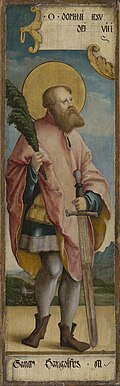 Gangulphus of BurgundyMartyrMay 11
 Anthimus of RomeHieromartyr · Priest of RomeMay 11
 Nikodim I of PećSaint · Archbishop of the SerbsMay 11
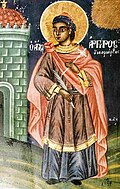 Argyrios of EpanomiNew MartyrMay 11
 Joseph of AstrakhanHieromartyr · Metropolitan of AstrakhanMay 11
- Nepotian of AltinumVenerableMay 11
- Blessed KristesiaSaintMay 11
- OlympiaMartyrMay 11
 Anastasius of LleidaMartyrMay 11