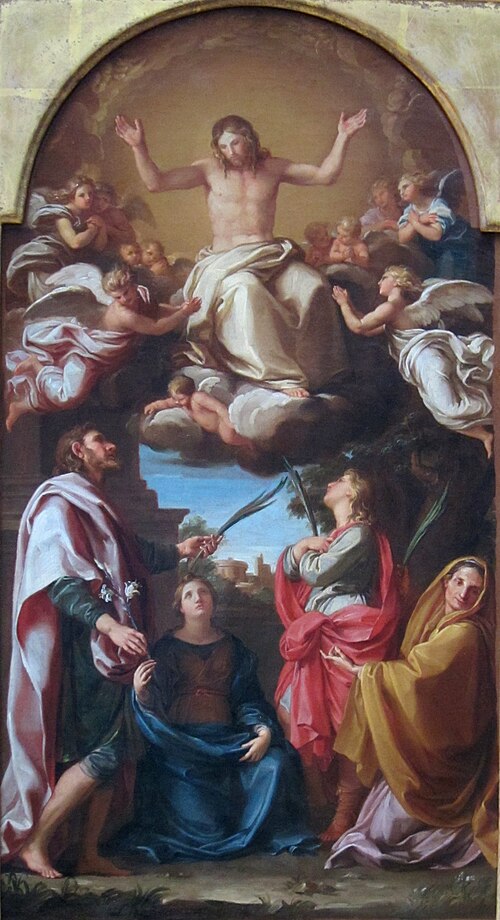
Holy Martyrs
Julian and Basilissa
Christian husband and wife, martyrs put to death around 304, venerated in East and West.
Life
The Holy Martyrs Julian and Basilissa were husband and wife, Christians who died around 304, in the persecution of Diocletian. They are honoured in both East and West. Nothing is known with historical certainty about them, and Julian of Antinoe has often been confused with Julian of Cilicia; the Roman Martyrology mentions thirty-nine saints of that name.
According to the legend, Julian was born at Antinoe in Egypt. His parents forced him to marry Basilissa, a noble and wealthy maiden; the couple agreed together to keep their virginity. Basilissa founded a convent for women, over which she became superior, and Julian gathered a large number of monks and cared for them. The two turned their house into a hospital that could shelter up to a thousand people, for which reason Julian is sometimes confused with Julian the Hospitaller. Basilissa endured great persecutions and fell asleep in peace; Julian lived many years after her.
In the persecution of Diocletian Julian was arrested, tortured and put to death, at Antioch in Syria, according to the Latins on the order of the governor Martian, or, according to the Greeks, more probably at Antinoe. According to the story he brought to the faith Celsus, the son of his persecutor the governor Marcianus, and Celsus's mother Marcionilla; he raised a dead pagan to life, who also believed. Those who turned to the Lord were baptised by the priest Anthony, and the pagan received the name Anastasius. For confessing the faith they were thrown into prison and beheaded together with Julian: Celsus, the young son of Marcionilla, the priest Anthony and Anastasius; it is said that Marcionilla's seven brothers were also killed, and other sources speak of twenty soldiers.
The two enjoyed great veneration from antiquity, before the eighth century. The Martyrologium Hieronymianum commemorates them on 6 January, and other martyrologies place them between 9 and 13 January or on other days. At Constantinople there was a church in their name, dedicated on 5 July. From Old English literature a fragment survives of Ælfric's Passion of Saint Julian and His Wife Basilissa, which shows how the two vowed on their wedding night to live in chastity, and how Julian died by beheading. The Orthodox Church commemorates them on 8 and 9 January.
Commemorated the same day January 9
 Macarius of AlexandriaVenerable · Hermit of the Nitrian DesertJan 9
 Polyeuctus of MeliteneMartyrJan 9
- Peter of SebasteSaint · Bishop of SebasteJan 9
- Hadrian of CanterburyVenerable · Abbot of CanterburyJan 9
 Anastasius of AntiochMartyrJan 9
 Eustratius the WonderworkerVenerable · Disciple of John the GreatJan 9
 Jonah of KyivVenerable · Founder of Jonah MonasteryJan 9
- WaningusSaint · Founder of Fécamp AbbeyJan 9
- Anthony of AntiochHieromartyr · Priest of AntiochJan 9
- Agnellus of NaplesSaint · Bishop of NaplesJan 9
- Antonina of NicomediaMartyrJan 9
- BaeithinSaintJan 9